
Latin American leaders on social media
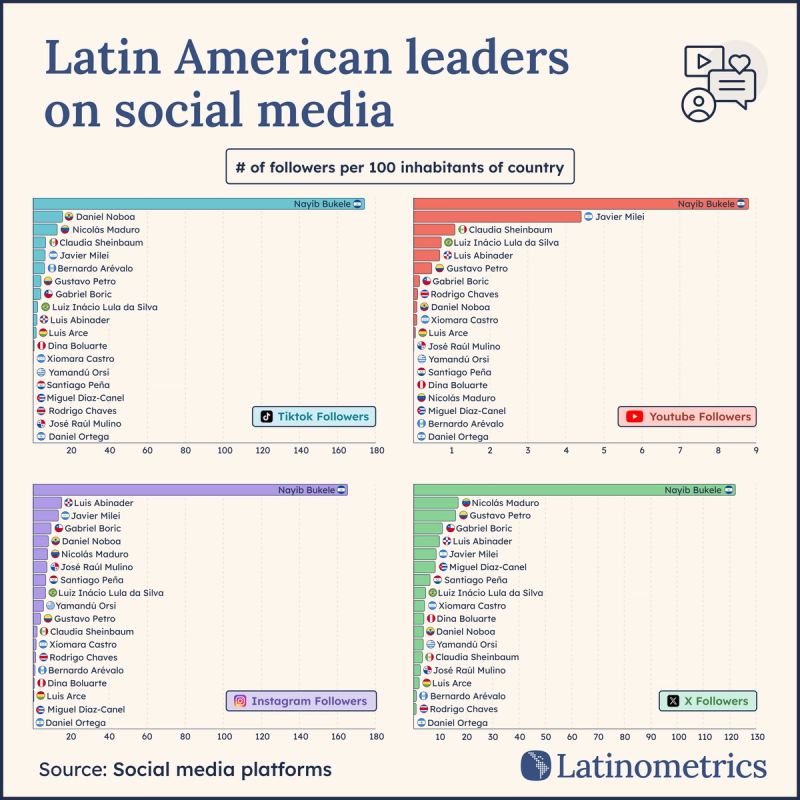
Nayib Bukele's social media dominance, seen across all platforms, reveals a new model for leadership—and a surprising link to public security.

Social media. Some would call it the best invention of the 21st century. Others…well, others would say it may just be the worst.
Like elsewhere in the world, Latin American leaders have mobilized both traditional and newer forms of social media to reach their audience. Some leaders have weighed in on pop-culture debacles, while others have taken to growing on TikTok through short, easily shareable videos.
Now, Nayib Bukele’s high popularity across social media is understandable. His high approval ratings, for one, must count for something. He’s also far more personally active than more institutional or traditional leaders like Paraguay’s Santiago Peña (who follows us on Instagram!) or Mexico’s Claudia Sheinbaum (who should!).
With Gustavo Petro and Nicolás Maduro ranked behind Bukele on X-formerly-Twitter, we can also draw the conclusion that more demagogue-type leaders tend to attract more followers than their peers on this site in particular, especially since some of these exact leaders will literally bicker with each other publicly on the timeline at two in the afternoon. Hard to believe the site’s free, really.
But Bukele’s power on the Internet goes way beyond roasting Petro, tweeting our charts, or making light of executive overreach by his allies. It speaks to the way he’s become a go-to model for how leaders around the region should approach public security and crime. And what do you think most Latin Americans would call the top issue?


