
North America: The largest trade relationships
North America's future hinges on integration, yet supply chain gaps and tariffs threaten the $800B US-Mexico trade.

Yesterday, Latinometrics was in Mexico City for the fourth annual North Capital Forum, which brought together business leaders, diplomats, policymakers, analysts and much more to discuss the future of North American integration.
Our Chief Editor even moderated a panel entitled Data for Decision-Making which featured a round-table discussion with business leaders from AT&T, GBM, ANPACT, Tule Capital, and Cabrera Capital Markets (CCM).
As part of this panel, we prepared a number of charts to drive discussion. You can find them all here, along with some key insights from the panel.
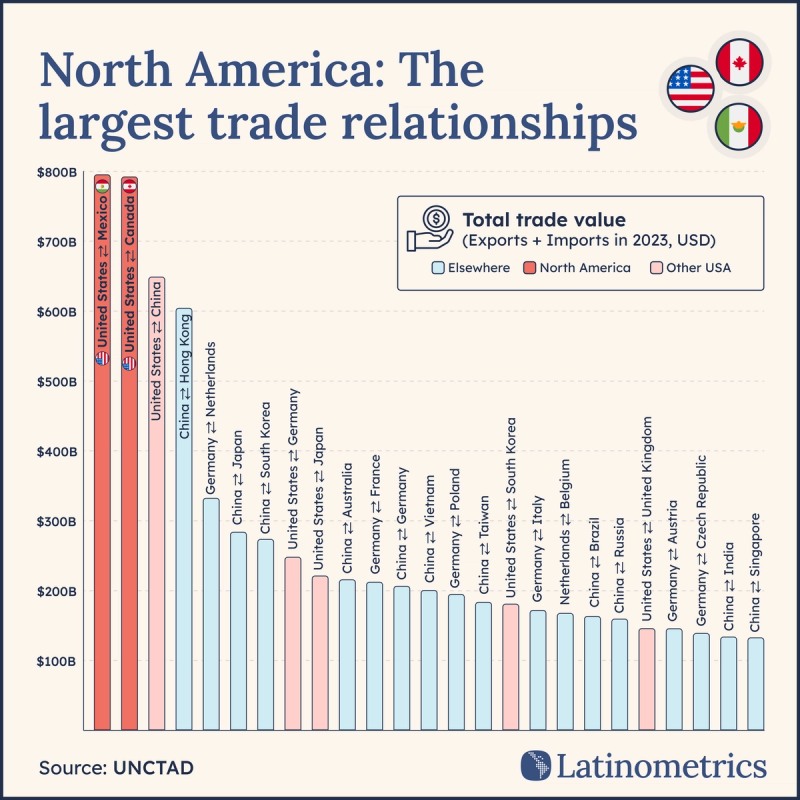
North America is home to the two largest trade relationships worldwide, led by the $800B US-Mexican commercial relationship. And perhaps no sector better encapsulates this relationship than the automotive industry, which has become a symbol of sorts for North American integration.
To Rogelio Arzate, executive president of Mexican heavy-vehicle association ANPACT, this industry is facing two main red flags:
A lack of supply chain synchronization across borders, and low credit access to other technologies. Yet, as Arzate highlights, the sharing of data and growing local content supplies (over Asian imports) offers huge potential for strengthening auto growth.
The latter of these two points, on local content requirements, is how the car industry and others hope to avoid soaring US tariffs. By ensuring compliance with the United States-Mexico-Canada Agreement, which is due for renegotiation next year, businesses can steer clear of painful trade barriers. The important thing is getting all sides to recognize the importance.
The USMCA is critical even when domestic politics pretend otherwise, as highlighted by CCM founder and CEO Martin Cabrera.
The US needs Canada and it needs Mexico to be competitive. [Next year’s renegotiation] is about really going in there, getting it done quickly, so we can move forward and continue the growth in all three countries.
Martin Cabrera
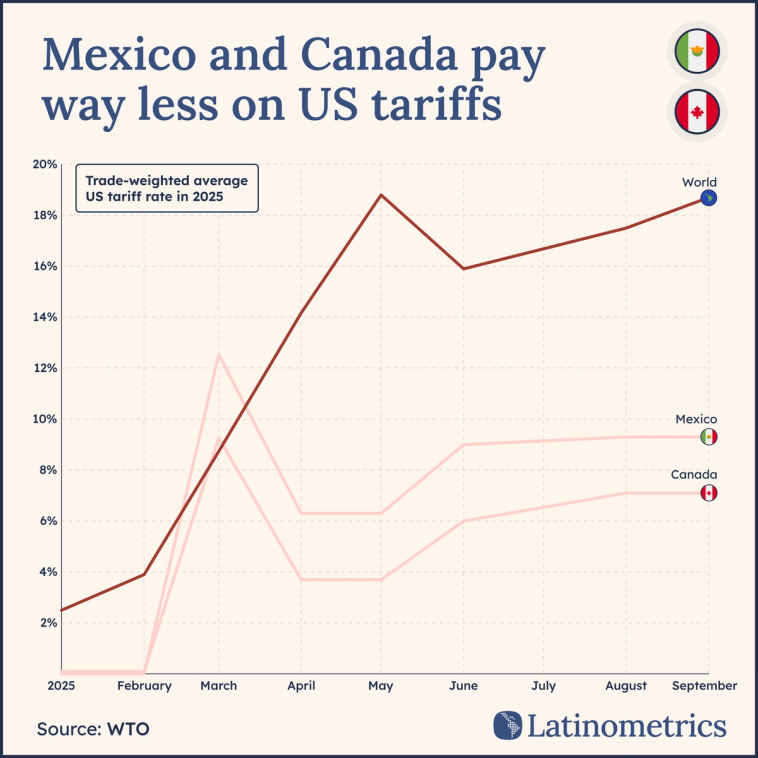
Of course, not all countries have equal leverage. Mexico is no doubt the country most exposed to the US worldwide, given 80% of its exports head north each year, so tariffs are almost uniquely dangerous. Given this, we asked Miriam Acuña, chief economist at GBM, how markets had evaluated Mexico’s performance vis-à-vis trade tensions.
Acuña noted that investors have tended to reward Mexico’s government for its smooth handling of both domestic and foreign economic matters, as evidenced by the peso’s 10% appreciation this year. Per her, the current Sheinbaum administration’s smooth relations with the US government despite tariff impositions, as well as policy certainty, fiscal consolidation, and export diversification have all helped calm international markets in turbulent times.
This sort of cross-border thinking was not exclusive to merely the trade conversation, however. Paloma Merodio, assistant VP of data analysis and intelligence at AT&T, spoke on the telecom giant’s efforts to integrate new and advanced technologies throughout its mission of driving greater connectivity across the continent. As she noted in concluding remarks,
The more that North America develops, the more connectivity will become the core or the background of his prosperity.
Paloma Merodio
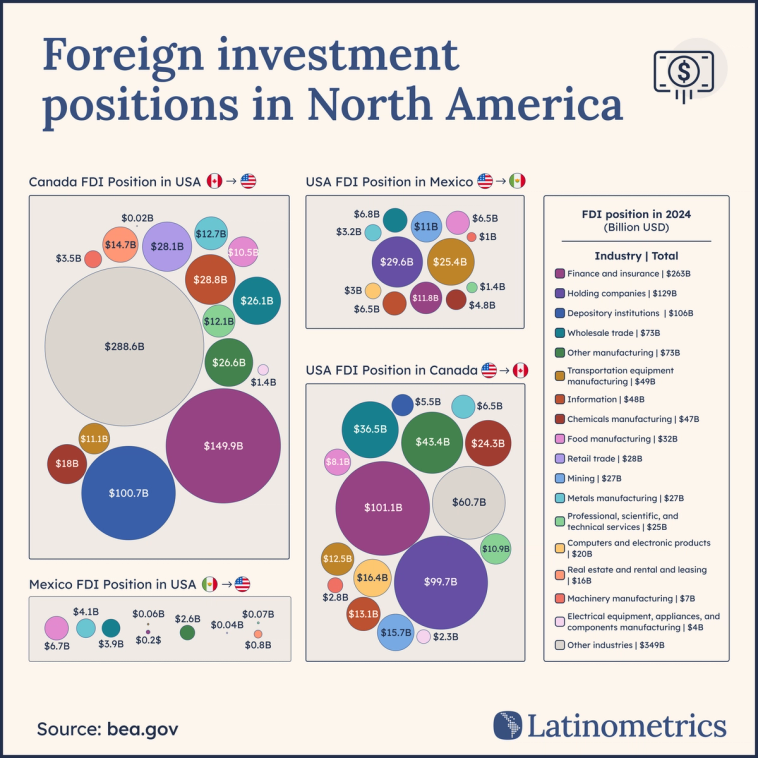
Of course, this need to stay at the cutting-edge of tomorrow’s technology, from AI to niche computing, permeates companies big and small. As we provided an overview of cross-border investment flows across North America, we asked Lala Elizondo, co-founder and managing partner of Texas-based Tule Capital, to shed some light on the opportunities for startup disruption of existing commercial or investment trends.
Adding an entrepreneurial lens to comments previously heard in the telecoms or auto sectors, she focused on the existing disconnected data gaps in North America, which provide a key opportunity for startups.
We need to become a more efficient region… There’s a huge opportunity for any startup to be able to take this international data, transform it, and deploy it in real time—that way, there's more transparency and more accessibility.
Lala Elizondo
We couldn’t agree more. We thank all of our North Capital Forum panelists and we hope to see some of their ambitions for the continent realized in the coming years.


