The Dominican Republic is LatAm's iPhone capital
All 10 of Latin America's best-selling phones last year were Androids. Why?

Many of us remember Steve Jobs walking onto a stage in January 2007, pulling the first iPhone out of his pocket, and changing phones forever. Within a couple of years, our Blackberries were collecting dust.
Nearly 2 decades and over 3B sales later, the iPhone is one of the most iconic consumer products ever made. But in Latin America, Apple's revolution played out differently. For most people in our region, the phone that replaced the Blackberry was an Android.
Why did Android win Latin America so decisively? It comes down to a single strategic bet Google made early on. Google built the operating system and let any manufacturer run it, which means companies like Samsung, Motorola, and Xiaomi can build phones at every price point. Today Android powers roughly 3 out of every 4 smartphones on the planet. In much of Latin America, that share is even higher.
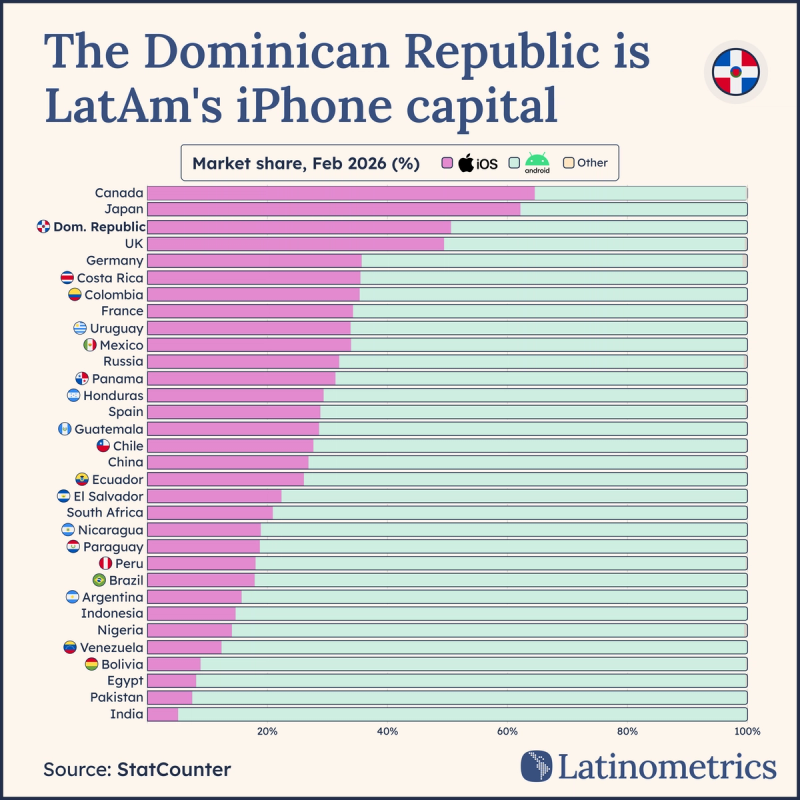
iOS hasn't cracked 50% market share in a single Latin American country. The one exception: the Dominican Republic.
Source: StatCounter
This may surprise some of our US or European readers, who could not imagine living in a bleak world dominated by green texts and a lack of AirDrop. The high cost of an iPhone doesn't help (especially with import tariffs). Compared to dozens of cheaper Android options, Apple's products have become a luxury item in our region, just like in West Africa or South Asia.
Latin America, with its large and heavily online population, is a priority for budget Android phone lines in particular. In its first year of release, the Moto G phone from Motorola (then owned by Google), was the top-selling phone across both Brazil and Mexico.
Fast forward to last year, the top-ten best-selling phones in Latin America were all Android-supported, with four of the top 10 being from Samsung and 80% of the best-sellers being lower-budget 4G phones that cost less than $200. The Galaxy A06 was the year's overall best seller.
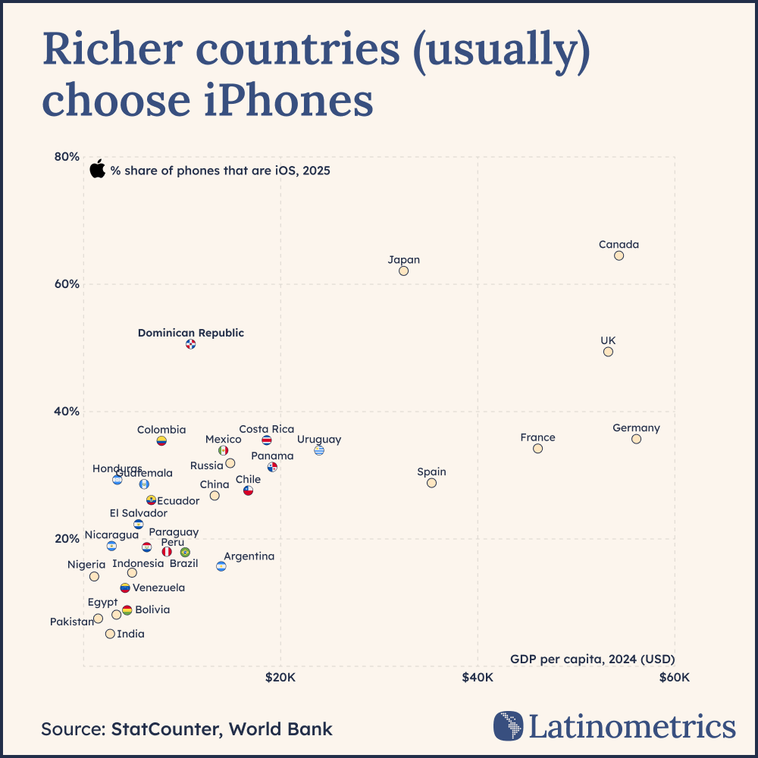
So what explains the outliers? GDP per capita gets you about halfway there, explaining roughly half the variation in iOS adoption across countries. But the most interesting case breaks the model entirely.
The Dominican Republic sits at nearly 50% iOS share. That's comparable to Germany and the UK, but on a GDP per capita of $10,876. The easy explanation is remittances from the US diaspora. But that theory falls apart quickly. Mexico, Guatemala, and Honduras all receive massive remittance flows from the US and sit well below 30% iOS.
And the sticker price doesn't explain it either. A Deutsche Bank survey of iPhone 16 Pro prices across 41 countries found almost no correlation between cost and adoption. Denmark pays $1,398 and has 61% iOS. India pays $1,401 and has 5%. There obvious differences betweend those two countries that would help explain the adoption better, such as poverty prevalence and culture.
As far as we can tell, nobody has written a convincing explanation for why the DR is an iPhone country. It could be the density of the New York and Miami diaspora, a used-iPhone pipeline flowing south, or something about carrier deals with Claro and Altice.
If you're Dominican or work in telecom, we'd love to hear your theory.