
Uruguay ranked as less corrupt than Canada & Japan
Uruguay ranks less corrupt than Canada & Japan, proving strong institutions beat fraud.

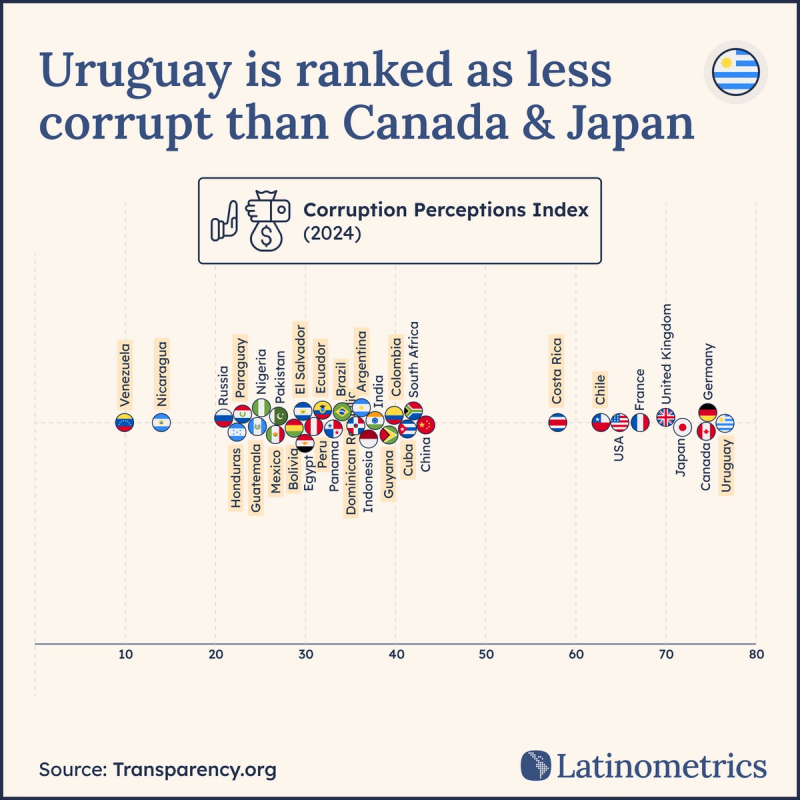
Latin America is home to a government with one of the cleanest reputations worldwide.
For as long as there has been a Latin America, there has been fraud.
Don't believe us? In the 1640s, nearly two centuries before Latin American independence, there was a massive financial fraud involving the quality and fineness of silver coins processed at the Mint of Potosí in modern-day Bolivia.
Local judicial and administrative officials partnered with mint assayers to purposefully overreport the amount of silver put into coins. The result was a global panic as prices increased while trade was wholly paralyzed in some parts of the world.
We bring up this story because, centuries later, corruption remains one of the most persistent problems facing Latin America. For much of the region, including autocracies like Nicaragua and Venezuela, as well as flawed democracies such as Honduras and Paraguay.
But then, there's Uruguay.
The small South American country is not just a regional leader in fighting corruption—it's a global one. Uruguay outpaces all of its neighbors as well as developed, long-running liberal bastions like Canada, Japan, or the republics of Western Europe. Not bad for a country only celebrating 40 years of democracy this year.
Powered by strong political institutions and a robust civil society and media, Uruguay has regularly topped metrics that evaluate national capacity for combatting corruption. Even when government scandals do emerge, as in 2023 under former president Luis Lacalle Pou, cabinets are replaced, officials are investigated, and due process is followed.
As Transparency International puts it, at the center of Uruguay's success is its "[abolishing] of clientelistic practices in politics and in the management of state resources." Put simply, the government primarily serves the average citizen above business or other interests.
Truly a model to study, not just for well-performing regional peers like Chile and Costa Rica but for all of Latin America and the world.


