🤱 Births & Fertility
Latin America's birth rate peaked in 1986, with Brazil's population now set to decline years earlier than predicted.
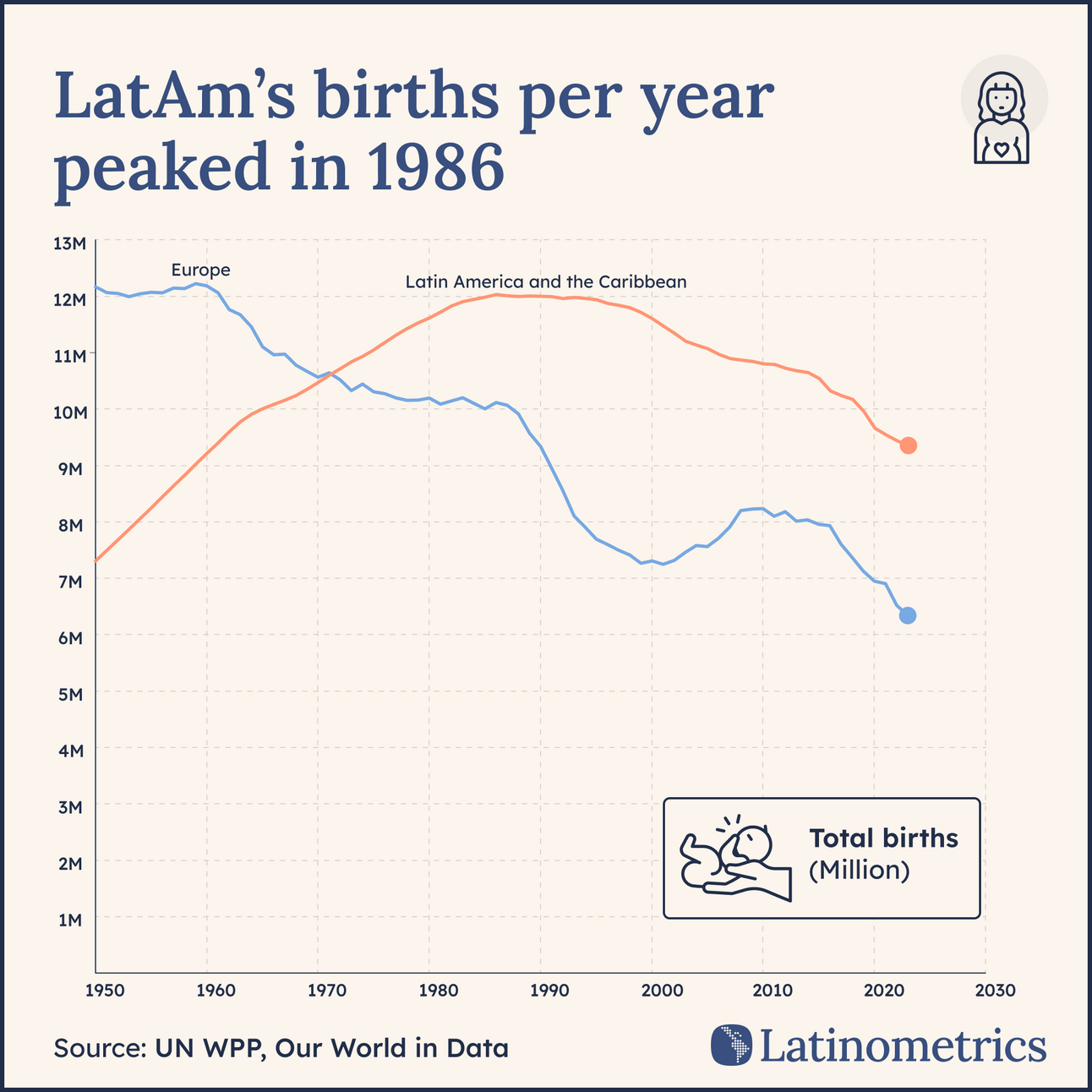
Still developing, Latin America is seeing unexpectedly sharp declines in birth rates.
The world of 2050 will look vastly different from today—to say nothing of the year 2100. In fact, the United Nations predicts that the global population will peak in the mid-2080s at roughly 10.3B people, before beginning to drop in the years afterwards.
And by then different world regions will have vastly different fates. For example, countries like China, Japan, and South Korea have already seen early peaks and will see big declines in national populations in the years to come, similarly to much of Europe.
Meanwhile, there’s Africa, which by 2100 is projected to hold the three most populous metropolitan areas worldwide: Lagos, Kinshasa, and Dar es Salaam.
But Latin America is in a weird place today. Despite still being a region of mostly developing economies, we’ve already seen a fairly big drop-off in population growth.
In the 1980s-1990s, there were roughly 12M children being born in the region each year. However, post-pandemic we’re seeing numbers to the tune of a quarter less than that.
What’s behind this drop? Well, it’s normal for countries, as they develop, to see fewer births. Costs of living go up, people are focusing on their education or obtaining better-paid jobs, and families have lower rates of infant mortality.
LatAm's fertility rate has decimated in 20 years
Yet for Latin America, it seems to be happening at a surprising pace. Brazil’s population today is just over 212M, and it is expected to peak at 220M in less than two decades before beginning to decline. And yet, just a few years ago the country was set to reach a peak of 233M in 2047.
And this is something we’re seeing around the region, from heavyweights like Mexico to small countries like Ecuador.
Is this all bad news? Of course not. But with record-high emigration figures, as well as an aging population to think about, the region’s leaders have got their work cut out for them in the years ahead.