
71% of Chinese investment in LatAm is state-run
BYD's $620M acquisition in Brazil is part of a two-decade, $200B wave of Chinese investment reshaping Latin America's economy.

When it comes to the changing eras of Latin America, few stories seem to strike the same poetry as a single factory in Camaçari, in the northeastern Brazilian state of Bahia. Ford, the most famous of US carmakers, shut down their local assembly plant in 2021—and lo and behold, within just two years Chinese auto giant BYD had acquired it for $620M).
Of course, the poetry was a little less potent a year or so later when local authorities shut down the factory over allegations of slave labor and human trafficking. But then, the story of multinational corporations and overseas investment isn't always a pretty one.
Since 2005, China has invested over $1.5T worldwide, with Latin America serving as a special market of interest. The region has attracted roughly $200B in Chinese foreign direct investment (FDI), and Brazil in particular finished 2025 as the top FDI destination once more, a title previously held in 2021.
Let's break down some of this Chinese investment.
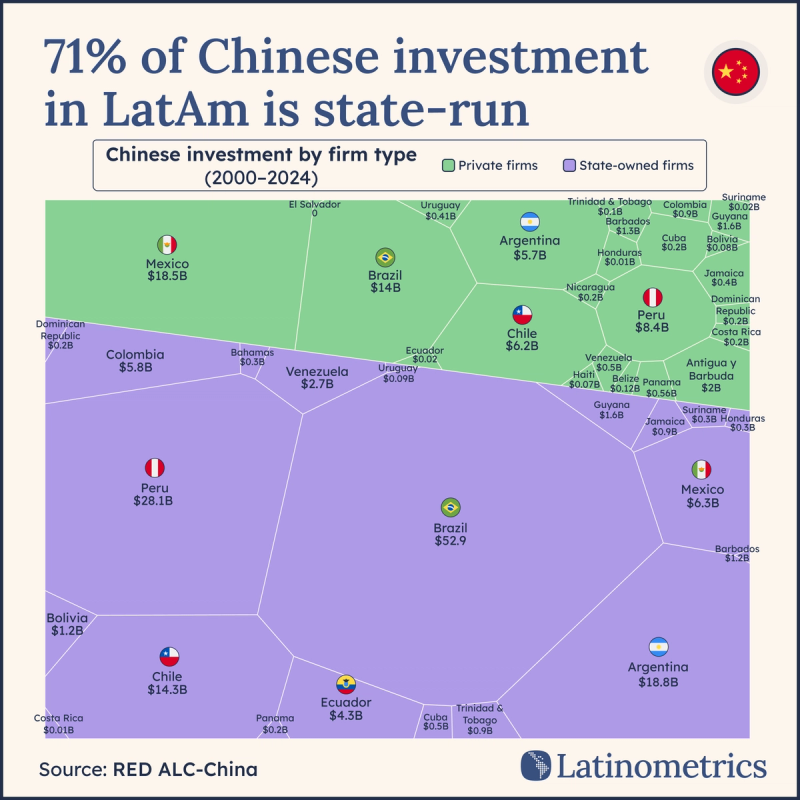
To start, it's worth looking at who or what exactly is doing the investing. State-run companies dominate Chinese FDI in Latin America, making up nearly three-quarters of the total.
These state-owned enterprises include players like State Grid, Sinopec, and China National Petroleum Corporation (CNPC), all of which are among the world's largest companies by revenue.
Beginning in the 1990s and 2000s, these sprawling conglomerates were tasked with "going out" and strategically investing overseas, in part to maintain their growth following rapid domestic development and in part to help secure the key resources China needed to continue to secure its growth. Accordingly, investments have included offshore oilfields, lithium mines, and even agricultural and soy companies.
Which isn't to say all Chinese FDI in the region has come from these state-owned giants. Privately-owned companies like Didi and Tencent have also been active in regional markets like Brazil and Mexico, making strategic multimillion-dollar acquisitions and investments in order to strengthen their local positions.
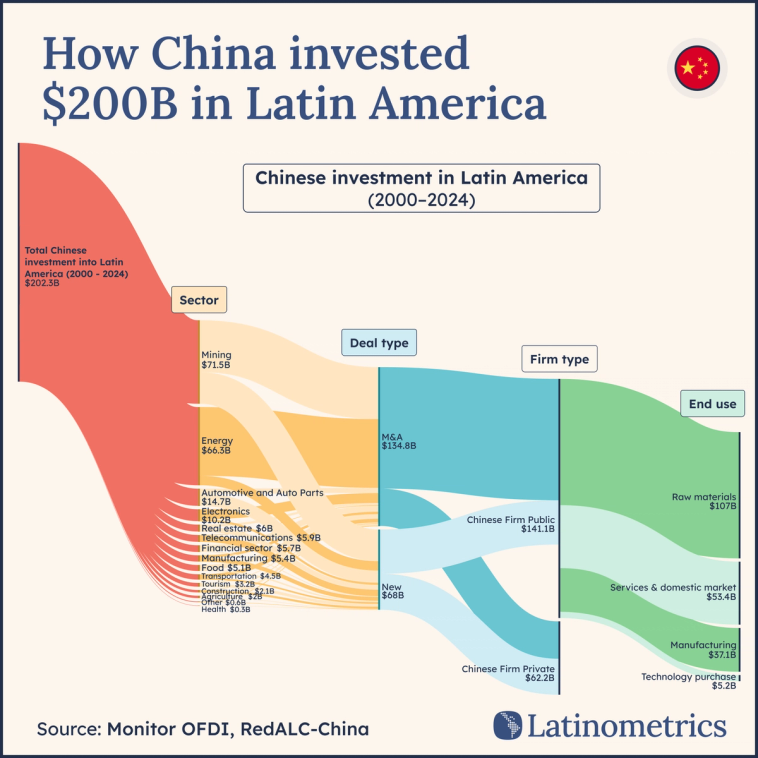
Above all, though, Chinese FDI in Latin America is oriented towards energy and mining, which together make up over 70% of all capital invested in the region. Mining especially is a key regional priority for Chinese firms, which have leveraged mergers and acquisitions to consolidate access to minerals like gold, lithium, and iron, particularly in Andean countries like Bolivia, Colombia, and Peru.
Source: REDALC-China Monitor (OFDI)
The issue with investments like these is the same as it has been in past decades with investments from US or British firms. This FDI, which can provide short-term capital infusions, often does not involve any sort of technology transfer or long-term positive effects for the municipalities in question.
Local communities may face displacement or pollution, while fewer decent jobs are created than in the case of a new manufactory or commuter rail project. And while not every project leads to a labor investigation or a costly underperforming dam, Latin America holds too many cards to not negotiate better terms in the region's dealings with Chinese multinationals.


