
Where does China put Latin Americans to work?


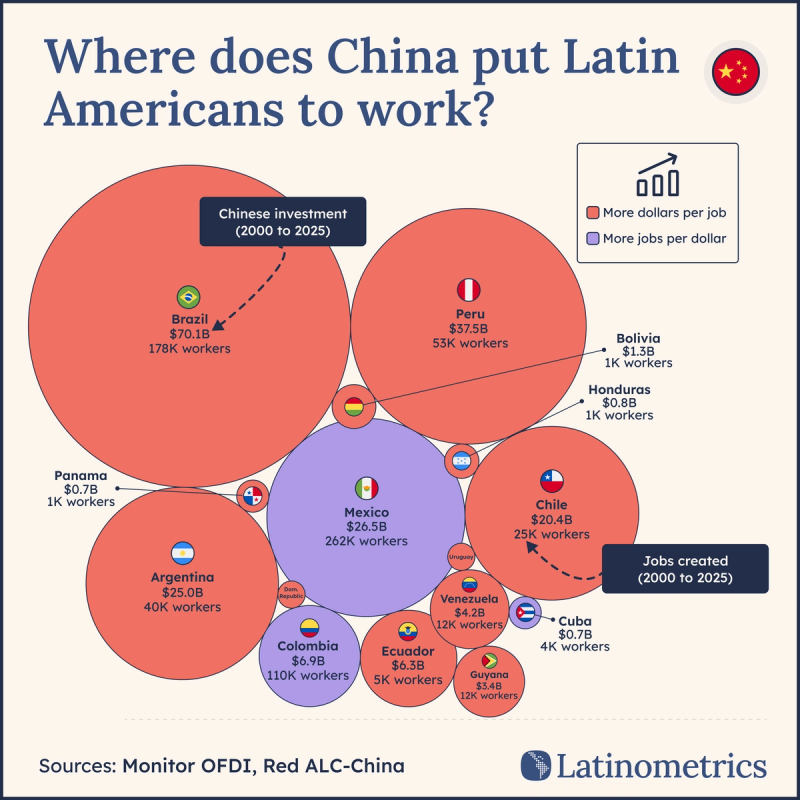
Chinese Job Creation in Latin America
Traditional logic has always held that investment creates jobs. If you want a region like Latin America to grow and prosper, then lots of solid foreign direct investment (FDI) is needed to create the jobs necessary to fight poverty.
But in this chart utilizing the most recent available data (2026) from our friends at the Red ALC-China's OFDI Monitor, the reality appears to be far more nuanced.
Chinese companies have invested over $213B in Latin America and the Caribbean between 2000 and 2025, representing nearly three percent of the region's total GDP so far this century.
Top Chinese FDI Destinations in Latin America
Over half of this investment went to just Brazil ($70B) and Peru ($37B), so you'd expect most jobs to have been created in these two countries.
But in fact, of the roughly 705K jobs created from Chinese FDI over the last quarter-century, more were created in Mexico (262K) than anywhere else in Latin America and the Caribbean, despite the fact that the region's second-largest country received "just" $26B in Chinese investment in this time period. That's well behind Peru and just ahead of the far smaller Argentine economy at $25B.
Not to mention, the average Chinese deal in Mexico is roughly a third the size of the average Brazilian one ($127M vs. $387M). Smaller checks, more jobs.
Mexico's Secret Sauce
What, then, explains the difference? Sectoral specialization likely has a role to play.
Contrary to the mining and energy investments which have historically dominated Chinese FDI in Brazil, Peru, and other resource-rich South American countries, Mexico has received more industrial and manufacturing FDI, particularly since 2020.
So that's how even just a $710M auto factory (2023) in Nuevo León or a $380M port investment in Veracruz (2019) can — when managed with efficiency and transparency — lead to the creation of some 50K new local jobs.
And these are low-capital, high-employment investments that compare favorably to not only miner jobs down south, but also more informal employment like the projected 57K jobs created by Didi's $9.5M local market entry in 2020.
And the Mexico pattern arrives at an awkward moment for Washington: the same factories generating Chinese-funded jobs are the ones US nearshoring policy is trying to relocate away from Chinese capital.
Mexico isn't alone. A million Chinese dollars buys 16 jobs in Colombia, 10 in Mexico, and 5 in Cuba. In Chile? Just 1. What do those three share that the others don't?


