
Corruption is Still a Huge Problem in Latin America
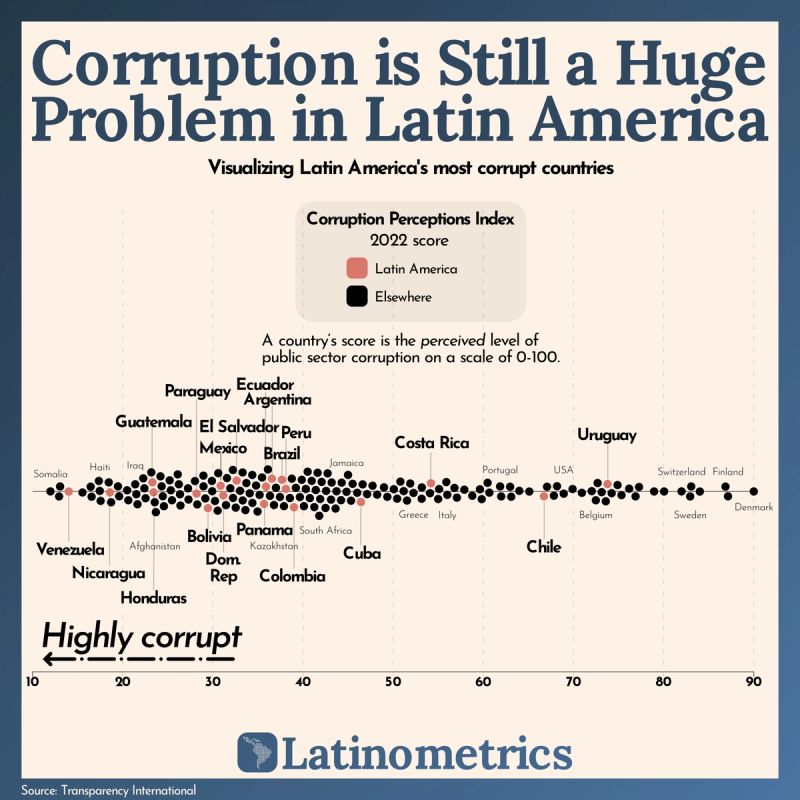
Uruguay is less corrupt than the US and France, but most of LatAm falls below global averages.

Talk to any Latin American about their country’s politics or business environment for long enough and one theme will almost inevitably emerge.
Corruption is something of a sad commonality in the region, as seen by Transparency International’s Corruption Perception Index. The ongoing fight against dirty politics is one being fought in each and every country—with varying results.
Unsurprisingly, the Latin American country that performs best on our CPI chart for 2022, Uruguay, is also the least unequal country in the region. It scores an impressive score of 74 (out of 100), tying for 14th place globally and falling ahead of major democracies like France, Japan, and the United States.
Chile and Costa Rica round out the regional top 3 with respective scores of 67 and 54 that put them well ahead of most of the world. Not too shabby either.
Unfortunately, for these countries’ neighbors the picture is a lot less rosy. Most Latin American countries fall below the global average score of 43, including the region’s biggest countries of Argentina, Bolivia, Brazil, Colombia, Mexico, and Peru.
And for some countries in the hemisphere, the problem is even worse. Venezuela and Nicaragua fall among the most corrupt countries worldwide, with scores below 20 that put them in the company of failed states such as Somalia and Yemen.
Corruption is a sinister problem that permeates at all levels of society. It has obvious impacts on the political life and business environment of a country, naturally, but can pervade at even the day-to-day interpersonal interaction between people. Even an average amount of corruption can color how Latin Americans engage with their neighbors, their countries, and their region.
With this in mind, we hope to see a return to some of the major anti-corruption work done in the last decade in countries such as Chile and the Dominican Republic. After all, one-man crusades cannot bring about an end to dirty money—only the steady strengthening of legal and political institutions can.
Only then can Latin America truly flourish.


