
Brazil and Chile have been beating the S&P 500
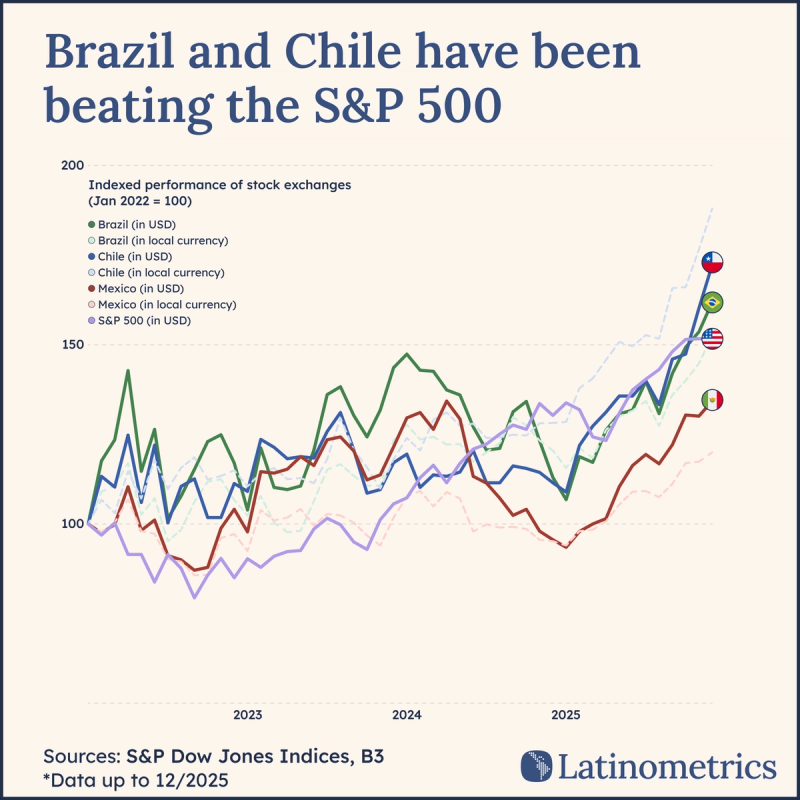
Brazil and Chile's stock exchanges have quietly outperformed the S&P 500 since 2022.

Well, it’s that time of the year…again. With conflict escalating in the Middle East and instability around the critical energy chokepoint that is the Persian Gulf and the Straits of Hormuz, oil prices are spiking and worldwide markets are taking a beating.
If this sounds familiar, remember that last year saw repeated bouts of high volatility and instability in global financial markets, as everything from war to tariffs to sluggish growth to plain ol' business uncertainty turns bulls into bears.
And given that the United States has been at the center of most of this instability for the last fourteen months or so, investors have been looking for markets with less American exposure. Latin America has delivered.
Don't believe us? Just look to the performance of both Brazil and Chile's stock exchanges, which have outperformed the S&P 500 index since 2022. As of the end of 2025, Chile's IPSA was up over 73% in USD terms since March 2022, and Brazil's Ibovespa was up 59%. Over the same period, the S&P 500 managed around 40%.
Chile has been the strongest performer in USD terms. The gap between the local-currency and USD lines on the chart tells you something important: investors didn't just benefit from rising stock prices. A strengthening Chilean peso gave their returns an extra boost on the way out.
What's behind Chile's lead? A big factor is copper. With prices elevated by structural demand for electrification, Chile's mining sector has been riding the energy transition wave. But it goes beyond commodities:
Rate cuts from the central bank have made equities more attractive, pension reform has pushed more institutional capital into the market, and the banking sector (28.7% of the IPSA) has benefited from normalizing credit conditions. Add a strengthening peso on top, and you get a market where 28 of 30 companies posted positive returns in 2025 — the IPSA's best year since 1993.
Further north, Mexico has lagged, held back in large part by its deep exposure to US risks as well as creeping concerns about centralization of power following its recent judicial reform.
Naturally, these markets are tiny compared to the NYSE or Nasdaq (we're talking billions, not trillions). But for investors looking to diversify away from US risk, size isn't really the point.
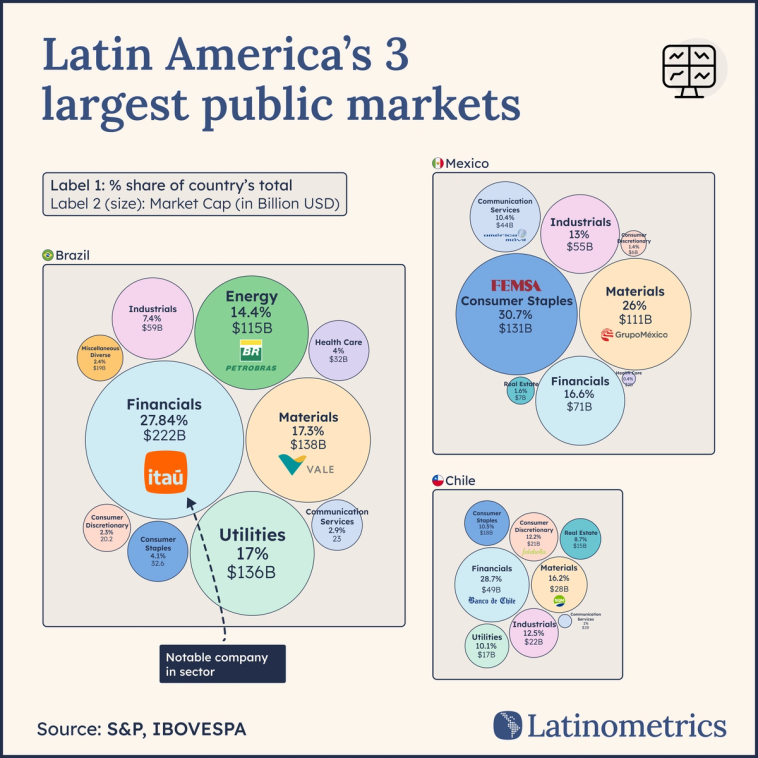
Take Brazil, the region's only equity market that actually looks like one (as in, more than two sectors doing the heavy lifting). With over $800B in aggregate market cap, the country's exchange is about double that of Mexico and over quadruple Chile. Four sectors number over $100B, showing some useful diversity when compared to the highly concentrated Mexican market, in which consumer staples and materials alone make up over half the market cap.
As the financial capital of Latin America, Brazil reflects a mature, diverse market, led by massive banks and insurance players such as Bradesco, Itaú, and Santander.
The country's markets have also benefited from its relatively low exposure to US tariffs. Strong fundamentals help too: both unemployment and inflation are at record lows, and the economy is on solid enough footing that foreign capital keeps flowing in.
For decades, the assumption that serious equity investing starts and ends with the US was built on one thing: American markets were where the stability was. When that flipped, some investors did the simplest thing possible. They looked somewhere else. And what they found were markets that had been quietly compounding while the S&P churned.
The next time oil spikes or tariffs escalate, Wall Street will scramble for cover again. Some investors (like you, reading this) already know where to look.


