
From 1 to 8.5B Liters: How Heineken Grew in the Americas
Heineken's Americas sales surged 9x in 13 years, fueled by a $7.7B acquisition and Amstel Ultra's 100M-liter success.

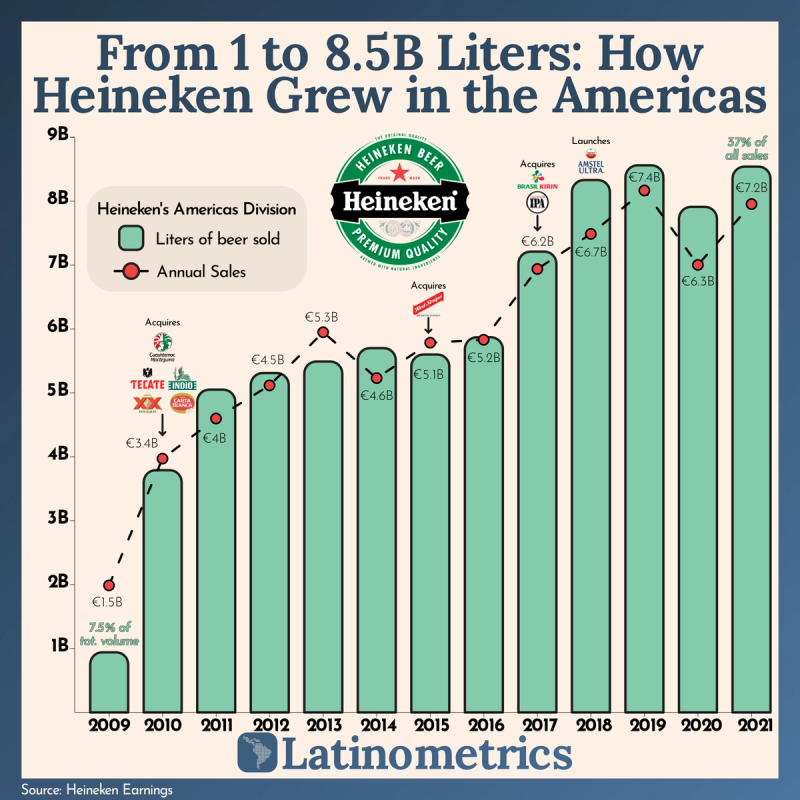
In 13 years, Heineken has multiplied by 9x the amount of beer it sells in the Americas. The biggest jump in a single year for that segment happened when the company bought Cervecería Cuauhtémoc Moctezuma in 2010 for $7.7B. Has the investment paid off? Heineken reported revenues of $7.3B for the Americas segment last year, and it now represents 37% of Heineken’s total beer sold globally. The company's impressive sales have been fueled by iconic brands like Tecate, Dos Equis, Lagunitas IPA, and most recently, Amstel Ultra.
Amstel Ultra was Heineken's clever invention; using one of its European brands in Mexico, it capitalized on the growing demand for low-carb beer alternatives. Through crisp branding and powerful marketing campaigns (with none other than Rafael Nadal, for example), Amstel Ultra has skyrocketed in popularity. In fact, many people in the country confuse Amstel Ultra for Michelob's Ultra, the more recognized brand worldwide. Last year, the company reported it reached 100M liters of Amstel Ultra sold and an expansion plan into 12 new countries. It also plans to expand its Amstel Ultra Hard Seltzers line, which was launched in Mexico and New Zealand in late 2020.
In 2017, Heineken made yet another bet, this time for $704M, on Latin America's potential by acquiring Brasil Kirin. It was then a subsidiary of Japanese Kirin Holdings, which itself had already consolidated several brands in the Brazilian market. The mastery coming out of Belgium and the Netherlands in operating hundreds of beer brands is quite remarkable. AB Inbev (Belgian) is the largest beer company in the world, and Heineken (Dutch) is the second. Both companies are at the forefront of beer innovation. They have maintained relevancy in a fast-paced, competitive industry by following a similar playbook: enter a market through an acquisition (interestingly, Mexico is a critical one for both), experiment with new product lines, adapt quickly to trends, and expand what works into other markets.


