
🥇 Gold Rush
War, central banks, and $4.6K gold are handing LatAm's miners a once-in-a-generation windfall.

With the Iran War wreaking havoc on global equity and energy markets, there is high demand for safer assets in which investors can park their money.
The stability of the US dollar and other safe US assets has been increasingly questioned over the last year, owing to chaotic tariff announcements, budget-busting policy, government shutdowns, and now the outbreak of yet another war in the Middle East.
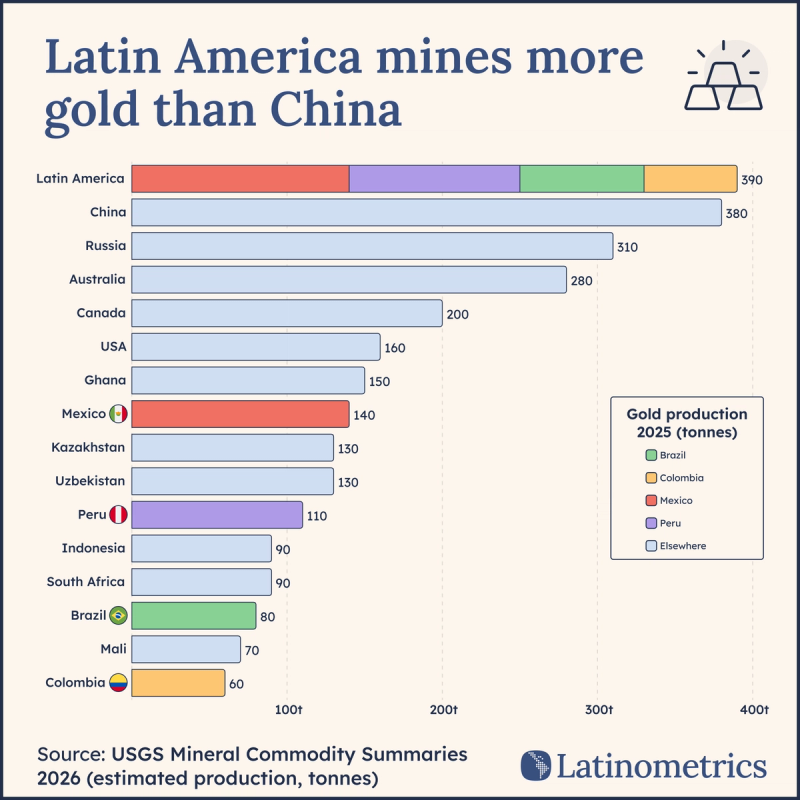
Accordingly, many are turning back to ol' faithful—gold, the precious metal that's been used as some form of currency or asset since man first abandoned the barter system many centuries ago. Gold is on the rise, and luckily enough Latin America is home to four of the world's largest producers: Mexico, Peru, Brazil, and Colombia. Combined, they mined 390 tonnes last year; China, the next closest, managed 380.
Much of that output flows through foreign giants like Newmont, which runs South America's largest gold mine (Yanacocha, Peru) and one of Mexico's biggest (Peñasquito). But local players are in the game too. Mexico's Fresnillo, the world's largest silver producer, mined 600K ounces of gold last year, and Peru's Buenaventura is pouring $750M into a new mine set to come online this year.
This year marks the 55th anniversary of when Nixon ditched the gold standard (the system that pegged the US dollar to gold at a fixed $35 per ounce, meaning every dollar was theoretically backed by a lump of metal sitting in Fort Knox).
To give an idea of how far we've come, one gold ounce is today valued at over $4.6K, down from its late-February high of $5.2K but more than double its value less than two years ago.
Investors are fleeing the dollar just as central banks around the world are shoring up their own gold reserves. Brazil's gold reserves are up 12% since early 2022, part of a global de-dollarization wave. China and India have grown theirs by 16% over the same window, hedging against the very dollar instability this story opened with.
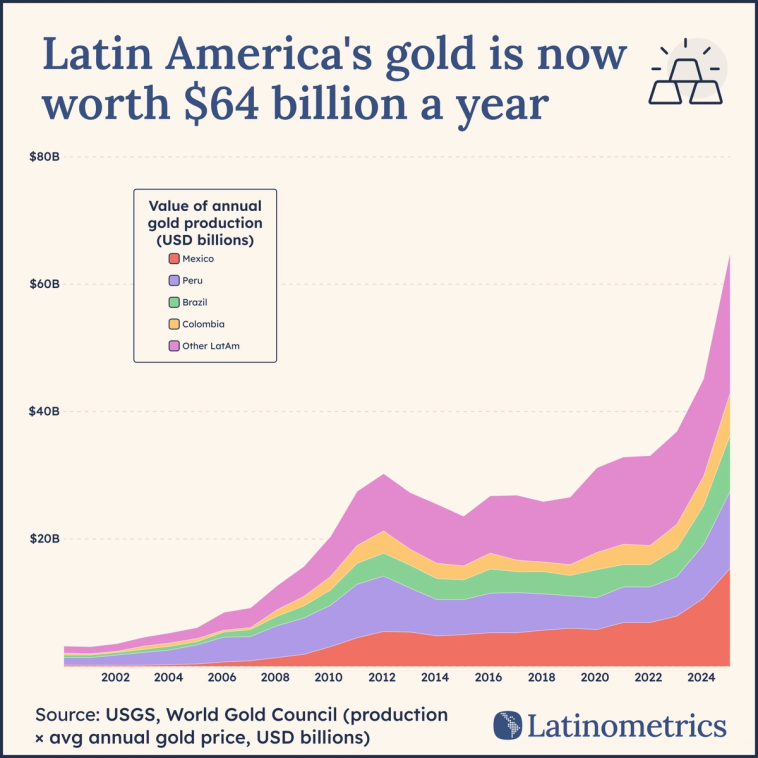
So like with many other macro-trends shaping the global economy today, Latin America is in a position to benefit—with some considerations.
With all of the geopolitical instability in the world today, the question is not so much whether gold should be expected to rise further in value, but rather how much Latin American economies can benefit from their large reserves of this precious metal.
After all, gold made up nearly a fifth of Peruvian exports in 2024, and Peru's shipments to China alone surged 400% in the first half of 2025. Meanwhile, an estimated 250,000 artisanal miners produce roughly a quarter of the country's gold outside the corporate system entirely. Gold prices are soaring and Latin America is sitting on the supply. The question is whether countries like Peru will see that wealth show up in something other than a mining company's earnings call.


