
Brazil's Government is the Most Heavily Indebted in LatAm
Brazil's debt hits 85% of GDP, making it LatAm's most indebted, despite strong economic growth.


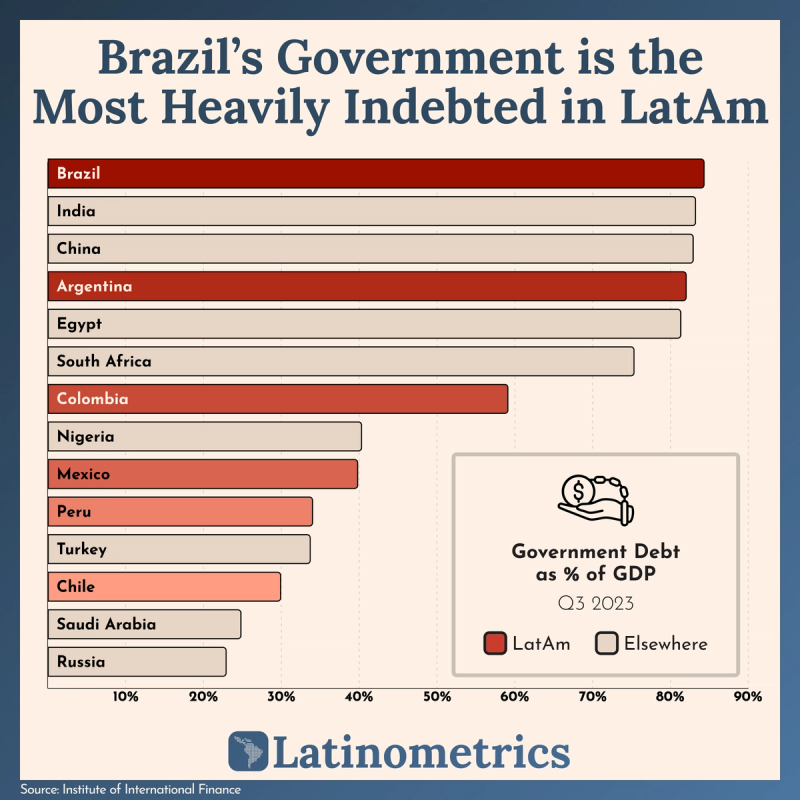
Exploring the dynamics of fiscal policy in LatAm's top economies.
Every once in a while, you may come across a conversation about national debt which, similarly to personal debt, deals with how much money a country owes to a creditor. In the context of Latin America…well, you probably are thinking of a country already.
Argentina famously owes the International Monetary Fund roughly $45B, a staggering debt it incurred with the aim of stabilizing its economy—something which two years later has not occurred.
However, Argentina is not the most indebted country in Latin America today.
For that, you need to look to Brazil, which has a government debt of roughly 85% of gross domestic product (GDP) as of late last year. By both gross debt and debt ratio, Brazil is Latin America’s leader.
This may well surprise you. Brazil? The country which defied all macroeconomic expectations and saw over 3% economic growth last year, in the process rejoining the top 10 world economies? How could this be?
The answer is complex, as it almost always is with issues of fiscal policy. Brazil has notoriously outspent its growth for years now, trying to keep its economy afloat in times of crisis like those seen in 2014 or 2020. Today the country is attempting to woo investment and financing for development projects in an effort to reach once more the success of its 2000s golden era.
Not all debt is bad debt, mind you. Taking on debt in order to fund strong development projects which create high-quality jobs or provide entrepreneurs with a social safety net which allows them to better innovate is advisable. But short-term thinking is dangerous, especially since the two most basic ways of fighting a deficit and lowering national debt – cutting spending and raising taxes – are both politically unpopular.
Which brings us to a second regional comparison, that of government debt versus tax regimes. Paradoxically, both Brazil and Argentina are among the highest tax collectors in the region, while other major economies like Mexico, Peru, and Chile all collect fewer taxes and have lower debt.
This may seem counter-intuitive, but it’s worth recalling recent decades in considering this. Mexico and the Andean countries each underwent rather extensive privatization and liberalization of their economies in the late 20th century.
Chile’s Augusto Pinochet and Peru’s Alberto Fujimori, for example, each implemented so-called shock therapy policies in order to reduce their countries’ state burden and allow for greater presence by the private sector. This may have held deep implications for income inequality, but it also means today the state apparatus is far slimmer in each of these countries than in South American peers such as Brazil and Argentina.
Argentina’s new president Javier Milei wants to implement similar policies, privatizing large sectors of the economy and in the process reducing Argentina’s deficit. Only time will tell if he will succeed.


