
Only startups & Big Tech add software jobs
The software labor market is splitting in two.

"We have 20,000 programmers. This is the first year in history that we won't grow in the number of programmers. And it's highly likely that in five years we might have 10,000 programmers, not because we've laid them off, but because we're not hiring anyone."
So spoke Mercado Libre founder Marcos Galperin on a recent podcast appearance. His words caused an online uproar as people considered the implications of Latin America's most valuable company placing a moratorium on hiring new programmers in 2026.
Yet Galperin is not alone. Companies of every size are rethinking what software engineering talent is worth as AI reshapes the job itself.
Nor is this trend reserved for Latin America.
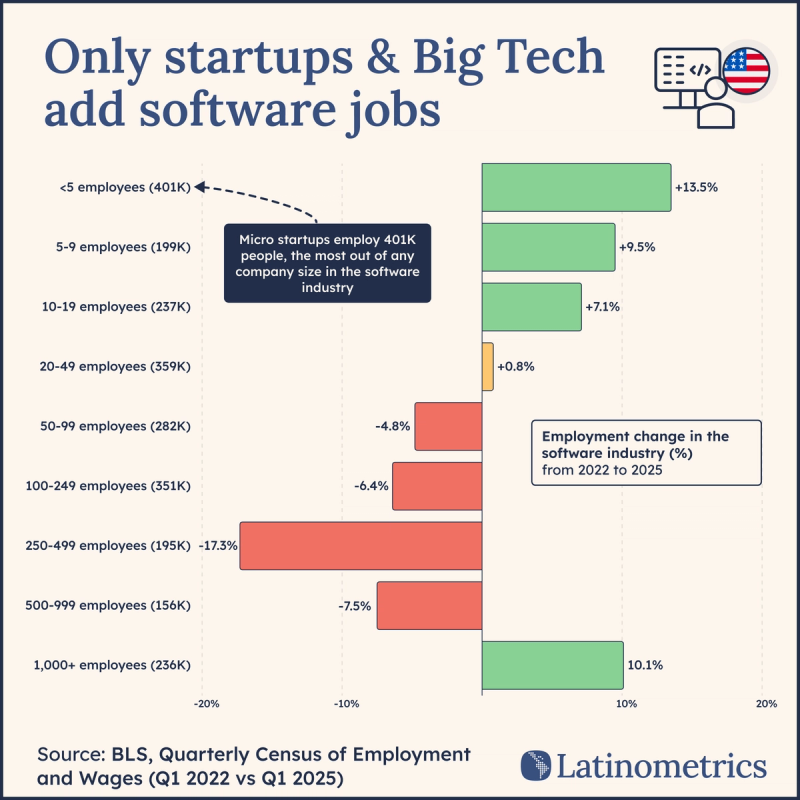
The chart above was built using quarterly census data from the Bureau of Labor Statistics of the United States in 2022 and 2025.
Mid-size shops here means roughly the 50-to-999-employee band: too big to be a scrappy startup, too small to be Microsoft. That's the band getting hollowed out.
While many of MELI's largest US counterparts kept growing their developer headcount, and the smallest shops grew even faster, everything in between went the other way.
The deepest cuts landed on companies with roughly 250-500 employees, which saw an average of nearly 20% reduction in just a few short years.
Part of this may come from a drawdown following big boom years in 2021 and 2022, while part of the story is of course tied to the rise of AI in the workplace.
So programmers may not only struggle to find good software engineering work in Argentina or even Latin America. Within major global economies like the US, too, times are tough.


