💼 Job Creators
The real story behind Hispanic employment, business growth, and job creation in the US.
We create custom data stories for global companies that want to reach Latin America's business community — the same kind of content you're about to read below, but built around your industry expertise and distributed to our 300K+ audience. If that sounds interesting (for you or someone you know), let's talk to see if we're a good fit. [Schedule 15 minutes →]
The first casualty of war is truth, or so the old saying goes. And while we may live in times of war, let us today modify that idiom by stating The first casualty of politics is truth, too.
Inconvenient truths have long been sacrificed at the altars of ideology and political convenience, and the last year or so has been no exception in the United States. The US is in a period of domestic tumult, with increasingly unpopular crackdowns on immigrants that have led to a number of high-profile deaths among citizens and non-citizens alike.
Given all the caricatures swirling around today about "violent criminals" (debunked) and "drains on the system", we thought this week we'd pour some cold water, or data, on the stories out there by taking a true look at how roughly 70M Hispanics shape the US economy.
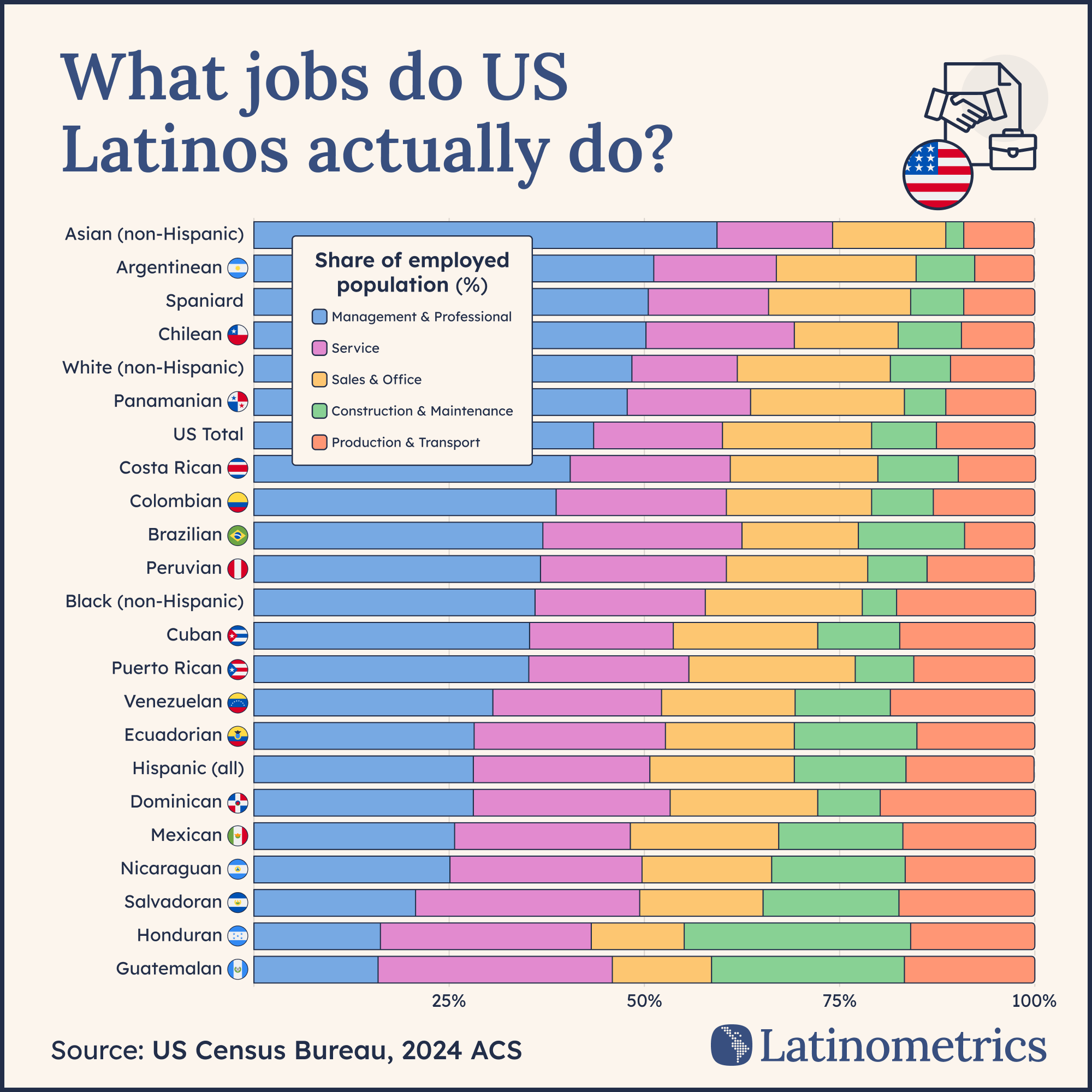
Latin Americans face varying degrees of opportunity in their home countries, and the same is true upon acquiring US citizenship. Case in point, while modern discourse may reduce Hispanic workers to agricultural and construction work, the reality is that more actually work in white-collar and corporate jobs in sectors such as management or services.
This holds especially true for Argentinean, Chilean, and Panamanian immigrants, who tend to outperform most US demographic groups and national origins—with Asian Americans, the fastest-growing racial and ethnic group in the country, providing a notable exception.
On the flip side, construction does account for the employment of roughly a fifth of Central American immigrants, who on average are among the poorest people from the Americas to acquire US citizenship. And increasingly, they're not just the workers. Hispanic-owned construction firms nearly doubled between 2018 and 2023, adding over 155,000 jobs.
But naturally, Latino employees only provide about half the equation. To truly measure impact, one needs to look also to Latino business owners, which have created more jobs since 2018 than any other racial or ethnic group.
Take MasTec, a Miami-based infrastructure firm founded by Cuban-American Jorge Mas. It's now a $12B company with over 30K employees building everything from 5G towers to wind farms. Or Goya Foods, the largest Hispanic-owned food company in the US, which distributes over 2,500 products across the Americas.
And it's not just the big names. Our analysis of US Census data showed that between 2018 and 2023, the number of Hispanic-owned employer firms grew by nearly 50% across all sectors. In real estate, it was 85%. In construction, 80%. Over the same period, non-Hispanic White-owned firms in those same sectors grew between 1% and 6%. So much for being a burden on taxpayers.
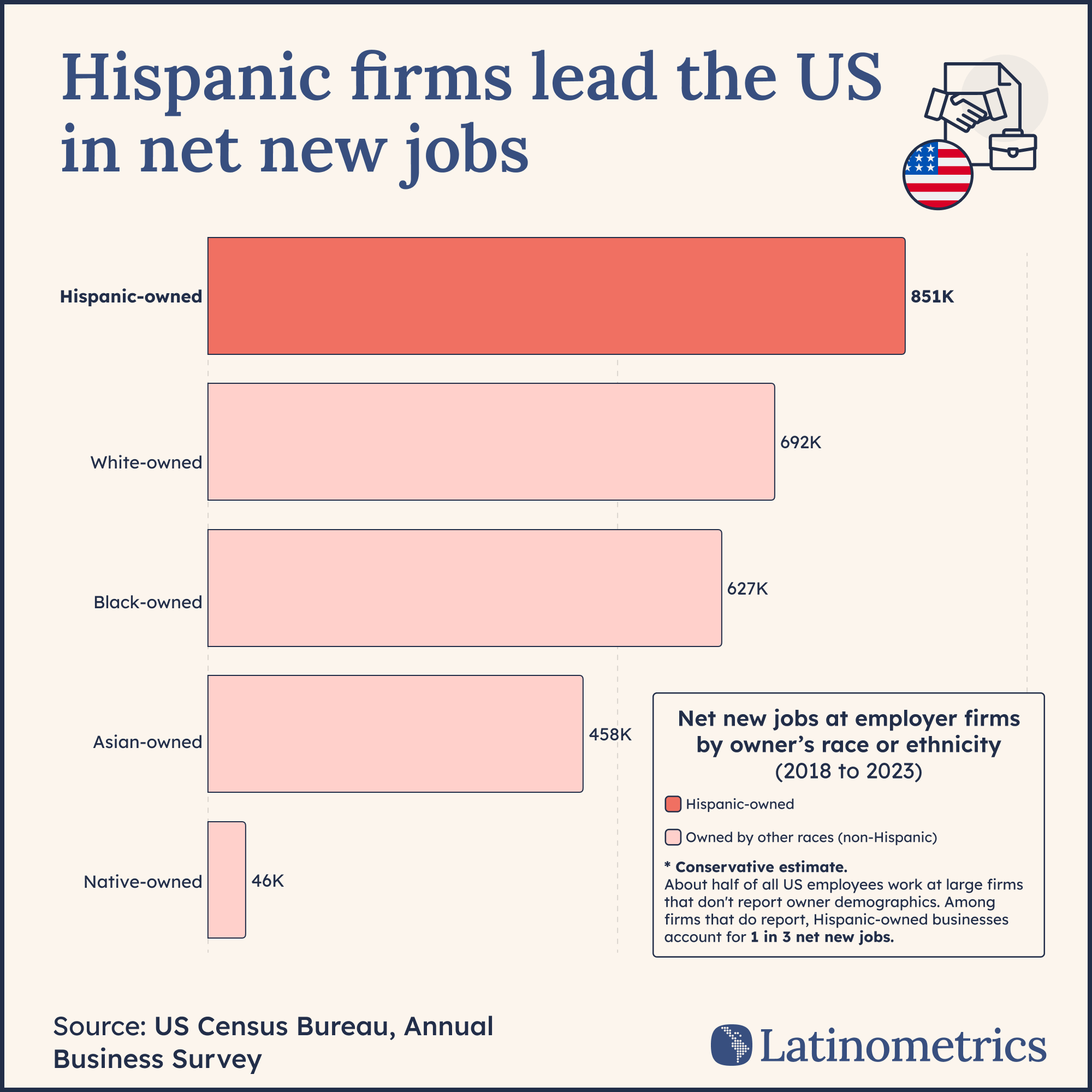
The trend is accelerating. Hispanic-owned firms went from 5.6% to 8.4% of all US employer firms between 2017 and 2023. Total US employer firms grew 3.3% over that period. Hispanic-owned firms grew 54%. Revenue scaled even faster, from $423B to $730B.
The political debate frames 70M Hispanic Americans as a question the country needs to answer. The data suggests the opposite. A demographic group generating a nearly $3T economic footprint (larger than the GDP of France) and 850K new jobs since 2018 isn't asking for a seat at the table. It built the table.
Voters and policymakers can paint that with whatever brush they'd like. The invoices will keep coming regardless.
Comment of the week 🗣️
Martin shares that our data on Brazilian wages is missing a big piece: Brazil’s massive informal economy.

Feedback or chart suggestions? Reply to this email, and let us know!