
How Have Obesity Death Rates Evolved Across Latin America?
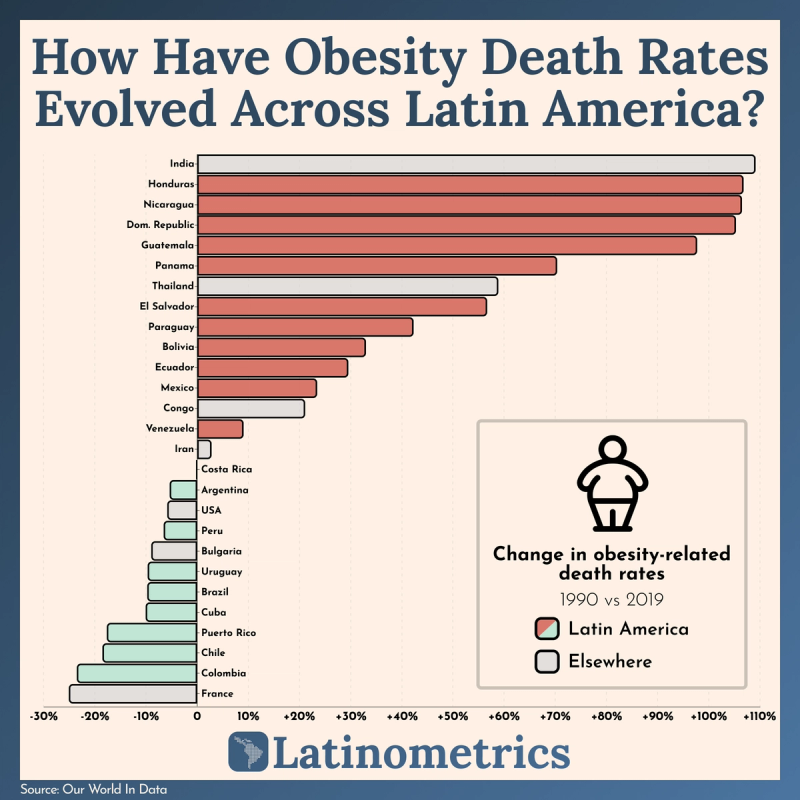
Obesity deaths double in Dominican Republic & Central America, while Colombia & Chile cut theirs by 20%.


A few years back, a joint report by the United Nations Food and Agriculture Organization (FAO) and the Pan American Health Organization (PAHO) provided a startling statistic: over half of all inhabitants of Latin America and the Caribbean are either overweight or obese.
That’s over 350M people. Specifically, the two international organizations estimated that roughly a quarter of the region’s citizens are obese, meaning overweight to an extent that it harms their health.
Meaning that this isn’t merely a cosmetic or social crisis: it’s a health one too.
With that in mind, this week, we’re looking at how obesity-related deaths have changed in the last few decades, as urbanization, economic growth, and lifestyle changes have led to a lot more obesity in the region. We’re cutting off our chart at 2019 as the last year before the pandemic came and wreaked havoc across the region.
Perhaps unsurprisingly, this metric appears inversely correlated in large part with development. The Dominican Republic and the countries of Central America’s Northern Triangle have each seen their number of obesity-related deaths just about double since 1990. Meanwhile, regional leaders such as Colombia and Chile have been able to reduce their number of deaths by just about 20%, meaning one-fifth fewer deaths each year.
So what’s at play when observing the worrisome rise of obesity? Some of the leading factors we’ve written about, such as the widespread prevalence of soft drinks like Coca-Cola in some of the region’s poorest areas. A turn from fresh produce to ultra-processed foods plays a part, as does a lack of access to quality education and health services.
Fighting hunger and undernourishment is essential, and there has been substantial progress on this front in countries such as Brazil and Uruguay. However, it’s not just about getting food to the families that need it, but also ensuring that the food in question is nutritious and healthy. Otherwise, we risk more countries on the top of this chart when we check back in in 30 years.


