
In LatAm, English Proficiency Inversely Correlates With Closeness to the US
Farthest LatAm countries from the US have better English. Argentina leads, Mexico is second-worst.


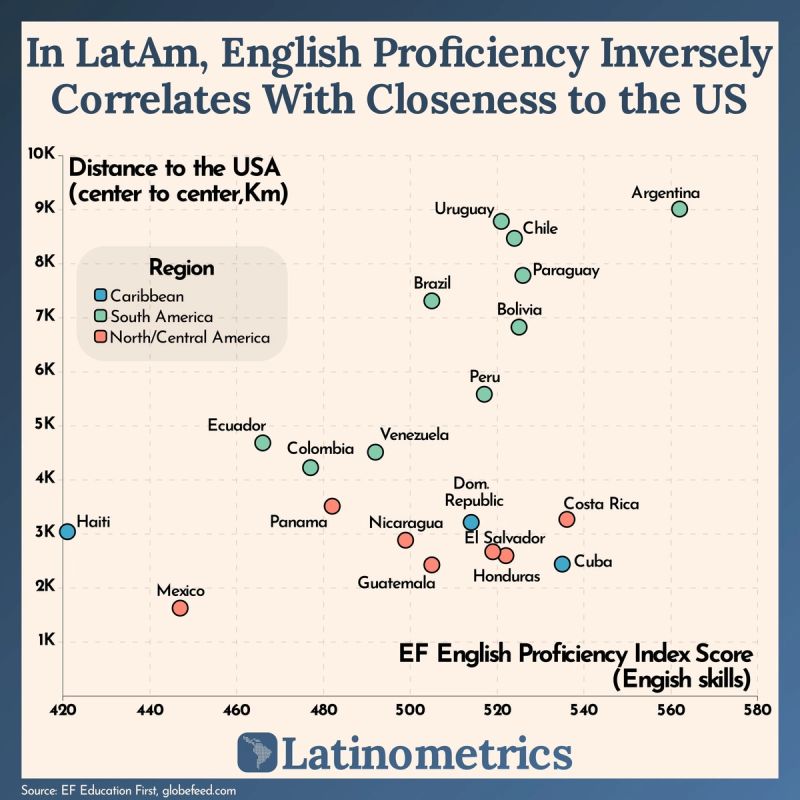
The farthest LatAm country from the US — Argentina — has the best English proficiency score in the region; Mexico has the 2nd worst.
Contrary to intuition, Latin American countries farthest from the US have better English levels. Many factors are at play, so this phenomenon is better explained as a tale of two extremes: Mexico and Argentina.
Amazingly, data indicates that Mexicans are a lot less likely to be able to read this than Argentinians.
Mexico, the only Latin American country with a border with the US and its main trading partner, has the second-worst English level in the region, only ahead of Haiti. Education First places Mexico in the "Very Low Proficiency" bracket, along with countries like Somalia and Yemen.
The country's low score reflects the education system's lack of emphasis on the subject. English didn't become part of Mexico's public school curriculum until 2018. In addition, less than half of the country's higher education institutions make it a mandatory subject, according to ANUIES. This translates to a system with virtually no English testing or proficiency requirements.
Conversely, Argentina is the only Latin American country in the “High Proficiency” bracket, which includes countries like Luxembourg and Switzerland. This means that most Argentinians can make English presentations at work, understand TV shows, and read newspapers in English.
In Argentina, formal and informal English learning has contributed to high scores. In all primary and secondary schools, learning a second language has been mandatory since 2007, and English is by far the most common choice. When it comes to universities, most have exit requirements for proficiency, meaning students must prove English proficiency to graduate. Further, informal learning has become a common practice. The British Council claims that as many as 2.5M Argentinians, or 5% of the population, find their own ways to learn English through TV, books, radio, and the internet.
When it comes to Latin America as a whole, the region is making good progress in this subject. Ours was the most improved region worldwide, with all but one country (Dominican Republic) improving their scores relative to last year and Nicaragua and Ecuador being the most improved.
However, a worrisome trend is that while adults are improving their English level in the region, young people's scores have fallen significantly since 2020. The drop is likely due to pandemic-related school closures. Making up for lost education (of all forms) during the pandemic will remain a challenge in LatAm's coming years.


