
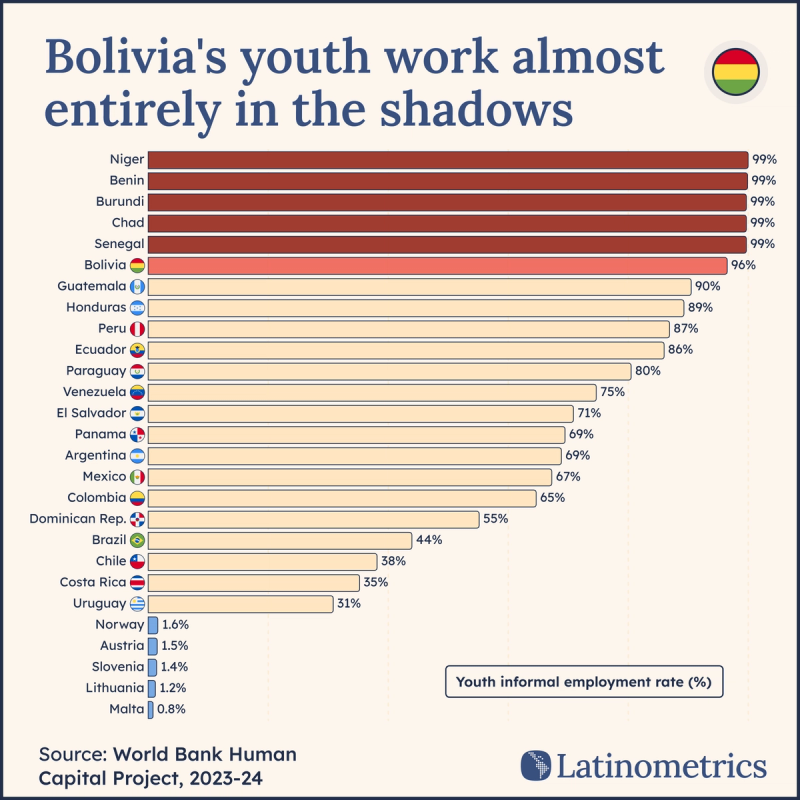
Bolivia’s youth work almost entirely in the shadows
Even Uruguay, Latin America's best performer, has 20x more young workers off the books than Europe's worst.

There’s a long-standing rule that politicians and scholars alike have long acknowledged: the young drive revolutions. Just look around the world for any number of examples.
In 1968, student sit-ins paralyzed France and young activists powered the Prague Spring. More recently, unemployed young adults were at the forefront of the Occupy Wall Street and Arab Spring protests—or at the regional level, the 2013-2014 protests in Brazil and Chile’s Estallido Social.
Mass youth unemployment tends to be the powder keg for protests and revolutions. But young people can hold jobs and still hunger for change if said jobs lack worker protection or dignity, or fail to pay a livable wage.
Across Latin America, one particularly common issue is informality, meaning labor that’s outside of the state’s recognized tax and pension system. And nowhere in the region is informality a bigger problem for the youth than Bolivia.
In Bolivia, less than 5% of young workers are paying into the formal Bolivian economy. This means less tax revenue for the state, but it also means a lack of protections for these young adults, no sick days nor worker’s compensation benefits if they’re injured on the job.
Informal labor is costly to the state and precarious to the worker. It’s also not reserved for the youth, as one recent estimate put over 80% of Bolivia’s overall workforce as self-employed or informal workers—making a fight to reduce this rate a top priority for recently-elected Bolivian president, Rodrigo Paz, and his brand of so-called “popular capitalism.”
If Paz is looking for a model for bringing young workers into the system, he could look to some of his neighbors…or he could look well to the north to one Latin American country which also had more than 90% of its youth working in the shadows at the beginning of the century.
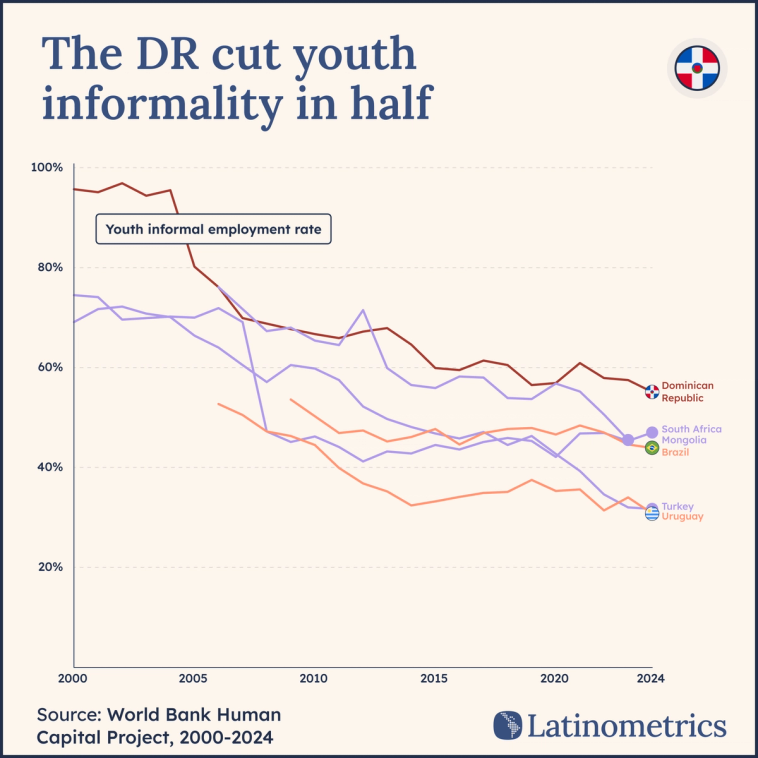
In 2000, the Dominican Republic had a similarly high youth informality rate to Bolivia. A quarter-century later, the rate has plunged to a rate closer to 60%—still high, but far from where it started alongside least developed countries like Niger. How have successive Dominican governments achieved such a drop?
For one, there was the creation of a universal and mandatory social security system in 2001 through Law #87-01. A report from the International Labour Organization (ILO) cited this social security system alongside its corresponding health care coverage expansion as helping to reduce the Dominican informality rate.
More generally, a continued reform agenda which facilitates business registration (especially for smaller enterprises) and allows for greater social protection architecture can help the DR continue its successes…while providing a model for countries like Bolivia to follow suit.


