
LatAm's Financial Inclusion: From Account Ownership to Credit Cards
Account ownership soared to 74%, but credit cards barely budged. LatAm's next challenge? Debt literacy.

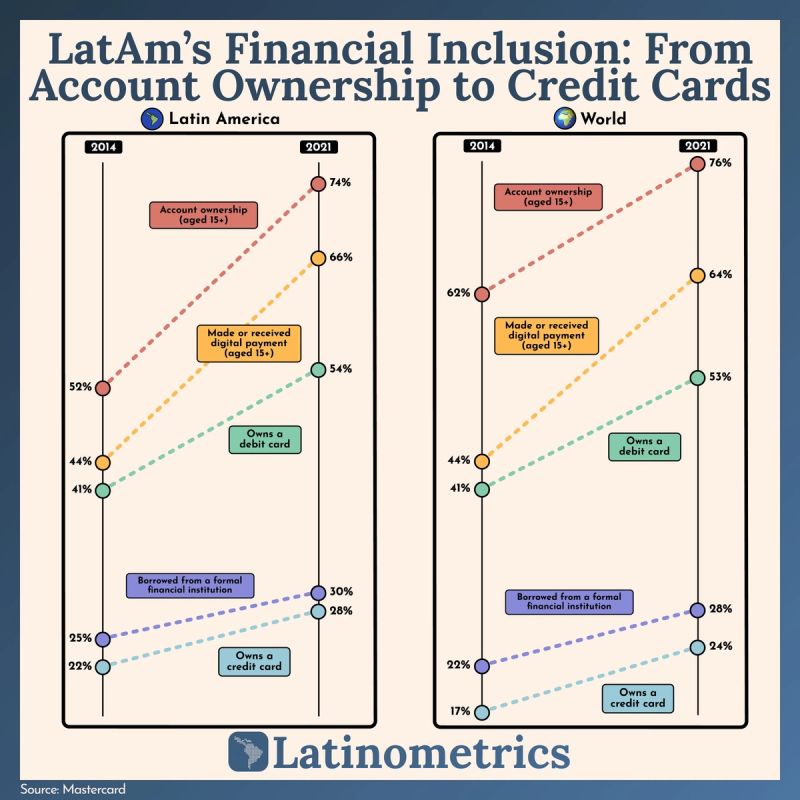
We can examine financial inclusion in Latin America and tell two different stories. On the one hand, the percentage of people in our region who now own a bank account has made impressive progress — from 52% in 2014 to 74% seven years later.
This monumental growth, representing hundreds of millions of Latin Americans becoming part of the formal banking system, partly explains why so many startups and Venture Capital firms have seen (and continue to see) tremendous potential in this sector. However, if we look at credit card ownership, the percentage has barely budged in the same period — from 22% to 28%.
The next challenge for financial maturity in LatAm is convincing us that we could benefit from using credit cards or at least debit cards (which are owned much more widely, at 54% of the population). The region has yet to get comfortable with the idea of borrowing in general, with only about 30% of the eligible people doing so from a bank or other institution. This opportunity is precisely what Fintechs and established banks are racing to solve. Most notably, Nubank recently declared its 80M Brazilian customer milestone, surpassing the giant Banco du Brasil.
What's a realistic threshold for Latin America to reach regarding credit card ownership? Well, in the US, the percentage is 82% of adults own one. But such widespread use doesn't come without burden — about half or more US adults have credit card debt. In other words, they have credit card balances that can easily cost them 20%+ in annual interest rates and enter into debt spirals that are hard to get out of. As debt makes its way into our region, it's crucial that our population is well-informed about how it can benefit them but also its risks.


