
LatAm Shows Strong Support For Regional Integration
Over 70% of Latin Americans support regional integration, even out-pacing EU countries like France and Italy.

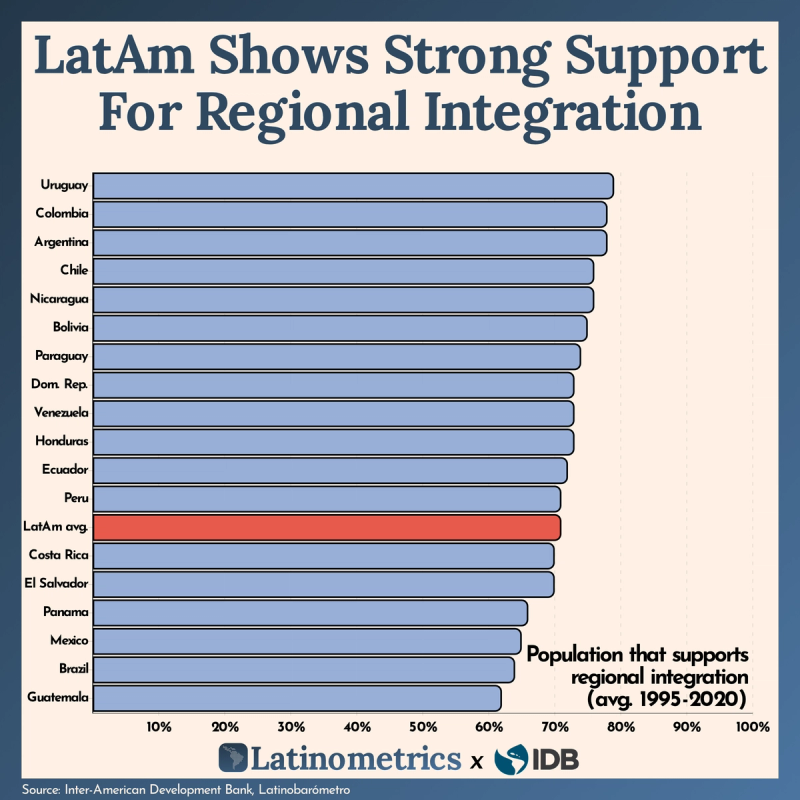
If the last 30 years have brought Latin America anything, it’s regional integration. There are over a dozen different organizations serving political or economic integration in Latin America, nearly as many as there are countries in the region. And judging by a new report from the Institute for the Integration of Latin America and the Caribbean (INTAL), part of the Integration and Trade Sector of the Inter-American Development Bank (IDB), integration support is best exemplified by asking Latin Americans themselves.
On average, over 70% of Latin American citizens support regional integration, whether that takes the form of shared passports, common markets, free trade areas, or political unions. This may surprise you, especially given that countries with far more integration with their neighbors—say, France or Italy, which are both member states of the ambitious European Union—generally closer to just 50% support. While these EU countries may have greater intraregional trade, Latin America has advantages, not least of which is common language. After all, 2 out of 3 citizens in the region speak Spanish, and Brazilian Portuguese is a whole lot closer to Spanish than Dutch is to Bulgarian.
Uruguayans lead the region, with 4 in 5 citizens of the small developed country on board for greater regional integration. Uruguay’s capital serves as the headquarters for both Mercosur and the Latin American Integration Association, and the country sees the value in the far larger markets of its neighbors when seeking to expand its trade opportunities overseas. The 2nd-most integration-friendly country is Colombia, which maintains close economic ties with its partners in both the Andean Community and the high-growth Pacific Alliance, with Argentina rounding out the top 3.
But even the countries with the least amount of support still demonstrate a region hungry for integration. Guatemalans seem the most skeptical of the idea; still, over 60% of citizens support integration despite setbacks in both the Central American Integration System and Central American Parliament. Apprehension of regional governance there could well be simply apprehension of existing governance.
Meanwhile, Brazil and Mexico also seem a bit more integration-adverse than their neighbors at roughly 64-65% in favor. Here, Latin America’s giants may see less direct gains than their smaller neighbors, as the two countries must play larger roles by nature in any integration efforts in the region. The roughly 35% of both countries that does not support regional integration is likely interested in focusing on fixing national problems first.
While the mosaic of regional organizations encompassing Latin America is dynamic and varied, this INTAL report demonstrates beyond a doubt that local citizens want greater integration with their neighbors. If governments wish to build upon this goodwill, they should aim to consolidate their goals and ambitions, and leave ideology at the door.
After all, transnational challenges require transnational solutions. And Latin Americans are clearly well aware.


