
Latin America a Rich Source of STEM Talent
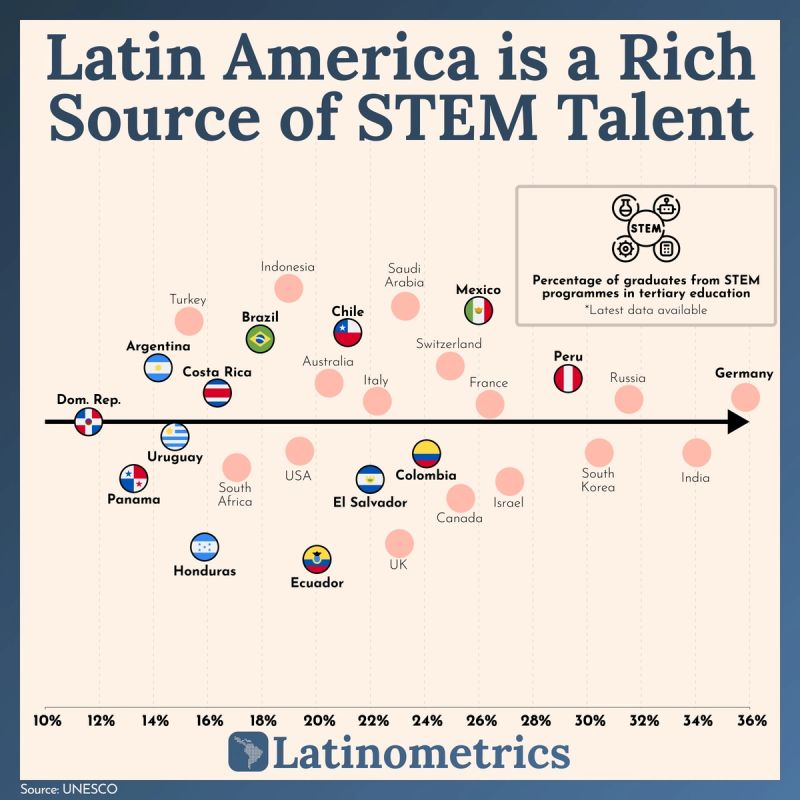
Peru leads Latin America with nearly 30% of graduates in STEM, rivaling South Korea's highly skilled workforce.


Let’s say you run a large biotech firm in San Diego and you’re looking to expand your team. Where might you look for early-career professionals hoping to cut their teeth with some entry-level work experience? Japan? Taiwan? The Netherlands?
Try closer to home: Latin America has some of the brightest college graduates in the world. The number of students attending university has exploded in the last half-century. Today the region is seeing an increasingly educated workforce as a result—including in the fields of science, technology, engineering, and mathematics (or STEM).
Based on the most recent figures from UNESCO, many Latin American countries are seeing growing numbers of students head down the STEM path. Peru leads the pack, with just shy of 30% of graduates pursuing a STEM degree. This puts the Andean country of 33M people within spitting distance of South Korea, a country that for decades has been known for its highly-educated and highly-skilled workforce.
Following Peru, we’ve got Mexico, with roughly a quarter of their college students graduating with a STEM degree, placing Latin America’s industrial powerhouse somewhere between the highly-developed countries of Switzerland and Israel. Falling in a range of 20-24%, Colombia, El Salvador, Chile, and Ecuador all see higher percentages than the United States, which might explain why so many engineers and scientists from these countries work for US-based firms following graduation.
Of course, we champion Latin Americans getting degrees and upgrading to higher-skilled work with better pay. For too long, the world’s biggest companies have looked to Northern Europe and East Asia for their high-skilled talent pools, and we’d like to see Latin Americans be considered for these jobs. Ideally, companies won’t just recruit the best of the best to bring to Boston or Vienna but also set up sites to grow their business within the region, preventing local brain drain in the process.
At the same time, STEM shouldn't become the path for all university students just due to employment prospects—after all, Latin America stills needs its lawyers, economists, writers, artists, teachers, and entrepreneurs, especially if those are their callings. But we applaud local engineers making ever-bigger splashes across the region and beyond, and we look forward to Dominican or Argentine scientists ushering in a brighter tomorrow.


