
Most of LatAm roduces 50%+ renewable energy
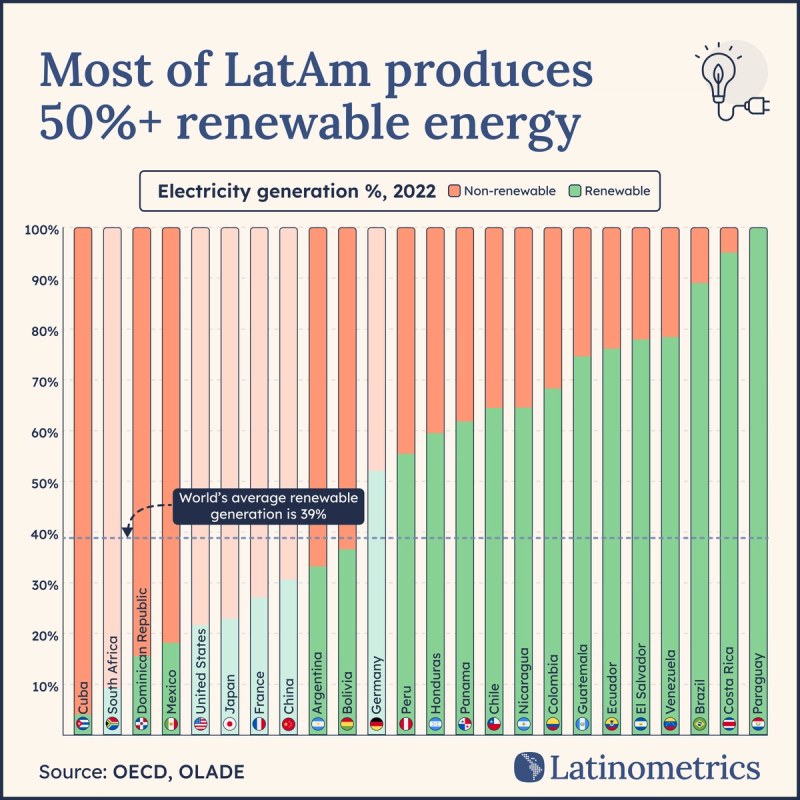
Brazil's 90% green grid and Paraguay's hydro-power leadership show LatAm outpaces the US and Europe.

We live in exciting times.
With all of the negative news swirling around the development world, it’s easy to lose sight of the vast amounts of progress which have been made on a number of fronts.
For example, a decade on from the negotiations of the Paris Climate Accord, there remains much work to do (and agreement on whether anything needs to be done) in powering the green transition and decarbonizing the global economy. However, one estimate states that over a third – 35%, to be exact – of the world’s electricity generation will come from renewable sources this year.
That’s a big jump from where we stood a quarter-century ago. And unsurprisingly, Latin America is helping to lead the way.
Led by hydroelectric champions like Paraguay and Costa Rica, the region is generating more and more of its electricity from renewable means. Brazil, by far the largest country in Latin America, has a power grid that is 90% built off green sources, demonstrating that a massive developing economy with both industrial and agricultural might can still lead in the energy transition.
Meanwhile, it is worth considering the context: most of Latin America falls ahead of not only the United States by this metric, but even ecological leaders like France and Germany. While some outliers exist, including most notably Mexico, the fact that most regional countries generate over half of their power through renewable sources is a very good sign.
Now, when we say renewable sources, what exactly do we mean? To illustrate, let’s break down Latin America’s energy matrix, putting the green contenders against their fossil-fuel counterparts.
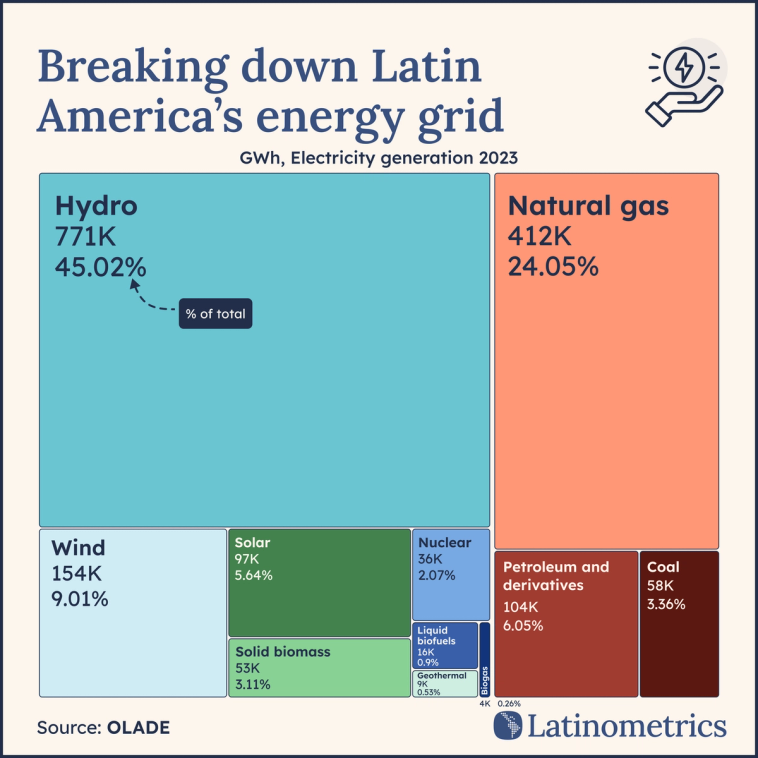
Hydroelectric energy is the clear leader, providing nearly half of the region’s total electricity production in 2023.
This clean source has been the secret for energy self-sufficiency for countries like Paraguay, which shares two massive hydroelectric power plants – the Itaipu and Yacyretá dams – on its borders with Brazil and Argentina, respectively. These binational hydroelectric dams, one of which is the world’s third-largest, represent not only the future of energy generation, but the power of transnational policymaking to reach this future.
No doubt, fossil fuels continue to play a substantial role in the regional power grid. Argentina’s large Vaca Muerte shale gas fields, and Brazilian oil exploration in the Amazon, demonstrate the continued presence of traditional energy sources in Latin America.
But as a whole, the region has made concentrated efforts towards green diversification, whether through Mexico’s love affair with solar power or the wind farms all along Chile’s beautiful coastline.


