
Latin American militaries are bigger than you think
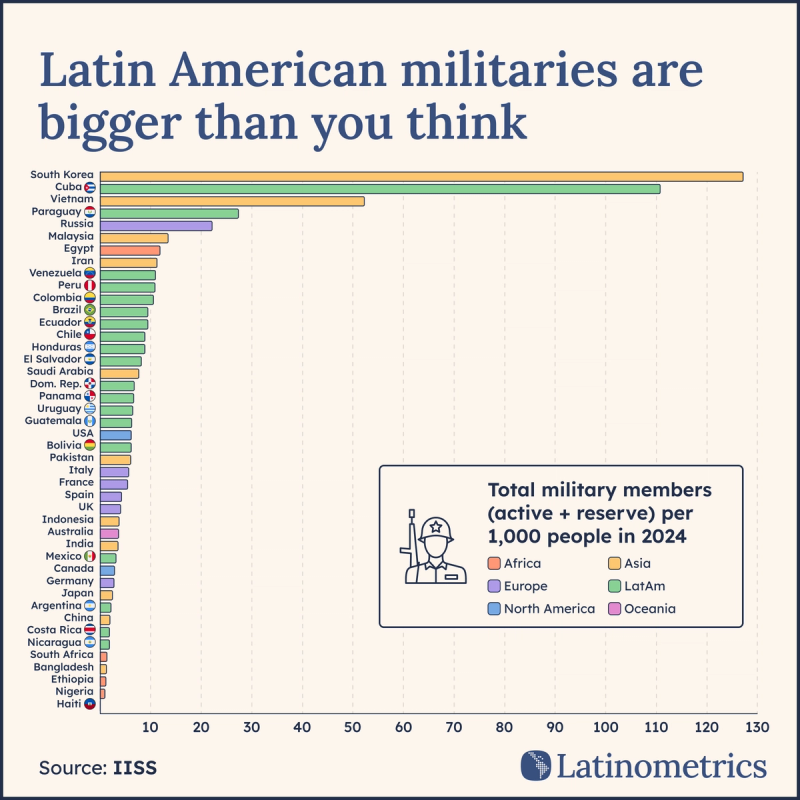
Latin American militaries are larger than you think, with Cuba's force bigger than Russia's relative to population.


Latin America is far from perfect. From inequality to crime to sluggish productivity, the region’s got its fair share of challenges.
But in a time of wars in Ukraine and the Middle East, in a time of military tensions between China and Taiwan or Armenia and Azerbaijan, the lack of interstate conflict in Latin America is certainly commendable.
Diplomatic spats, like Ecuador versus Mexico or Argentina versus Colombia or basically everybody versus Venezuela? Sure, that’s an ordinary Tuesday. But regional countries haven’t actually fought a war over, say, territorial sovereignty since the Cenepa War fought between Ecuador and Peru in early 1995. That’s nearly 30 years ago now.
Sure, there are countries like Costa Rica, which abolished its standing army in 1948 and today just maintains a smaller military-like security force. But looking to countries in the rest of the region, we see some relatively large armed forces. Cuba, for example, has over a tenth of its population affiliated in some way with the military, despite not being at war.
And if you think “Well, look at Cold War history to understand that” – what about Paraguay? Why is there a bigger share of Paraguayans, which haven’t fought a war since the 1930s, serving than Russians who are currently fighting their neighbor?
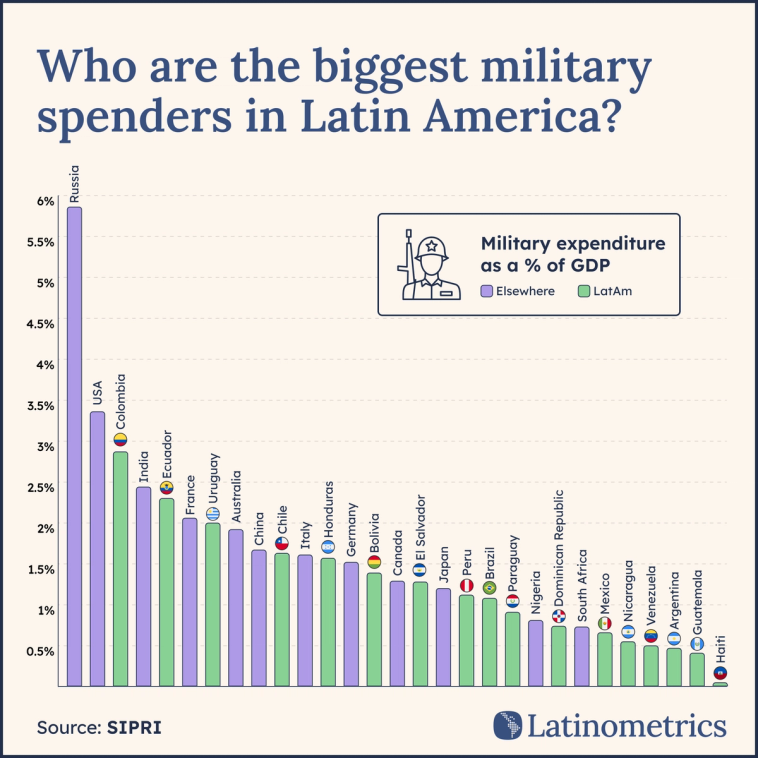
The countries with the highest defense spending relative to GDP are those with ongoing security concerns (with the exception of Haiti, which simply has no functioning government to speak of). Ecuador’s military, with a yearly budget of $2.4B, is currently waging war on the local gangs and international criminal outfits which have overrun the country. Meanwhile, neighboring Colombia has long spent high sums on its own $10B per year military, which has a legacy of over 60 years of conflict with local armed groups and drug cartels. To this effect, Colombia’s army has also long enjoyed substantial military aid from the US.
There’s of course a lot of baggage associated with defense spending. The next three countries on our above chart – Uruguay ($1.4B), Chile ($5.7B), and Honduras ($480M) – all have bloody histories with their own armed forces.
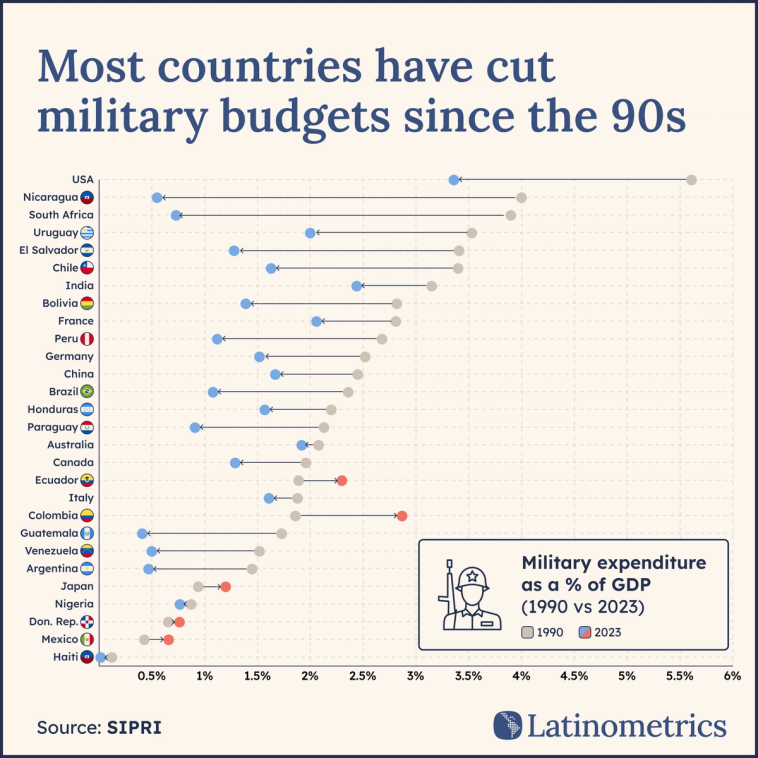
All of this to say that the military is not a completely benign force. Local leaders have increasingly expanded the role of their countries’ militaries, ranging from airport management in Mexico to squashing dissent in Venezuela.
We should of course applaud the lack of warfare in the Americas relative to other continents. We just hope to see Latin America transition to a security situation where defense spending can be reallocated towards fixing some of the region’s other problems.


