🎢 VC Reset
Mercado Libre and Nubank are worth 170 billion combined. Neither founder was chasing an exit.
We create custom data stories for global companies that want to reach Latin America's business community — the same kind of content you're about to read below, but built around your industry expertise and (if it fits our criteria) distributed to our 300K+ audience. If that sounds interesting, let's talk to see if we're a good fit. [Schedule 15 minutes →]
If you were online during 2020 and 2021 (and who wasn't?), you know tech startups took center stage across Latin America. Whether you were in Mexico City, Montevideo, or Medellin, it felt like every other day a new entrepreneur got funded to fix something about your country's financial system, usually by porting a playbook from the US or Europe.
Five years later, a lot has changed about the venture capital world. Just being a fintech doesn't cut it anymore. Or a healthtech. Or any of the "techs" for that matter. Investors care about one thing in your pitch: AI.
In fact, nearly every VC deal in Latin America in 2025 had some AI angle, according to Latitud. Mexico's Kapital became the region's first AI unicorn (worth $1B+) in September.
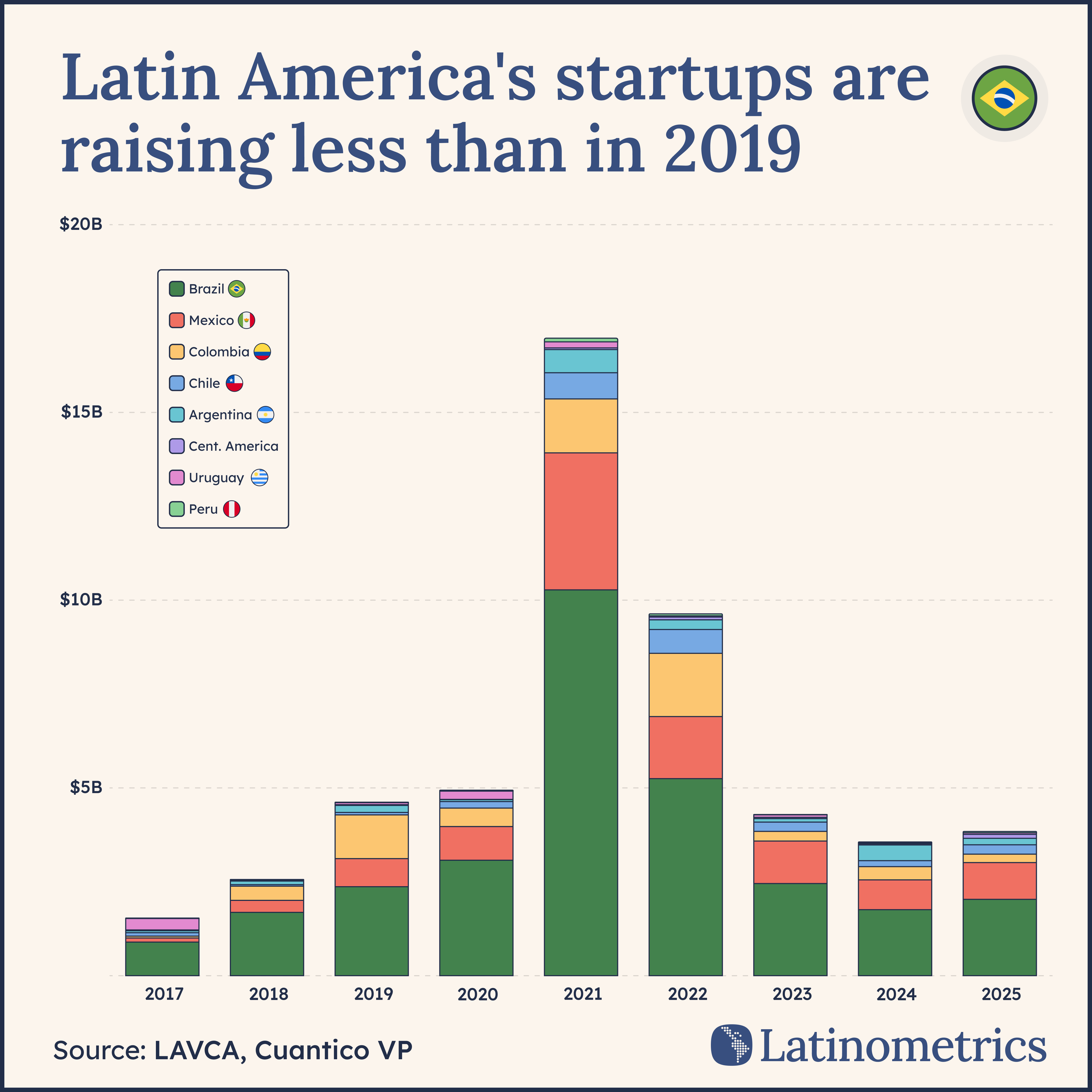
Investors have become a lot more picky. Last year, founders got the lowest amount of funding checks written since 2017, but they invested 14% more dollars overall than in 2024, according to Cuantico VP.
Some things never change though, and Brazil attracting billions in funding is one of them.
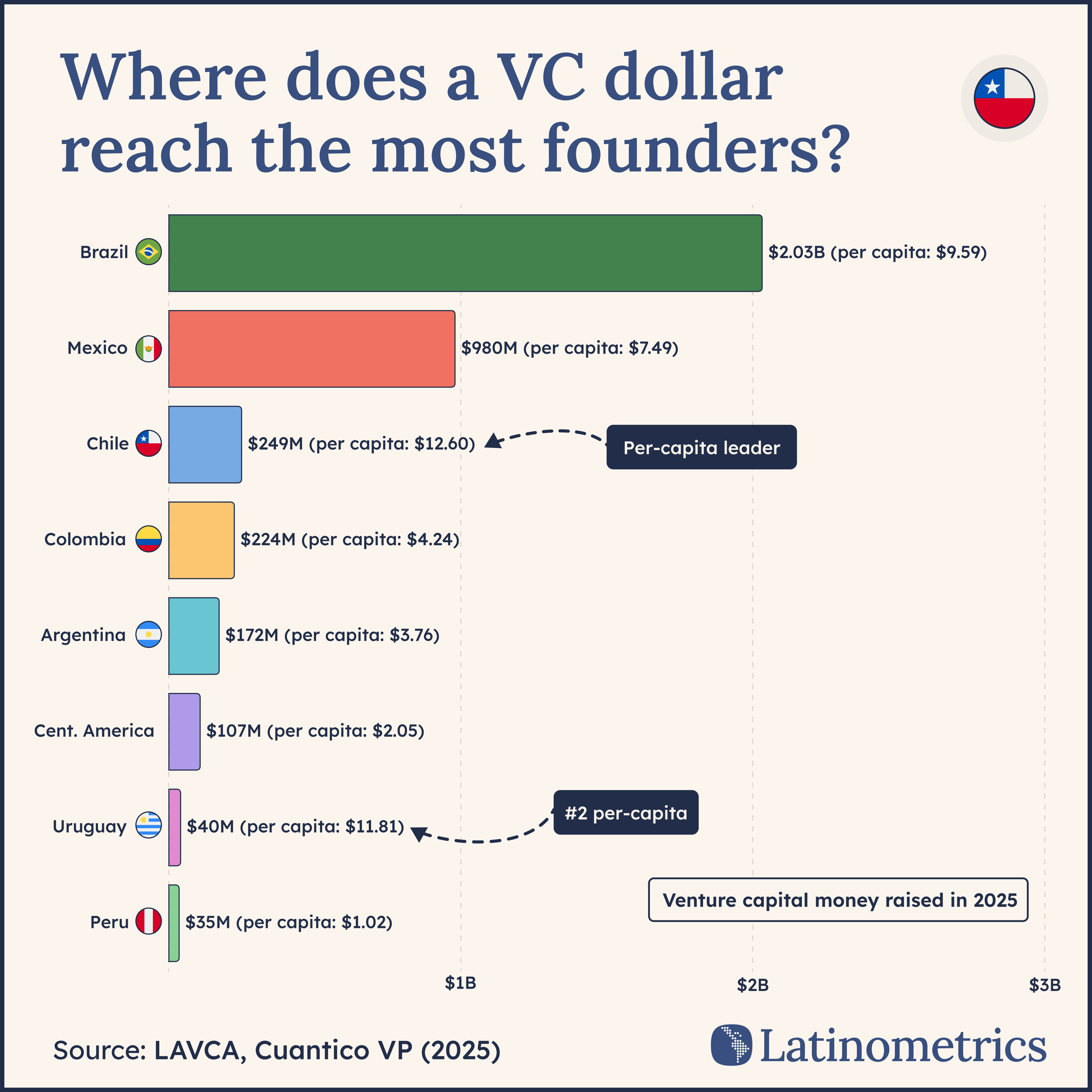
But OK, Brazil is the 7th most populated country in the world, so it attracting the most money is not exactly breaking news. Per capita, the story flips. Chile and Uruguay lead the region with $12.60 and $11.81 per person respectively, more than Brazil's $9.59 and nearly double Mexico's $7.49.
Uruguay's jump isn't a statistical accident. Montevideo has climbed from Latin America's 22nd-busiest startup city to its 7th in just four years, the fastest-rising tech hub in the region, per LAVCA. The ecosystem was anchored by dLocal (the Uruguayan payments company that went public on Nasdaq in 2021) and has been carried by crypto-friendly regulation and a bilingual engineering pool that exports talent across the region.
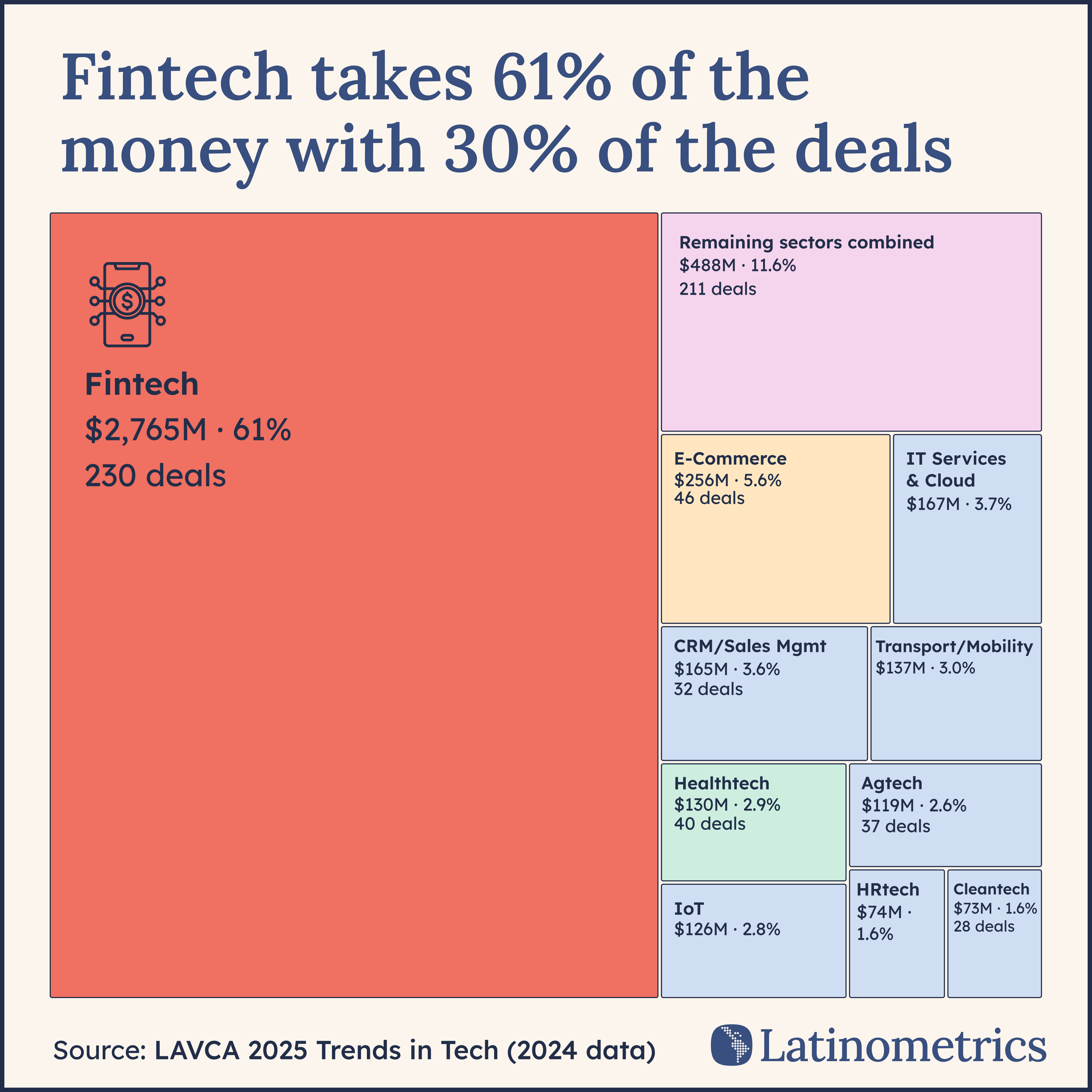
Aside from financial access, what other problems are startup founders solving with AI? After fintech, e-commerce attracted the most capital and deals. Online shopping remains a huge untapped industry in the region. Around 400 million Latin American adults are online, but only 135 million (roughly 1 in 3) actually buy there. Startups like Mexico's Yavendió, which raised a pre-seed round in February from Magma Partners, are tackling the gap with AI agents that run entire e-commerce flows (from product recommendations to payments) directly on WhatsApp, where most Latin Americans already do their chatting.
Healthtech has also been a rising star. As birth rates fall and Latin Americans live longer, founders are racing to serve an older population. Life expectancy in the region now sits between 75 and 81 years. Chile (81.2) is on par with the UK, while Brazil (75.8) and Mexico (75.1) are closing in on the US (78.4). Countries like Bolivia and Guatemala still have an 11-to-15-year gap to the world's longest-lived nations. Startups like Brazil's Sanii, an AI platform matching families with caregivers, nurses, and physiotherapists so elderly parents can age safely at home, are quietly building the infrastructure for that shift.
Still, fintech hoovers up most of the money. One vertical writes bigger checks than every other sector combined; e-commerce, healthtech, SaaS, mobility, and agtech are left splitting the rest.
And the macro story is harder to spin. Even with 2025's bump, Latin American startups are raising less capital than they did in 2019. That's before the Nubank IPO, before the 2021 boom, before Milei, before everything.
There's another layer under that chart. Most of the money Latin American startups raise doesn't come from Latin America. In Mexico alone, about 92% of 2025 venture capital came from foreign investors. The region does have world-class local firms betting on its own talent. Kaszek (co-founded by Hernán Kazah, Marcos Galperin's former partner at Mercado Libre), monashees, Canary, NAZCA, and Atlantico are all in. But their combined firepower is dwarfed by the a16z's and SoftBanks writing the biggest checks. Why would you expect outsiders to bet on you if you won't bet on yourself first?
But don't let the macro headlines distract from what's happening underneath. Across the region, entrepreneurs are still taking real bets on real problems: a caregiver-matching platform for aging Brazilian parents, a WhatsApp AI agent helping small Mexican brands sell for the first time, healthtech startups expanding access that public systems can't keep up with.
Venture has never been an industry for everyone, and most startups don't make it. The 2021 script told every founder the only path ran through Series A, B, C, and a Nasdaq bell. Five years in, the ones writing the next chapter are often the ones who stopped chasing the exit and started building companies worth staying in.
Just ask Marcos Galperin or David Vélez. The founders of Mercado Libre and Nubank built startups into the only two tech companies in Latin America's top 10 by market cap, worth roughly $170B combined. Neither founded with an exit in mind. Galperin was blunt with a class of Stanford students.
"If your motivation is just to do an initial public offering or have an exit or sell your company, it's not enough."
On Miguel Armaza's podcast (Miguel is a friend of Latinometrics), Vélez went a step further.
"We did Nubank because we wanted to build, we wanted to problem solve, we wanted to create an impact. And it was the sheer joy of creation and creating impact."
Their brains work differently, and that's the invitation hidden inside every one of Latin America's still-unsolved markets.