
Who's Latin America's most oil-dependent economy?
Latin America has cut oil consumption per dollar of GDP nearly in half since 1973.

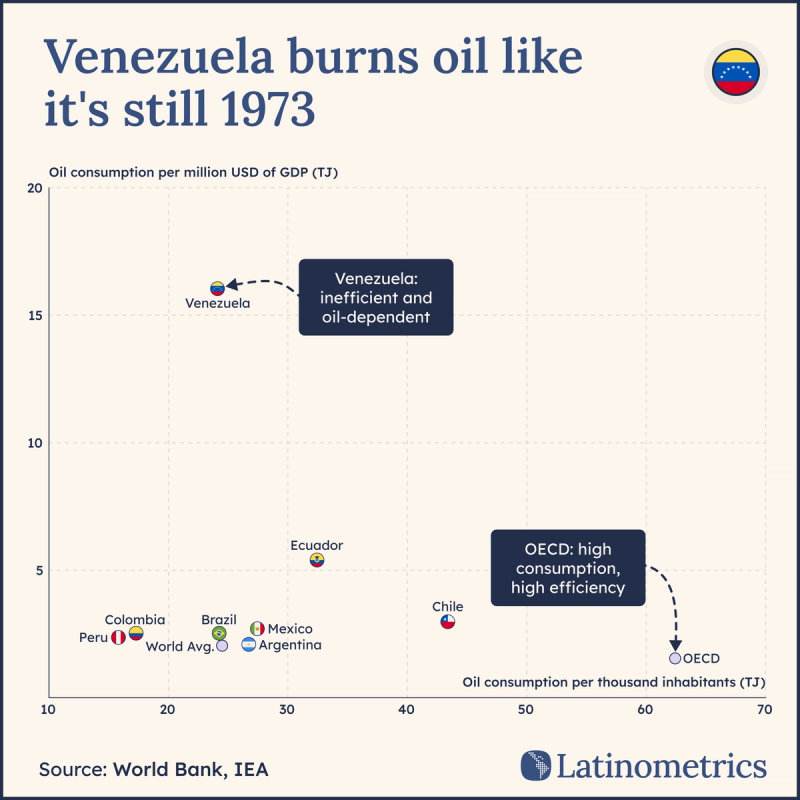
Last month, the IMF cut its 2026 growth forecast to 3.1% and bumped inflation to 4.4% — and that's the optimistic case, assuming the Iran War wraps up quickly. Oil has been the bedrock of the modern global economy for much of the last century. Unfortunately for the rest of us, this central role has meant that anytime oil markets fluctuate wildly, the global economy is going to take a beating.
How much of a beating? In the 1970s, an oil embargo ended three decades of economic expansion and plunged the world into crisis. Part of the 2020 stock market crash came from the Russia–Saudi Arabia oil price war.
But the world has gotten better at absorbing the punch. How do we know? Oil intensity: think of it as miles per gallon, but for entire economies. It tells us how much crude it takes to produce $1,000 of stuff. In 1973, more than a barrel; today, less than half. Latin America has followed the same curve, with one very loud exception.
Unlike its peers, Venezuela's outdated, terrible infrastructure is living in the 1970s and not modern times. Oil consumption per GDP in the country is roughly triple that of its Latin American neighbors. Set it next to the OECD and the gap looks less like a development gradient and more like a time machine. For decades, a liter of gasoline in Caracas cost less than a sip of bottled water.
Having cheap gasoline during boom years led to the country developing wasteful consumption, often in old and inefficient vehicles, with side effects like high smuggling rates. This continued even as the country collapsed in the 2010s.
Meanwhile, every other economy on this chart has spent fifty years getting more growth out of less oil. Venezuela is doing the opposite, burning more oil per dollar than it did during El Chavo del 8's original run.
As Latin American countries develop, especially oil giants like Brazil or Colombia, they'll face a fork. Currently their oil intensity is lower than the OECD's owing to weaker industry and lower tech levels. The question is which direction they move from here.
Brazil seems to have picked a side. Roughly 27% of every liter of gasoline at the pump is now ethanol (a legacy of the 1975 Proálcool program), and flex-fuel cars make up the bulk of new sales. Ecuador? It still loses an estimated $100M a year to fuel theft alone, a sign its subsidy-and-pipeline model still looks more like Caracas than Brasília.
A petrostate isn't built in a day. Neither is the discipline to avoid becoming one.


