
Private sector vs Pemex gas stations in Mexico
Pemex, once a $100B revenue giant, now faces debt equivalent to 10% of Mexico's GDP.

Can Mexico's new leader save Pemex from collapse?
Drive down a street in Mexico and you’ll see one logo again and again and again.
Petróleos Mexicanos, more commonly known by its official portmanteau Pemex, is Mexico’s state-owned oil company and one of Latin America’s largest and most well-known enterprises. It was created in 1938 upon the complete nationalization of Mexico’s oil sector by President Lázaro Cárdenas, the most popular Mexican leader of the twentieth century.
Cardenas initially appropriated the local oil holdings of foreign multinationals owing to his close relationship with his country’s labor movement. But the result is that he created a behemoth, a sprawling Fortune 500 firm which in good years has powered the country’s growth with taxes on revenue approximating $100B in 2023.
We are not in good years.
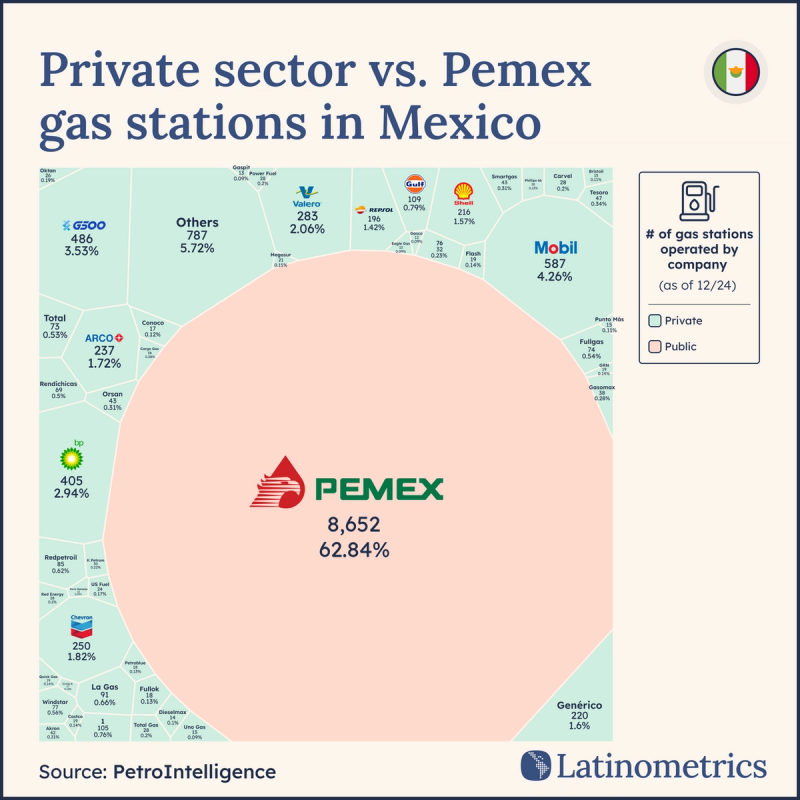
Despite its nearly 9K gas stations making up almost two-thirds of the country’s total, Pemex is currently in the midst of a transformational struggle. Mexico’s energy giant has of late been called the world’s most indebted oil company, owing debts equivalent to nearly a tenth of Mexico’s total gross domestic product.
Part of the reason is that Pemex, like its notorious Brazilian peer Petrobras, has long been at the mercy of successive national governments interested in milking its revenues to pad state coffers. The company has thus been unable to properly invest in diversifying its revenue streams, and politics have often outweighed firm rationality.
Like Petrobras or the Venezuelan equivalent, Petróleos de Venezuela (PDVSA), Pemex’s close oversight by the government has made it susceptible to political whims and often courted scandals. But it also means the country’s government has a vested interest in turning things around.
In November, for example, newly-arrived President Claudia Sheinbaum announced that her government would be simplifying and consolidating the existing taxes on Pemex. By levying lower duties and allowing the firm to keep a bit more of its profits, the hope is that Mexico’s oil giant can obtain some breathing room by paying down some of its debts, reinvesting competently, and restoring some of its glory from the last century.
Will Sheinbaum be able to succeed where her last two predecessors have failed? Let’s all hope—for Mexico’s sake.


