
The Peruvian Sol is LatAm's most stable currency
Peru's politics resemble Argentina's, but its currency is treated like Chile's — here's how decades of policy discipline pulled that off.


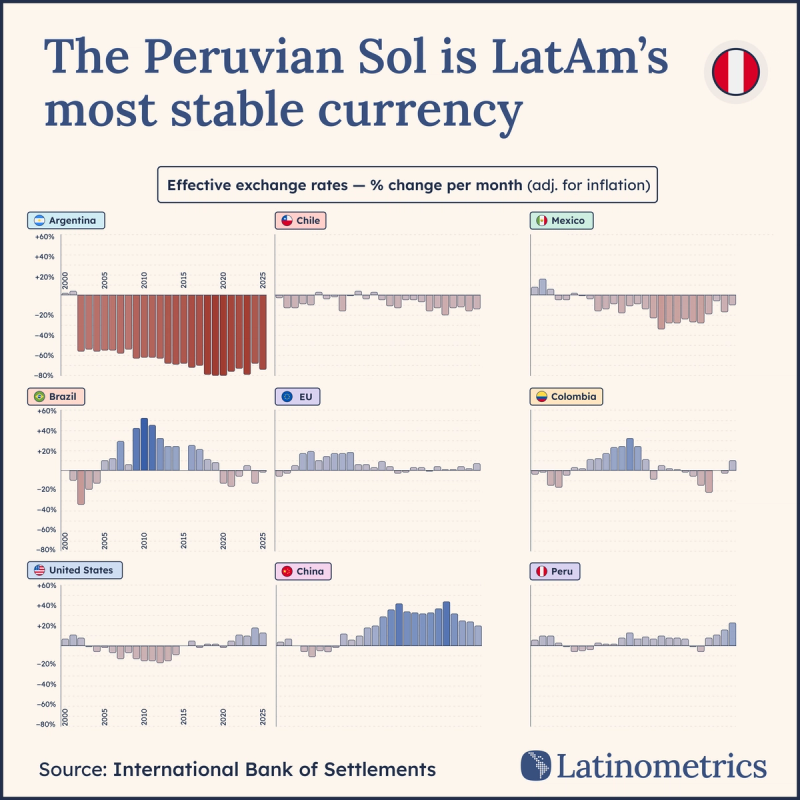
When it comes to emerging markets, Peru is what you might call a global anomaly.
One industry definition of emerging markets is “those countries where politics matters at least as much as economics for market outcomes.” Think of how investors punish Brazil for its stubborn fiscal deficits, or how the Argentine peso can see wild shifts in value based on even provincial elections.
But then there’s Peru, the country which famously has had over ten presidents in the last decade, which saw mass protests in 2022–2024 and where recent elections were a complete mess where no candidate reached even 20% of the first-round vote. By all accounts, Peru’s market outcomes should be a disaster.
And yet Peruvian inflation at around 2.5% remains within central bank targets and its sovereign bond spread over US treasuries is among the region’s lowest. Peru’s politics may resemble Argentina’s, but it’s treated by foreign investors like it’s Chile—reflecting even in its significantly less volatile currency, the sol.
The contrast between Peru’s currency and some of its South American peers may scratch heads, but it can be explained in part by a few factors.
For one, the many Peruvian presidents of late have largely avoided making the same unforced error, challenging the central bank, which has proven so popular with populist leaders ranging from Lula da Silva to Donald Trump. The Central Reserve Bank of Peru has been headed by the same man, Julio Velarde, for 20 years.
Velarde is an Ivy League-educated economist who holds a PhD and previously carried out advanced economic study in Germany. He’s been named among the world’s best central bankers on multiple occasions, and was left in his position throughout multiple consecutive election seasons.
Markets like this sort of stability, this kind of steady hand. They also appreciate Peru’s low debt-to-GDP ratio of roughly 30-35%, among the lowest in Latin America, as well as its impressive $95B in foreign reserves. It doesn’t hurt either that the country’s exports grew by 21% last year to reach a record $90B, with those all-important mining exports in particular jumping by 25% over the previous year.
So, yes, Peru is an emerging market, one where the politics can only be described as rough and the social fabric certainly under strain. But decades of smart fiscal and monetary policy have bought the country some more market leeway than most Latin American leaders today could hope for. One needs only check in on the Peruvian sol for the proof. But Velarde, now 73, won’t run the central bank forever — and whoever inherits his desk will inherit the only thing standing between Peru’s politics and its markets.


