
Latin American prisons are highly overcrowded
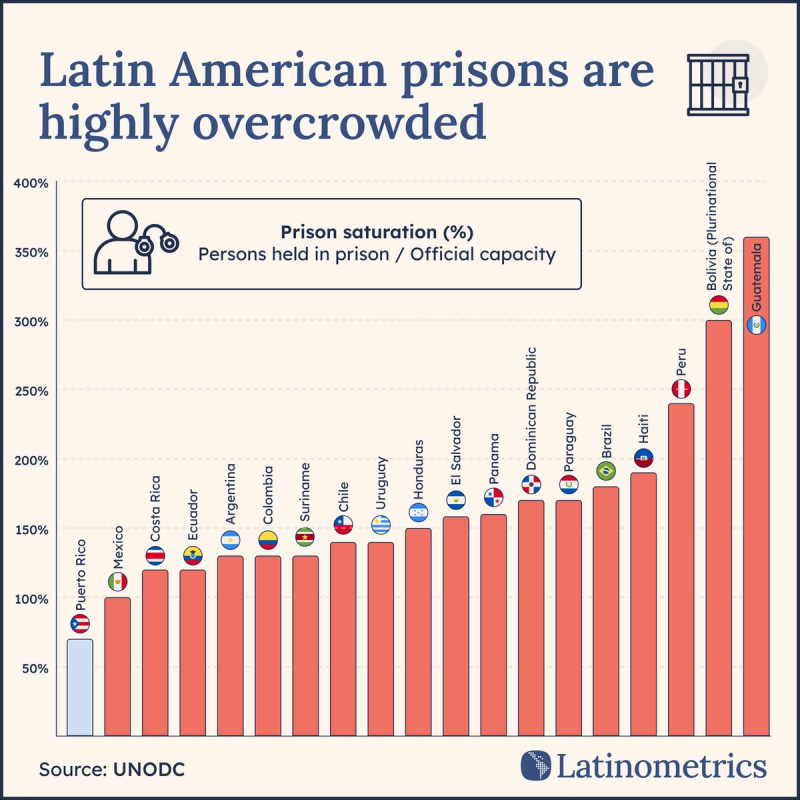
Almost all prisons in Latin America are over capacity. In many countries prisoners have to wait a long time to receive sentences.

“The homegrowns are next, the homegrowns. You've got to build about five more places.”
With these words, President Donald Trump of the US stirred outrage and worry across his country. In conversation with President Nayib Bukele of El Salvador, which in recent weeks had received hundreds of deported Latin American migrants, Trump once more floated the possibility of incarcerating even US citizens in the prisons of the small Central American country—in the process breaking with centuries of constitutional and legal precedent.
But as Bukele himself reminded Trump during their press briefing, El Salvador is a small country. Formerly considered the “murder capital of the world,” a years-long state of emergency and crackdown on gangs across the country has led to nearly two percent of the national population being imprisoned. This is by far the world’s highest incarceration rate.
In fact, issues with the carceral system pervade Latin America. The region has higher incarceration levels than most of the world, yet is not nearly as safe as would be expected—something unfortunately seen in everything from Ecuador to Mexico to this week’s attempted assassination of Colombian presidential hopeful Miguel Uribe Turbay in Bogota.
In practically every country of Latin America, prisons are overcrowded, dangerous, and in need of improvements. Mexico is a regional leader here, “merely” sitting at full capacity, while on the other end of the spectrum Guatemala and Bolivia are overburdened with prison populations exceeding over 300% capacity. Puerto Rico remains a rare exception.
Part of the story is an explosion in incarceration rates: per the Inter-American Development Bank, the total regional population grew by 10% between 2010 and 2020, while the prison population nearly doubled.
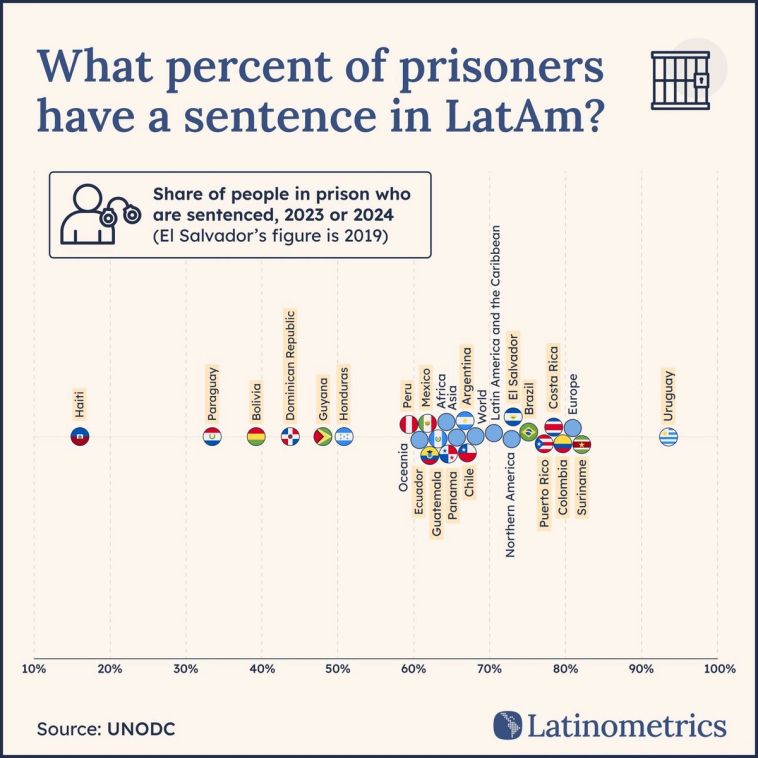
And the uptick in mano dura policies since the late 2010s has only deepened the problem. Rising violence means politicians resort to tossing more people in jail faster—often without due process or formal sentencing. Once in these underfunded, undermaintained jails, powerful gangs easily recruit new soldiers, strengthening their positions and contributing to the cycles of violence.
While some countries, like Uruguay, maintain high sentencing rates of at least 90%, other regional peers like Bolivia, Paraguay, and (of course) El Salvador show far less discretion. And this is to say nothing of a disaster like Haiti, where overrun prisons and open gang warfare have meant nearly half a decade of pure chaos.
What’s the solution to reducing Latin America’s prison problem? Is it merely a question of economic growth? Is a more holistic approach to justice needed? Or should we expect to see local governments merely deporting “homegrown” criminals elsewhere?


