
Latin America is replacing its religion
Something new is stirring in the spiritual heart of Central America.

Just over a month ago, the first Latin American pope – Pope Francis, from Argentina – passed away on Easter Monday. His death began the process to find the new head of the Vatican, the sovereign institution at the head of the Catholic Church.
His replacement, Pope Leo XIV, is not only the first pope to come from the United States (he’s a White Sox fan from Chicago), but by virtue of his 2015 naturalization the first pope to come from Peru as well. That was obviously cause for excitement for Peruvian Catholics, which make up roughly three-quarters of their country’s population.
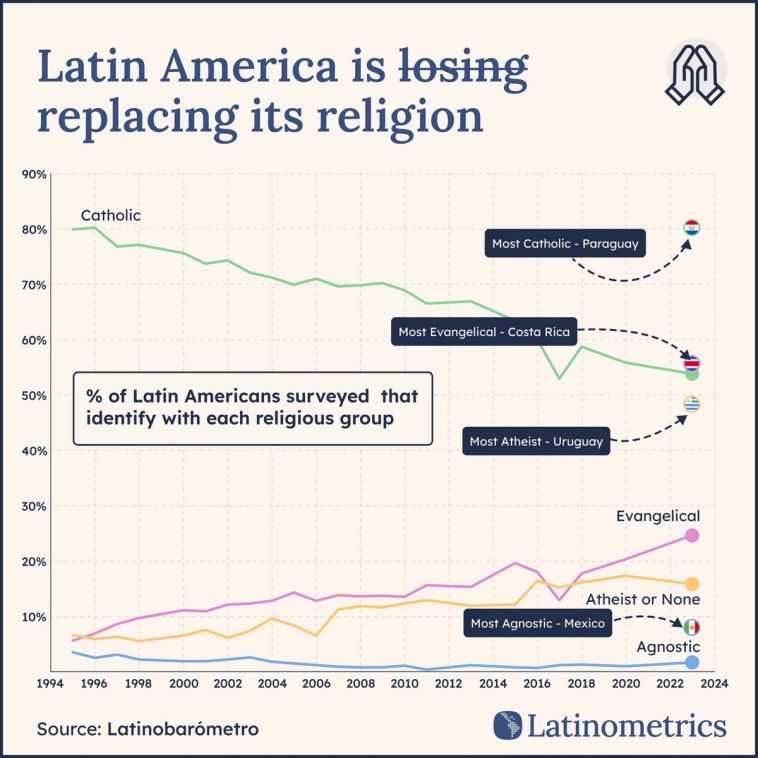
While 80% of surveyed Latin Americans were Catholics 30 years ago, that number has since fallen to just over half. Catholicism, brought over by Spanish and Portuguese colonists as well as later immigrants from countries like Italy and Croatia, has seen its regional dominance erode in the face of growing numbers of Evangelicals.
While in 1995 only about one in twenty Latin Americans were Evangelical, today that figure has risen to roughly 25%. Evangelicals have become a major political force in countries like Brazil, where their growing numbers have translated to an increasingly conservative national legislature.
Central America is without a doubt the Evangelical stronghold, as the faith makes up at least a third of the population of each country in the subregion. A whopping 56% of Costa Ricans, for example, are Evangelical—and the rise has been dramatic, growing from just 14% less than a decade ago.
What does the religious mix look like for all countries?
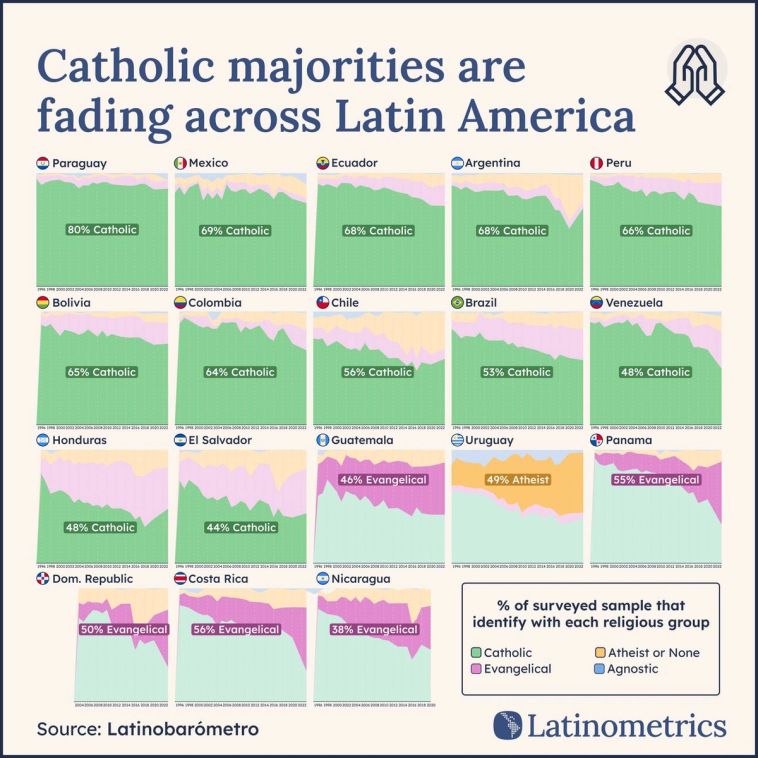
Meanwhile, Catholicism remains hegemonic in countries like Ecuador, Mexico, and Peru. The most Catholic country by proportion is Paraguay, where over 80% of citizens are Catholic.
Of course, not all Latin Americans are Christian or, indeed, religious at all. While there are small numbers of other faiths sprinkled throughout the region, such as the Jews of the Mexico City barrio of Polanco or the Muslims in Foz do Iguaçu, Brazil, many Latinos are also merely irreligious.
Half of Uruguay’s population is atheist, in fact, making it by far a regional outlier. And one in ten Mexicans is either agnostic or spiritual, a statistic which may surprise given the country’s religious reputation.
Should we expect to see more Latin Americans turn away from religion in the years to come? Or will the Evangelical wave put a stop to this shift?


