
Should Argentina Dellarize "Yuanize"? Its Trade With China is Much Larger Than With the US
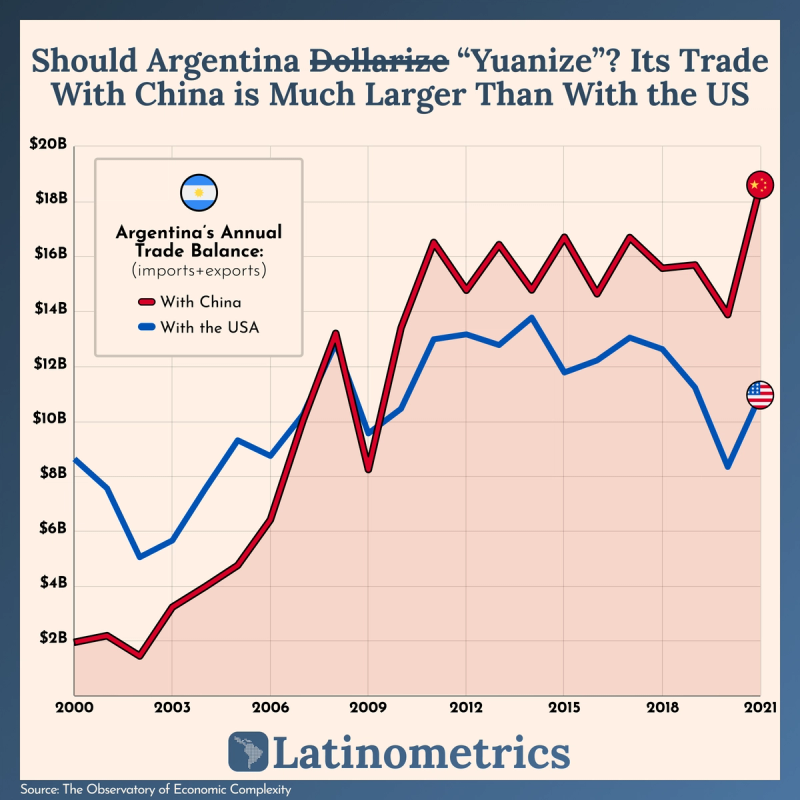
Milei wants to dollarize, but China is Argentina's top trade partner after Brazil.


If there was one winner from last month’s Argentinean blanket primaries, it was without a doubt Javier Milei, the ultraconservative candidate heading the far-right political coalition La Libertad Avanza.
Milei, a libertarian economist and politician most known for his anti-corruption message and...eccentric public image, has made the abolishment of Argentina’s central bank – and the dollarization of the economy – his flagship policy proposal.
By abandoning the peso and adopting the dollar, Milei hopes to at last escape the cycle of hyperinflation and economic crisis which has plagued his country for decades. Though this idea has been thoroughly criticized as unreasonable if not outright impossible, there is regional precedent: both Ecuador and Panama use the dollar as their main currencies.
However, when discussing Argentina’s account balance it’s not the US that we should discuss, but rather China. Since 2010, two-way trade with Beijing has surpassed that with Washington, particularly powered by commodity exports, with China today the 2nd-largest trade partner for Argentina (behind only neighboring Brazil).
Chinese demand for soy helped Argentina recover from its worst-ever economic recession in the early 2000s. Meanwhile, in recent years Beijing has helped Buenos Aires weather its current storm by agreeing to a number of currency swaps to help Argentina shore up its dwindling foreign reserves. Some of those yuan have even gone to help paying off Argentina’s $45B debt to the International Monetary Fund.
And how does Javier Milei feel about this economic lifeline from Beijing? Well, not too great. The frontrunner for next month’s general election made headlines recently for saying he wouldn’t trade with “socialists” or “assassins.”
Though he’s since backtracked and said the private sector can do what it wants, his comments on China – as well as those indicating his desire to leave Mercosur and his distaste for the leftist leaders of neighboring countries such as Brazil and Chile – showcase a radical approach to Argentinean commerce (and foreign policy). In fact, under a Milei presidency Argentina might not even join the expanded BRICS as planned in January.
We won’t pretend to know what will happen next month, nor do we want to make predictions. However, China is undeniably a key economic partner for Argentina today—and as some of Milei’s friends can attest, even anticommunists have to put trade ties before ideology.


