
Social Spending: LatAm Trails Far Behind OECD Countries
Latin America's social safety net is half that of developed nations, with Chile a rare outlier, while education spending lags 5-6x per student.

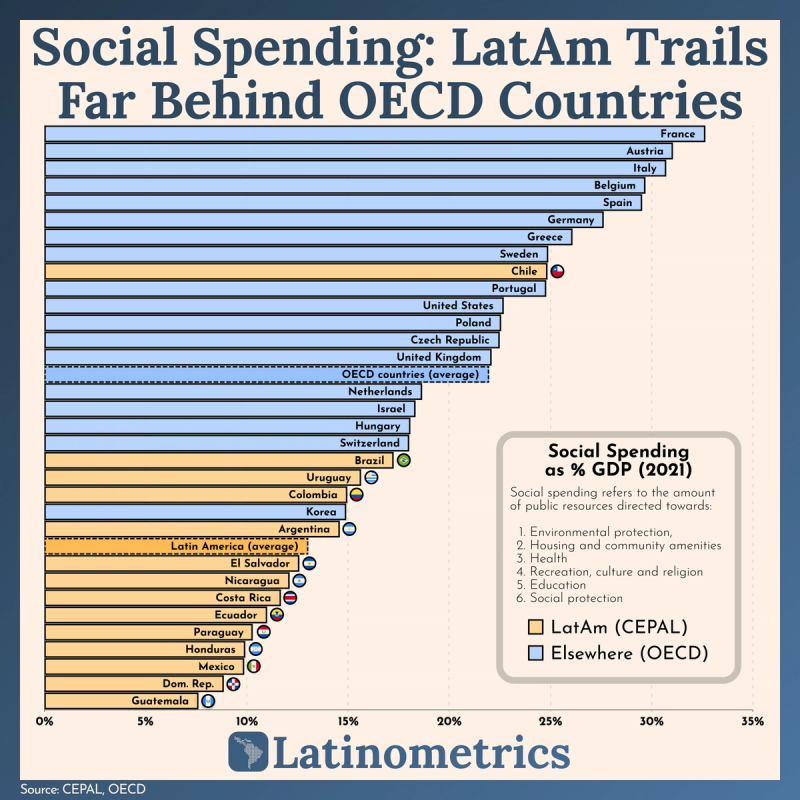
We present the above chart with a caveat: there’s no magic number for social spending. Some might point to France as a model for what a country should devote to its citizens, while others may tell you South Korea or the United States provide a more efficient model.
No matter your stance, it’s quite clear that Latin American countries have their work cut out for them, given the regional average for social spending is nearly half as much than the average for the OECD group of mostly developed countries. Chile is a notable outlier, setting aside just under a quarter of its annual GDP on public social expenditure.
What makes up this investment can also vary, as over half of Chile’s social spending goes towards maintaining social security and the pension system. Meanwhile, Guatemala devotes a far smaller 7.6% to its own social spending, with most of that money going towards education and health.
While the 4.1% of GDP spent on education in the region is just shy of the 4.9% spent across OECD countries, the latter overall invest between 5-6x more per student than Latin American countries. The gap has grown increasingly severe during the pandemic, with higher barriers facing regional students as schools shut down and learning went remote. These disparities are especially critical given the importance of education in fighting inequality, violence, and boosting productivity, three of the biggest challenges facing Latin America.
Social spending rose across the board in 2020 as governments tried to mitigate the worst effects of COVID-19 on poverty and inequality through costly emergency measures such as cash transfers or increased short-term benefits. This spending increase was maintained through 2021, leaving countries in tighter fiscal situations that have necessitated raising tax revenues and attempting to crack down on tax evasion.
Evidently, crises are disproportionate in their effects worldwide, as many of Latin America’s largest countries simply are not operating on the same budgets as their more developed European and East Asian peers. But crises like the pandemic—or natural disasters, or global recessions—demonstrate how important it is to ensure a strong social safety net for citizens. Education and health may seem costly in the short term, but failure to prioritize them will only be costlier in the long run.


