
Latin America's share of global species
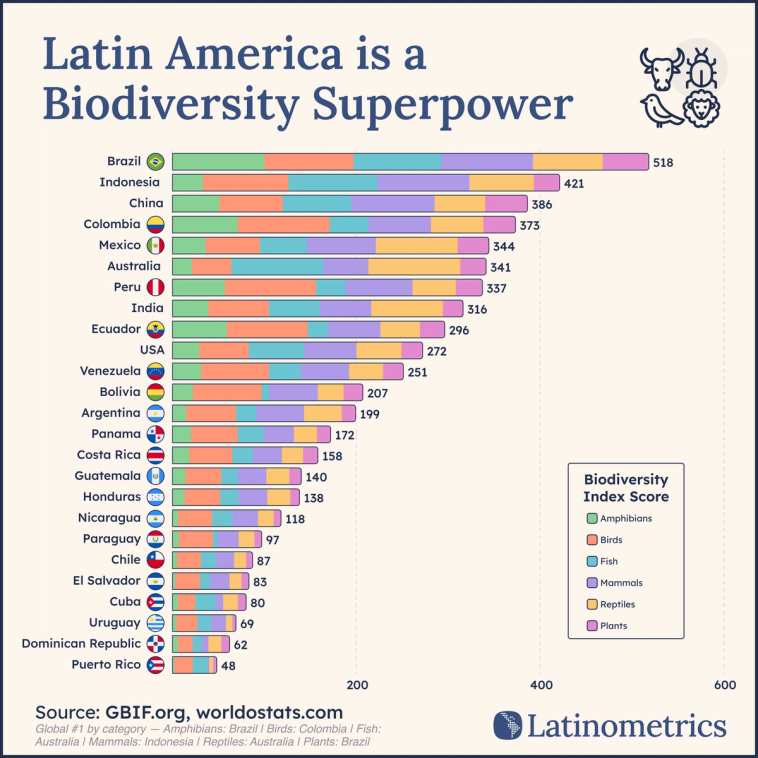
Seven of the world's 13 most biodiverse countries sit in Latin America — and 47,000 species worldwide are running out of time.

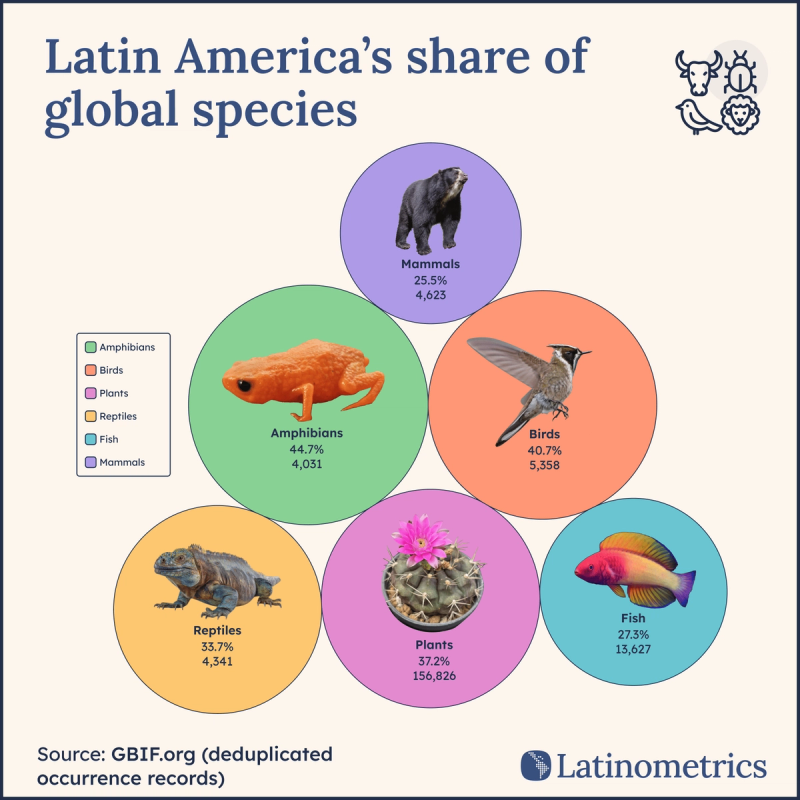
Long before any of us, this planet belonged to creatures that paved the way for our existence. We returned the favor by pushing many of them to the edge of extinction.
Then we showed up. And for millennia, we focused on our own survival at the expense of countless creatures. Today, more than 47,000 species are at risk of disappearing forever, and Latin America is home to some of the hardest-hit — the pink river dolphin, the golden lion tamarin, the harpy eagle. Creatures this region gave the world are now holding on in fragments of the forests and rivers they once ruled.
But at some point, we woke up. A few of us, at least, realized that as the latecomers who inherited this planet, we owed something to the creatures that came before us, and that we'd pushed too hard for too long.
And we have an outsized debt to pay: Latin America is home to entire categories of life on Earth. Brazil has more amphibian and plant species than any other country. Colombia has more birds — 1,900 species, about 20% of the world's total. Ecuador, a country roughly the size of the UK, holds 18% of the planet's birds and 7% of its land animals. In fact, of the seventeen universally recognized "megadiverse" countries on Earth, six are in Latin America.
Perhaps you've heard of global giants like the World Wildlife Fund (WWF) and the International Union for Conservation of Nature (IUCN), which have spent decades building the infrastructure of conservation across the planet. What you may not have heard of are the local heroes in our region. Rewilding Argentina and Onçafari brought jaguars back to Argentina's Iberá wetlands after decades of absence. The American Bird Conservancy has helped create more than 100 bird reserves across Latin America. These heroes are why Latin America still has a shot at paying that debt.
And the work is starting to pay off. A dozen Latin American species have multiplied their populations since the 1960s, some by many times over.
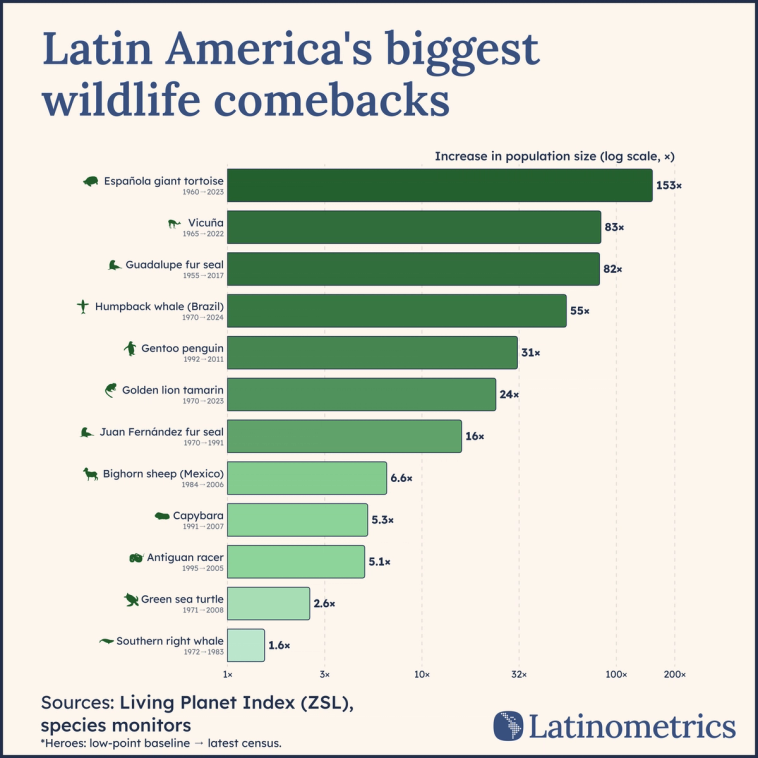
Take the Española giant tortoise. In the 1960s, just 15 individuals were left on its namesake Galápagos island. Galápagos National Park rangers gathered them up and started a captive breeding program, helped in no small part by Diego, a male tortoise repatriated from the San Diego Zoo in 1977 who went on to father an estimated 800 offspring. The program released its last generation into the wild in 2020. Today, 2,300 tortoises roam the island.
Or take the vicuña, the wild Andean cousin of the llama. In 1965, hunting had driven it down to just 6,000 individuals across Peru, Bolivia, Chile, and Argentina. Then Peru and Bolivia tried something different. They gave Andean communities the legal right to shear vicuñas for their prized fiber, as long as they protected the animals and released them back into the wild. The shift turned the vicuña from a poaching target into a shared local asset. Today, there are roughly 500,000 vicuñas across the Andes.
The Atlantic Forest where the golden lion tamarin lives is nearly 90% gone. A 2023 heatwave killed more than 150 pink river dolphins in Brazil's Lake Tefé in a single week. Latin America is home to nearly half the world's amphibians, and more than 100 species have already disappeared.
Not all of it was intentional. Latin America has its own human debts too. The work of feeding people, building cities, and pulling families out of poverty has often come at the forest's expense.
A few thousand rangers, biologists, and shepherds have been holding the line for the rest of us. The question is whether the rest of us ever show up.


