
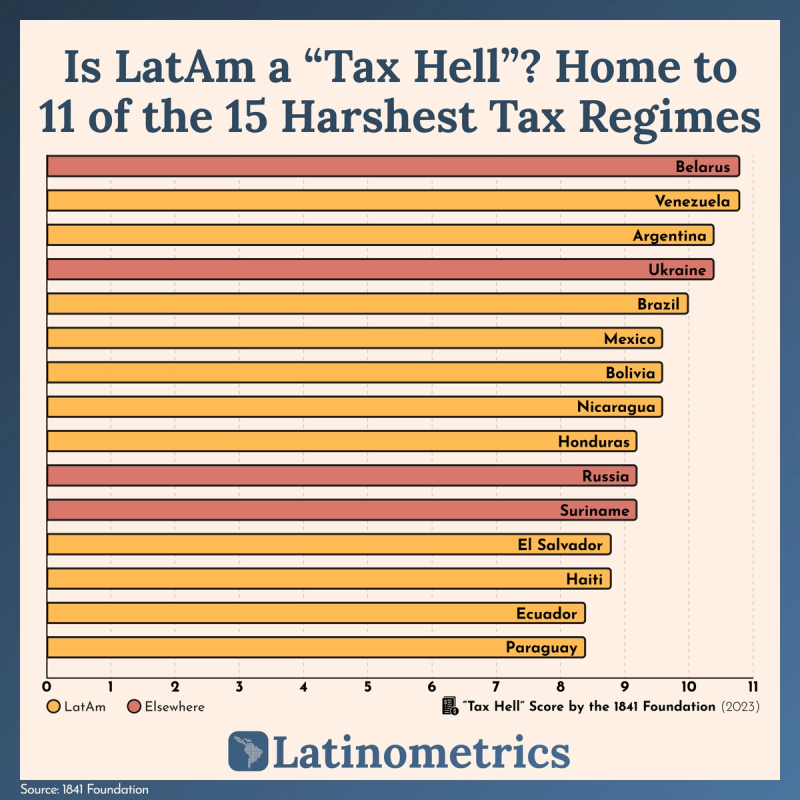
Is LatAm a "Tax Hell"? Home to 11 of the 15 Harshest Tax Regimes
Latin America hosts over two-thirds of the world's toughest tax regimes, but some nations prove improvement is possible.

Why do we have a bad reputation when it comes to taxes?
What’s the old saying? About how the only two certain things in this world are death and taxes?
Well, today let’s take a sober look at the latter, assessing the tax regimes of Latin America.
In truth…it’s not a pretty picture. Out of the 15 toughest tax regimes tracked by an annual index from the 1841 Foundation, over two-thirds lie in our region. Clearly, there’s some room for improvement; some countries in our region actually prove that improvement is possible.
What’s the criteria for a so-called “tax hell,” anyways? According to the index, a few metrics play into the scale: rule of law, property rights, fiscal burden, public debt, and inflation. Taken together, poor performance in these means that entrepreneurs have a harder time starting a business or scaling up, while investors may be more cautious when approaching a given country.
And what might this look like, on the worse end? It’s no surprise the two worst performers on this list, Belarus and Venezuela, are dictatorships. Corruption and a repressive state apparatus in these two countries means that people aren’t seeing their lives improve over time. A history of state expropriation of businesses, poor economic policies, and complete lack of rule of law have understandably made outsiders wary of setting up shop in either of these countries.
To a lesser degree, Argentina faces similar problems. The country’s bloated state, history of political and economic instability, and out-of-control inflation are all helping land it in the top three of the index’s 2023 scores, ahead of even war-torn Ukraine. Controversial new president Javier Milei may change this as he seeks to slim down the state and cut spending, but this strategy will certainly come with its own challenges and consequences for everyday Argentines.
After all, nobody (serious) denies the importance of taxes in funding public goods and making headway on important policies. Uruguay, Chile, and Panama prove that it’s possible to do so and are actually labeled as “normal” tax regimes by the 1841 Foundation. Along with Scandinavia and East Asia, these countries demonstrate the value of an efficient, well-taxed state.
Then there’s the rest of the region, including giants like Brazil and Mexico and even smaller countries like Paraguay and El Salvador which have tried to enact pro-business reforms in recent years. For the governments in each of these, the balance must come from protecting property rights and the rule of law while also ensuring their growth is equitable and sustainable.
An overburden of state presence, when coupled with bad policies as seen in countries like Venezuela or Nicaragua, is a recipe for disaster. And that’s one disaster Latin America can very much overcome.


