
LatAm college enrollment dips after 29 years of growth
It's back-to-school season. Are you off to college?

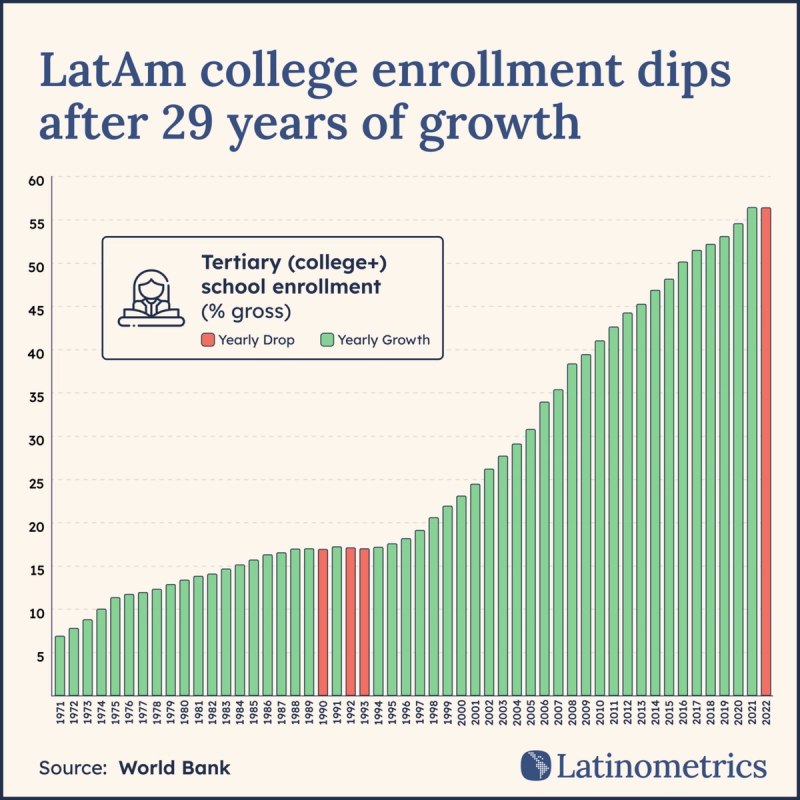
Fifty years ago, less than one out of every ten Latin Americans attended university.
Educational inequality, like income inequality, served as an enduring legacy of the region’s colonial past. Only the very wealthy could afford to head to college—and men tended to go in larger numbers than women (more on that later).
Today, it’s a different world. Over half of all Latin Americans have enrolled in some form of tertiary education, which refers to the university level and above (graduate school, etc.). The rise from the figures of the early 1970s to today have been drastic, seeing nearly uninterrupted growth.
Regardless, there’s probably no reason to fret—yet. The last few years which featured declines in enrollment preceded the region’s fastest period of growth. No doubt Latin America’s excellent universities, if they can assure continued financial feasibility, will continue to attract many of the brightest minds in the region.
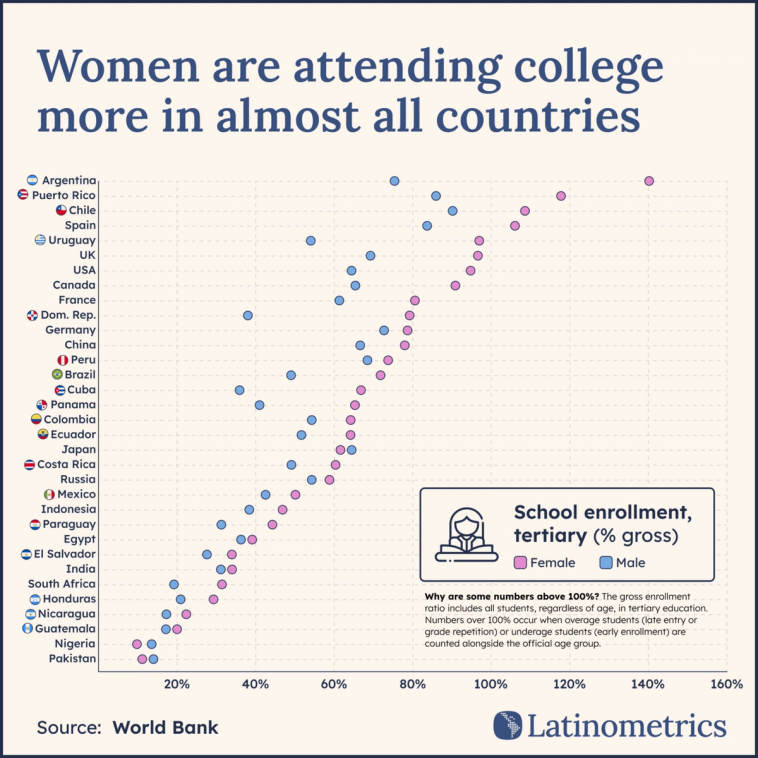
More often than not, these bright minds will be women, as today 6 out of 10 women in the region (compared to less than half of men) enroll in tertiary education. In fact, women have powered the rise of universities in Latin America since 1970, with 14x growth in enrollment numbers in that time period.
As a result? Latin American countries now look a bit more like the rest of the world when it comes to gender splits in schools, as our next chart shows.
Across the region, universities have become far more accessible to everyday Latin Americans, and with tangible benefits. After all, a college education help graduating students secure better jobs and even increase their wages.
Attending a university is not a dream for every single person, so we may never reach 100% college enrollment and that’s okay. The important thing is that the coming years see all those who want to further their education, men and women alike from Tijuana to Tierra del Fuego, be able to do so.


