
Uber Wins Market Share in Brazil, DiDi in Mexico
Uber dominates Brazil by 65% market share, but DiDi reigns in Mexico with 56%—thanks to cheaper fares.


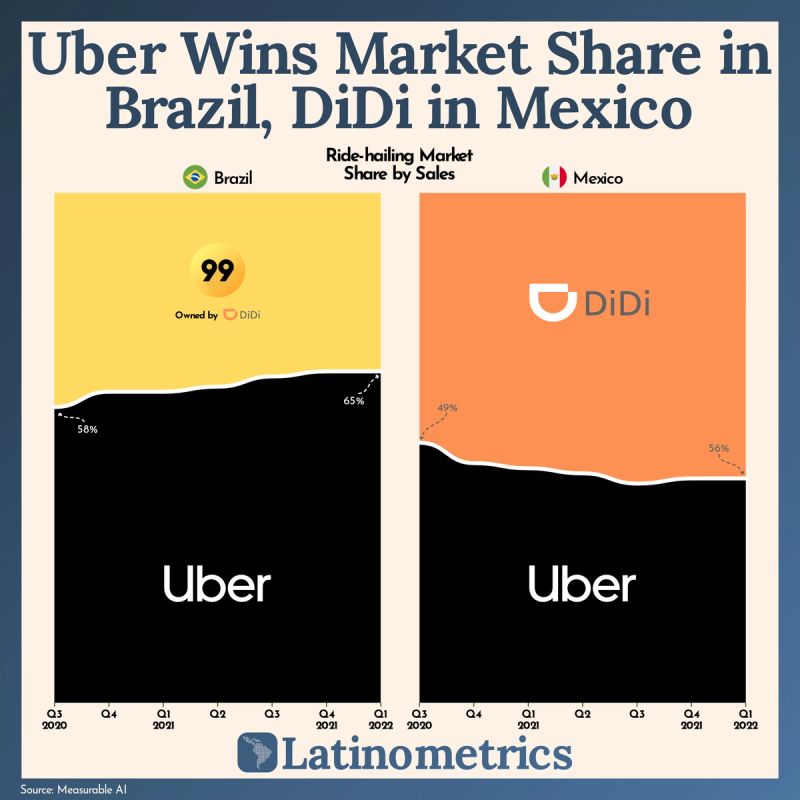
According to data by Measurable AI, with 600K+ drivers serving 100+ cities in the country and a country share of 65%, Brazil is Uber's biggest market outside the US. Its main ride-sharing competitor, 99 (owned by Didi), has an estimated 750K active drivers in Brazil and owns 35% of the market share. Both companies have a combined 28M Brazilian active users. Since 2020, Uber has taken 7% Brazilian market share from Didi.
In Mexico, Didi is the dominant app, with a 56% market share. During the same period, Didi's market share increased by 7%. In other words, the market gains that Uber has made in Brazil, it has lost in Mexico. Such movements in the market in both countries signal intense competition and a close fight for international dominance.
Fierce competition benefits consumers because it forces these platforms to lower their prices. Price is undoubtedly a significant factor in market dominance. In Mexico, where Didi is winning, the average Didi trip costs $65 pesos, compared to Uber's $93 pesos. In Brazil, the average 99 user pays $14 reales for a trip and $17 reales for an Uber trip.
Most of the ride-hailing action is happening in the big cities. São Paulo is Uber's busiest city in the world. Combined with NY, LA, Chicago, and London, they account for 22% of Uber's entire bookings worldwide.


