
Mexico represents a huge FDI opportunity for USA
Canada turned decades of trade into equity; Mexico is only now writing that playbook.


We here at Latinometrics hope you were seated comfortably when you read through last weekend’s edition of the exclusive Domingo Brief—you did read it, right?
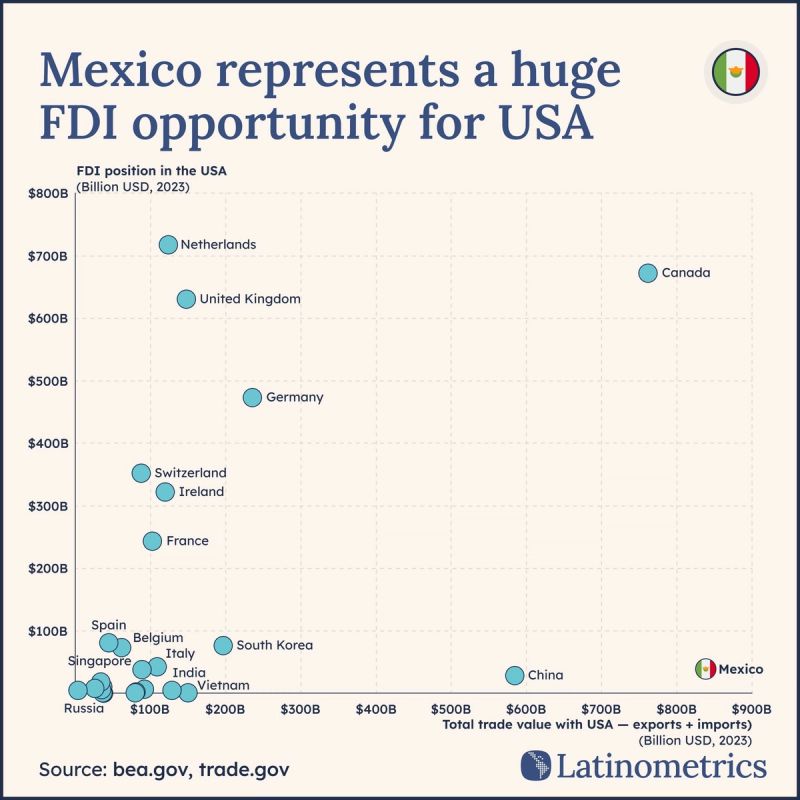
Beyond Bolivian ballot battles and Peruvian presidential prisoners, this week’s Brief took stock, if you’ll forgive the pun, of foreign direct investment (FDI) in Mexico thus far this year. After all, and this is not a hyperbole, but no country worldwide is more exposed to this year’s tariff-induced meltdown of the global US-centric trade system than Mexico.
The US is the source for over half of Mexico’s imports and the destination for over three-quarters of its exports. Integration at that level is hard to find anywhere in the world that doesn’t share a common currency.
But here’s a question we rarely ask: what about Mexico’s own capital crossing the border?
Turns out, even with an $840B trade corridor (the world’s largest), Mexican firms have barely $43B parked in the US.
So why the massive gap? History has a lot to do with it.
Canada’s corporate roots in the US run deep, and Europe’s ties go back even further. The US and UK, for instance, didn’t just trade goods—they practically co-authored the global financial rulebook in the 1940s. Generations of firms have grown up thinking internationally. Mexico’s big trade moment? That didn’t come until the mid-’90s with NAFTA. We’re still in the early chapters of a very different kind of bilateral era.
That newness explains why most Mexican firms still think local first—and why setting up shop in the US is a slower climb. Expanding north takes serious capital, legal firepower, and comfort with a foreign regulatory framework. For family-owned giants that dominate Mexico’s economy, those moves don’t happen overnight.
What’s the kind of investment we do see? Farmacias Similares went into Austin, Texas and plans to distribute via Amazon and CVS in Latino-heavy hubs. Meanwhile Oxxo, now in every Mexican corner, is busy rebranding hundreds of Texas, New Mexico, and Arkansas outlets—part of a long-term, nearly $385M, 900-store vision.
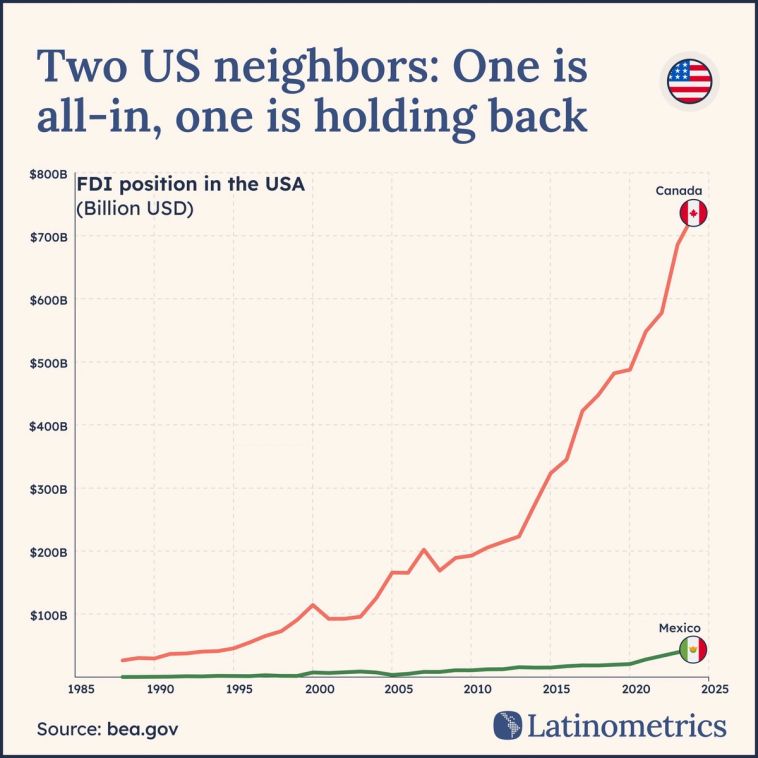
So what does it look like when a country goes all-in on building capital ties with the US?
The biggest Mexican heritage in the US is its people. There are currently 36M Mexican Americans, while just shy of 3M Americans report having Canadian roots.
Canadians, enjoying stability at home, can stay and instead bet big on the massive US market. Slow, steady corporate expansion, easy cross-border finance, similar legal frameworks and decades of US-facing M&A turned trade ties into balance-sheet ties.
Will Mexico ever catch up? Probably not, given the cultural differences and Canada’s massive head start. A step forward would be to offer improved standards of living to its citizens, and open its eyes to the opportunities to serve its diaspora in the US, just like Oxxo, Farmacias Similares, and others are doing.
Our second chart doesn’t show it, given Canada’s absolute eclipse over the Mexican line, but Mexican FDI stock in the US is more than double what it was in 2020.
Will Mexican diaspora demand be enough to justify growth?


