
Remittances keep Central America afloat
For much of Latin America, the dollars wired home from emigrants now rival every cent of foreign direct investment combined.

Last year, for the first time since 2004, Colombia took in more dollars from emigrants ($13B) than from foreign investors ($12B). And it isn't alone.
In much of the region, especially in the countries closest to the US, the most important sector of the economy may not even be an actual sector—just the people who have already left.
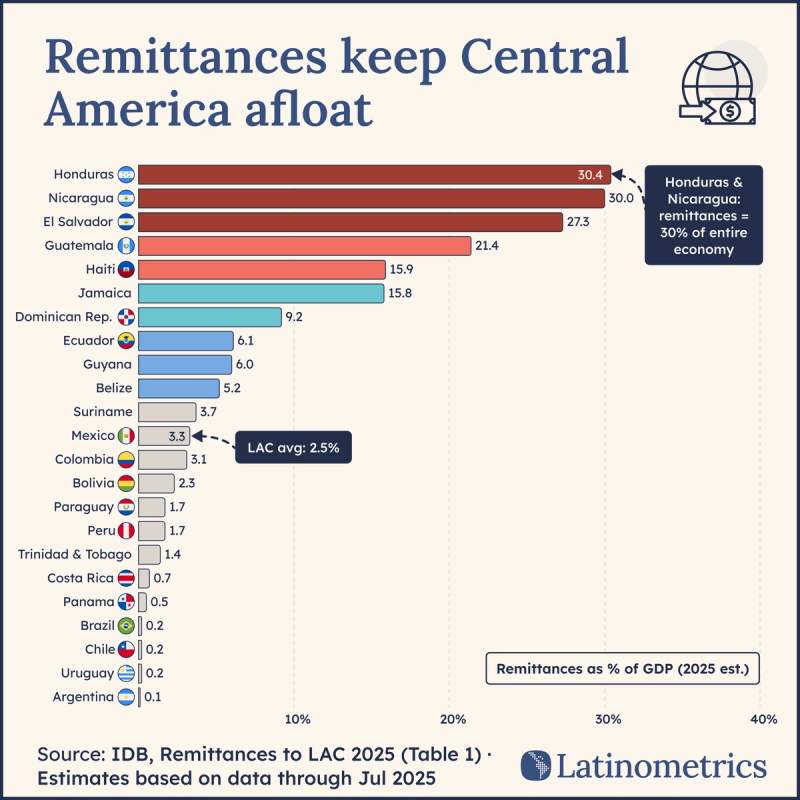
For scale, remittances play as big a role in the Honduran or Salvadorian economy as agribusiness plays in the Brazilian economy.
Remittances from overseas—especially the US—extend far beyond just wire transfers and have become essential for Central American and Caribbean countries. Central America reportedly received over $50B in remittances last year, up over 20% from the year prior.
In the process, these financial flows have become a cornerstone of local economies. In 2024, Honduras exported $10.5B in goods — every wire harness, every T-shirt, every coffee bean, every banana, every dollar combined. Remittances? $9.5B.
And for Honduras and its neighbors, the dollars wired home from abroad now rival (and often exceed) every dollar of foreign investment combined.
But a remittance pays the rent. A factory pays the rent, then trains the welder, then orders steel from the supplier down the road, then exports a finished product. One stops the moment the sender loses their job, while the other compounds.
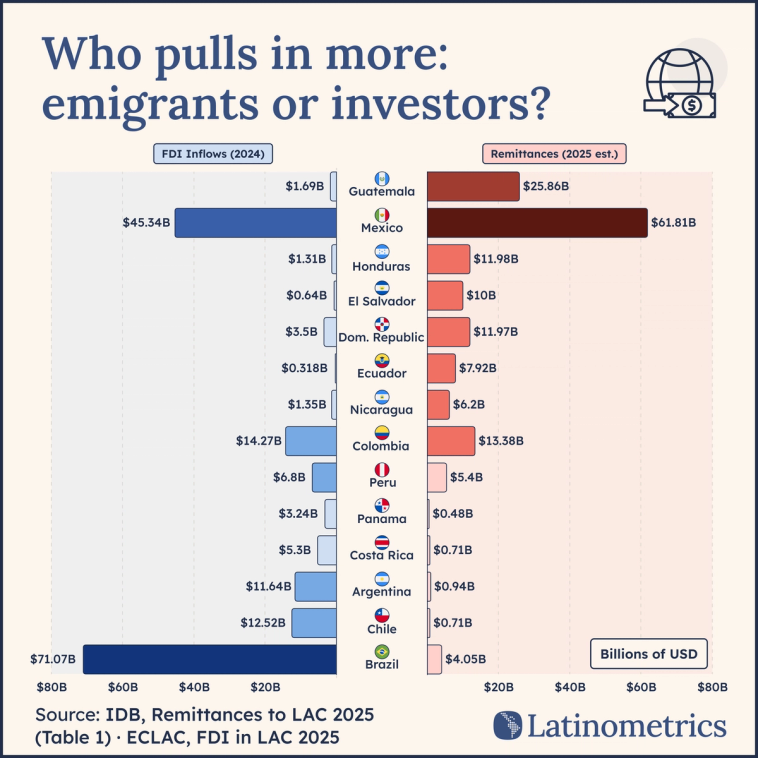
Now, these different flows are by no means mutually exclusive. Mexico is the largest remittance destination in the hemisphere, with over $60B in 2025 alone, yet it also manages to attract tens of billions of dollars in foreign investment as well.
Where the situation is more precarious is in cases like Guatemala, El Salvador, or Nicaragua, where the main influx of dollars is from emigrants rather than sustainable local investments.
In these cases, families’ financial futures can be at the mercy of wire fraud or job disruption owing to immigration crackdowns. ICE raids in Chicago become the difference between someone’s mother in Mexico City paying her bills or not.


