
The real flies high while Argentina's peso crashes
Lula asked why the world trades in dollars; 2025 offered Latin America a surprising answer.


A few months after assuming office as the President of Brazil for a record third time, Luiz Inacio Lula da Silva traveled to China, his country’s largest trade partner since 2009. While in Shanghai, he had some testy words for the world’s reserve currency:
“Every night, I ask myself why all countries have to base their trade on the dollar. Why can’t we do trade based on our own currencies? Who was it that decided that the dollar was the currency after the disappearance of the gold standard?”
While the image of a sleepless Lula da Silva tossing and turning over the greenback may bring some smiles, we can partly understand his frustration: when he last left office on New Year’s Eve of 2010, one US dollar was equivalent to just 1.66 Brazilian reais. Contrast that with nowadays, when that same US dollar nets you about 5-6 reais.
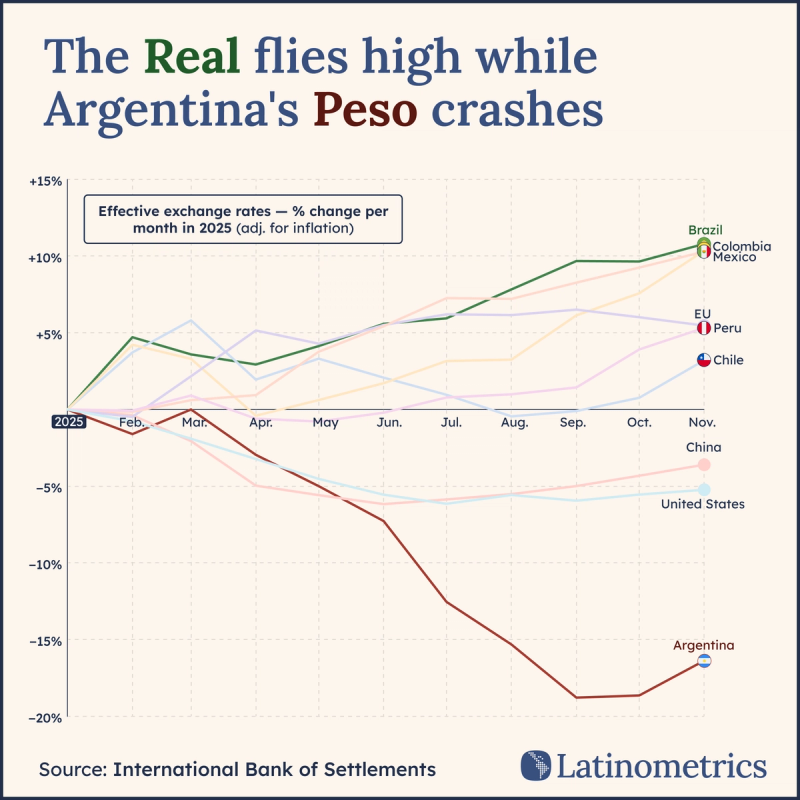
Notably, though, 2025 was a tougher year on the dollar than on the Brazilian real or most of its neighbors—with one clear exception.
Trade volatility, soaring budget deficits, and general economic uncertainty plagued the US last year, with the effects playing out across international markets. Despite remaining the world’s reserve currency and accounting for 89% of global FX market trades, investors dumped their dollars in favor of safer alternatives such as gold and even silver.
A turn away from the dollar would no doubt make Lula da Silva and crypto bros alike happy. Notably, major Latin American currencies—led by the Brazilian real as well as the Colombian and Mexican pesos—rallied, demonstrating less traditional alternatives than the euro.
As with so much else in recent years, Argentina proved a notable exception. The Javier Milei administration, since taking office in 2023, has allowed the peso to float freely within a specific band (roughly 951–1471 pesos per dollar on the wholesale market). When approaching these bands, as the peso did in October around turbulent elections, the Central Bank of Argentina steps in, selling off its (very limited) foreign reserves in order to prop up the currency.
Notably, a few months ago Argentina even had help, as the US government reportedly purchased pesos in the open market in order to help stabilize the currency.
We wonder what Lula thinks of that.


