
Venezuela: The Rise and Fall of a Petrostate
Venezuela's oil exports plummeted 80% by 2020, revealing dictators and overreliance as its true downfall.


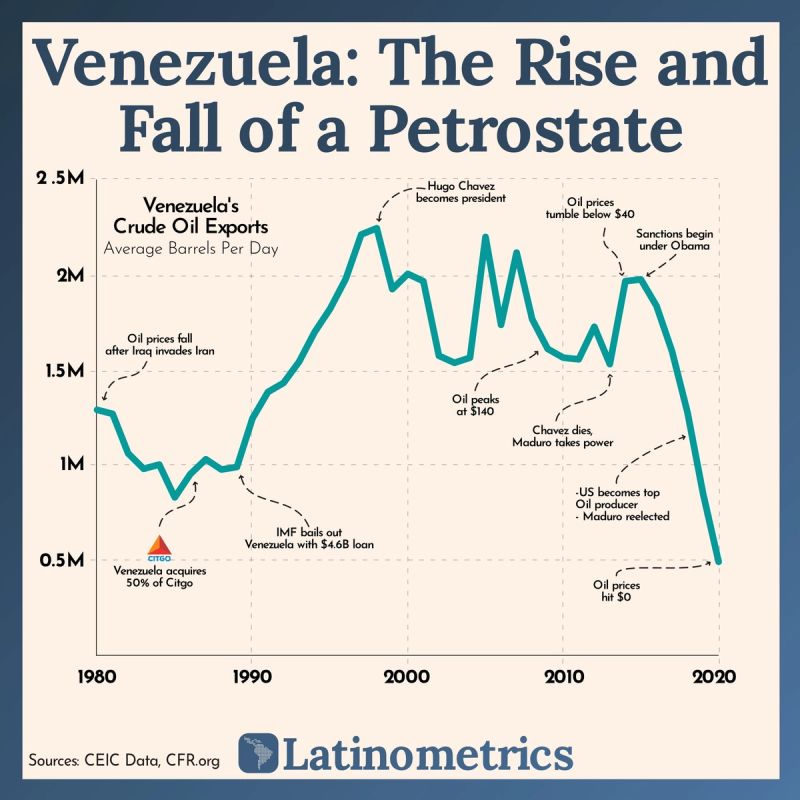
In 1922, Venezuela’s oil reserve — the largest globally — was discovered, and the country was set for an enormously prosperous period. It required foreign companies to pay 50% of their profits to the government in 1943. By 1950, Venezuela was the world’s 4th wealthiest nation per capita. It continued being considered Latin America’s crown jewel for decades later. Thanks to favorable oil prices, the government spent lots on social programs like health care, education, and food subsidies. Workers enjoyed the highest wages in Latin America. Amid this boom, President Carlos Andres Perez nationalized the oil industry and created Petróleos de Venezuela (PDVSA).
Venezuela’s fortunes started to shift in the 1980s when oil prices dropped steadily. The drop was a consequence of an oversupply of oil following Iraq’s invasion of Iran. PDVSA went on a shopping spree of foreign oil refineries during this period, most notably Citgo. The acquisitions amassed extensive debts for the country, and in 1989 the IMF provided a $4.6B rescue package. Over-reliance on oil and divided political institutions caused the economy to continue in a downward spiral.
Hugo Chávez entered the country’s spotlight, first through a failed military coup in 1992 and then was elected through a socialist campaign in 1998. Around the 90s, 66% of Venezuelans lived in poverty, and his socialist agenda appealed to much of the population. Chávez took on several reforms that reduced poverty by 20% but incurred even more debt. He weakened the country’s institutions and ended presidential term limits, becoming an unelected dictator.
The country’s fate continued to go downhill after Chavez’s death in 2013. Oil prices tumbled (and so did the economy), and Nicolás Maduro took office. Since his term started, dozens of countries have enacted sanctions to oppose his military regime. Millions of Venezuelans have since fled a country in crisis.
A few weeks ago, US officials approached Maduro to potentially remove sanctions after cutting out Russia due to its invasion of Ukraine. Although that could be positive news for Venezuelans, history shows that overreliance on its oil reserves and dictators are the real issues that need to be addressed.


