
Latin America's AI adoption
Latin America emerges as a $10B AI infrastructure hub by 2029, fueled by surging data center investments and rapid adoption.


Assuming you’re a decent civilized person with good taste, you keep up with our weekly Domingo Brief each weekend. In doing so, you might have noticed that we’ve increasingly featured stories of new data centers being developed across Latin America.
As the growing use of artificial intelligence requires greater data infrastructure across the world, Latin America has sprung up as a key “secondary market” for growing investments in this infrastructure, owing to cheaper real estate and plentiful energy access. Last year, the larger data center companies reportedly invested over $2B, while the overall market for these centers is expected to double by 2029 to reach up to $10B.
Naturally, Latin America is not just becoming a hub for data centers, but also for the growing adoption of AI by consumers, governments, and businesses alike.
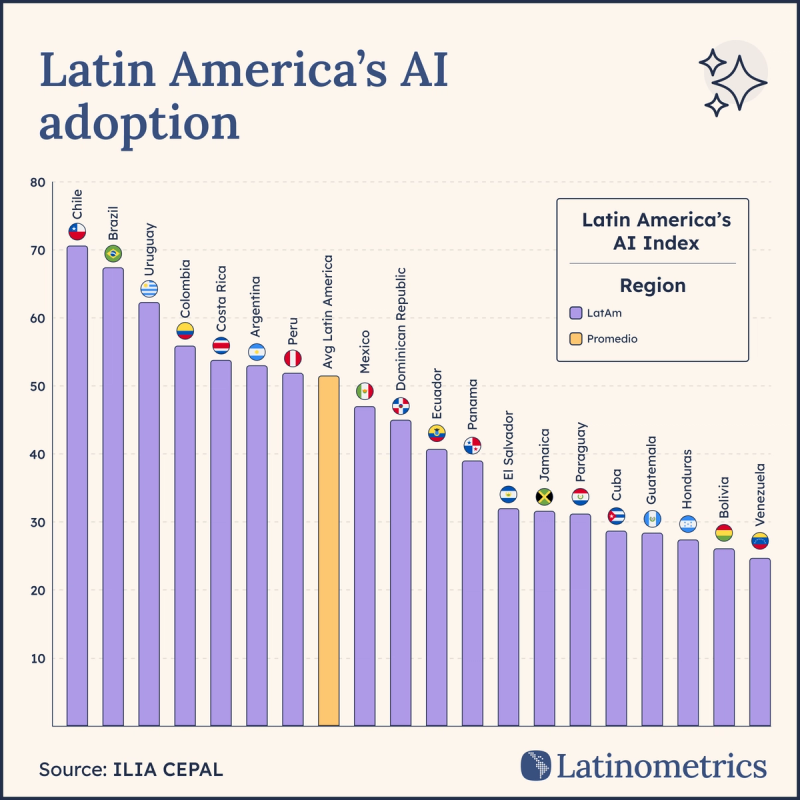
The top AI adopters in Latin America are not overly surprising, being led by two of the region’s most developed countries – Chile and Uruguay – as well as the largest country in the area, Brazil.
What’s more surprising is the difference in subregion: South America is clearly outperforming the rest of Latin America. In fact, only one Central American country, Costa Rica, outperforms the regional average.
Now, this makes some sense—after all, South America holds 409 data centers, massive energy resources, and plentiful real estate. But we can’t help but notice that the most industrialized Latin American economy is lagging in the AI game.
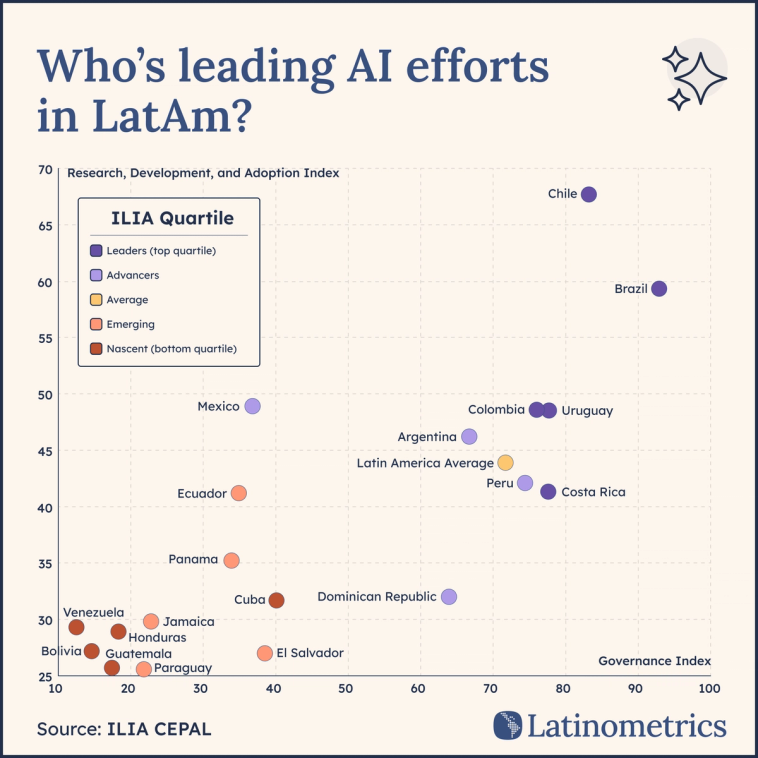
Despite being highly integrated with the US economy, which is by all accounts leading the global AI boom, Mexico is underperforming in terms of score on the AI Index. Perhaps this is due to simply real estate; after all, most new data centers are not being built in the country’s crowded capital, as elsewhere in Latin America, but rather in the state of Querétaro.
Or perhaps it’s rather a question of governance. While Mexico is considered an AI advancer in the region owing largely to its R&D and adoption rates, governance is where the country falls short of its South American peers.
If Mexico wants to catch up to its counterparts in Chile or Uruguay in harnessing this crucial technology, modernizing the framework by which businesses can see their AI efforts regulated could prove a strong first step.


