
Decades of Orange Production: Brazil Remains at the Top
Brazil's juice giant, Citrosuco, dominates global orange output, but new Asian competition threatens its reign.

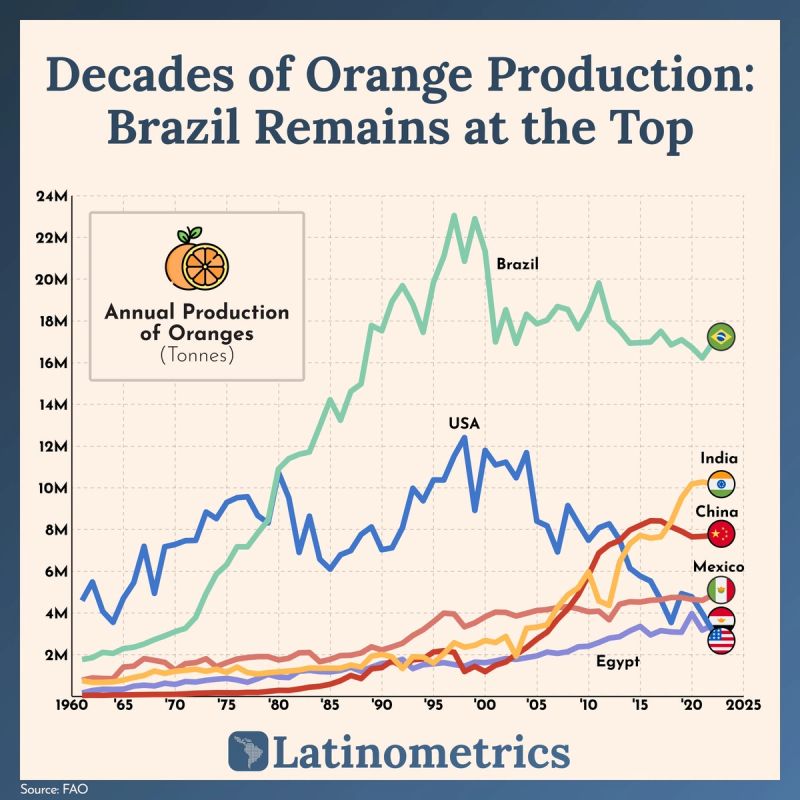
Brazil's rise as the world's orange leader and new competition.
To give you a sense of just how vast Brazil and its farming capabilities are, consider that at one point, until the year 2000, its orange farmland was larger than the entire island of Puerto Rico.
Fast-forward to today — although the land that grows oranges has halved, production has only decreased slightly thanks to efficiency and technology improvements, and Brazil's orange world dominance has remained.
It wasn't always this way; until the end of the 1970s, the US, specifically Florida, was the orange capital of the world. Florida has a few significant competitive disadvantages: much less land, more expensive labor, and hurricanes, which make crops more risky.
Nowadays, if you've had orange juice (and who hasn't?), it's likely that a little-talked-about company from Brazil, Citrosuco, had something to do with it. This company, often overlooked, plays a significant role in the global orange juice market.
Everything from Minute Maid and Del Valle (owned by Coca-Cola) to Tropicana (owned by Pepsi) is getting some oranges or orange concentrates from Brazil, specifically, although not officially disclosed, from Citrosuco.
Like any large corporation, it's had its controversies—most recently, a $2.5B civil lawsuit alleging past price-fixing practices.
However, the corporation has been at the forefront of innovating in the fields through new technologies to help it grow more oranges out of each acre and squeeze more juice out of each orange. It has also been praised for its efforts in maintaining sustainable farming practices.
If we consider Latin America a single orange producer, things have changed since the turn of the century. In 2000, Latin America was responsible for 45% of global production; today, it's 32%.
Our region has stopped growing its production, and players from other parts of the world, most notably India, China, and Egypt, have stepped in to fill demand and compete.
Just like Latin America disrupted the US decades ago, our region now confronts Asian and African competition, which isn't going anywhere. Brazil and others face the challenge of keeping farming practices sustainable and competitive despite outside pressures.


