
Mexico Drives Nearly Half of BBVA's Income and Profits
BBVA thrives in Mexico, holding $188B in assets despite market exits in the US and Chile.


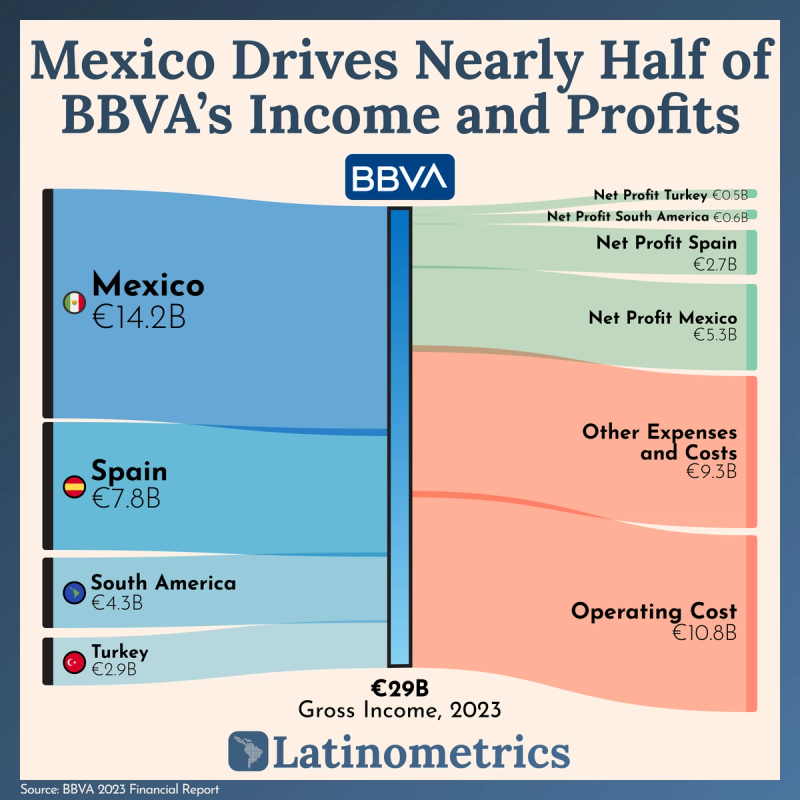
Mexico's biggest bank also calls Mexico its biggest home.
Despite an ultra-competitive and ever-changing banking landscape, BBVA has found solid ground in Mexico. Actually, "solid ground" is an understatement; the bank, founded initially as Bancomer more than 90 years ago, has thrived as the largest banking institution in the country, today holding $188B of assets.
The bank is deeply rooted in the Mexican market, which is still in its relative infancy — less than half of Mexicans 15 years or older have a bank account.
BBVA has maintained a solid customer experience, showing off the highest NPS in the country. It allegedly innovated with the first mobile banking app in 2010 and has rolled out some cool features you may not see in even the top US bank branches.
A simple example that's very handy to the average Mexican illustrates this: A BBVA customer can pay anyone, even if they don't have a BBVA account with cash, through a mobile-generated code in one of the bank's ATMs.
BBVA has struggled with growth in other regions, including its Spanish homeland. The Spain segment had a lower net interest income (its income after debt and interest deductions) in 2022 than it did in 2006.
Elsewhere in the Americas, BBVA has had several market retreats. In 2020, it was competed out of the US by more prominent players and sold its division in the country to PNC for $11.6B. Just three years earlier, it left its Chilean division in the hands of Scotiabank for $2.2B.
The company will likely continue to bet on Mexico, and its bold fintech acquisitions indicate it's ready for the new digital era. In 2018, it bought Mexico's OpenPay and acquired a significant stake in Brazilian neobank Neon.
This past year, it launched BBVA Spark, a business unit aimed at investing in "innovative businesses" or, in standard terms, startups. BBVA's stock has been riding high on solid financial performance, appreciating 52% in the past year.


