
Big Tech's Revenue Surpasses Some LatAm Countries' GDPs
Big Tech's revenue rivals LatAm GDPs, yet MercadoLibre dominates Amazon in the region.


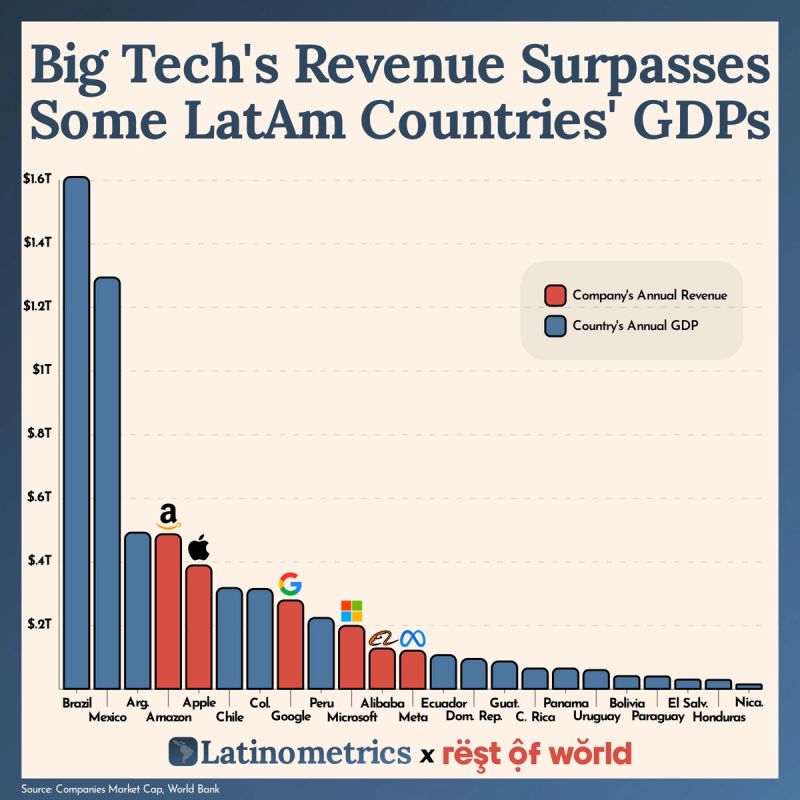
When people talk about countries being afraid of companies' clout, they're referring to this. Companies led by a handful of individuals have revenues comparable to some countries' entire GDPs. That illustrates the increasingly significant power and reach that Big Tech has in the world. Some governments, like Bolivia's, have created entire cyber-police forces with a single Big Tech company in mind.
Hugo Miranda of the Fundación Internet Bolivia says that when the country's informal commerce sector migrated online, it did so almost exclusively onto Facebook. The Bolivian government has been, therefore, at the mercy of Meta's arbitrary rules when addressing issues as delicate as child pornography or the illegal traffic of drugs and people.
But companies' sizes can be misleading. Distribution is also essential. Amazon may well be equivalent to the fourth biggest economy in Latin America. Still, the resources Amazon deploys in the region are nowhere near the amount seen on the graph. Amazon is not even the top e-commerce company in Latin America.
Argentinean-founded MercadoLibre, Amazon's main e-commerce competitor in the region, leads its rival in Mexico, Argentina, and Brazil — in these latter two, by a country mile. Now consider that, apart from being Latin America's three biggest countries in terms of GDP, they also make up 95% of MercadoLibre's revenue in the region.
Yet, on this graph, MercadoLibre would be a tiny slither, with revenue adding up to just shy of the GDP of Nicaragua. The difference is that Latin America is MercadoLibre's entire market; for Amazon, Latin America is almost an afterthought, with a tiny amount of its revenue coming from the region.


