
Bolivia is Now a Top 5 Gold Producer in LatAm
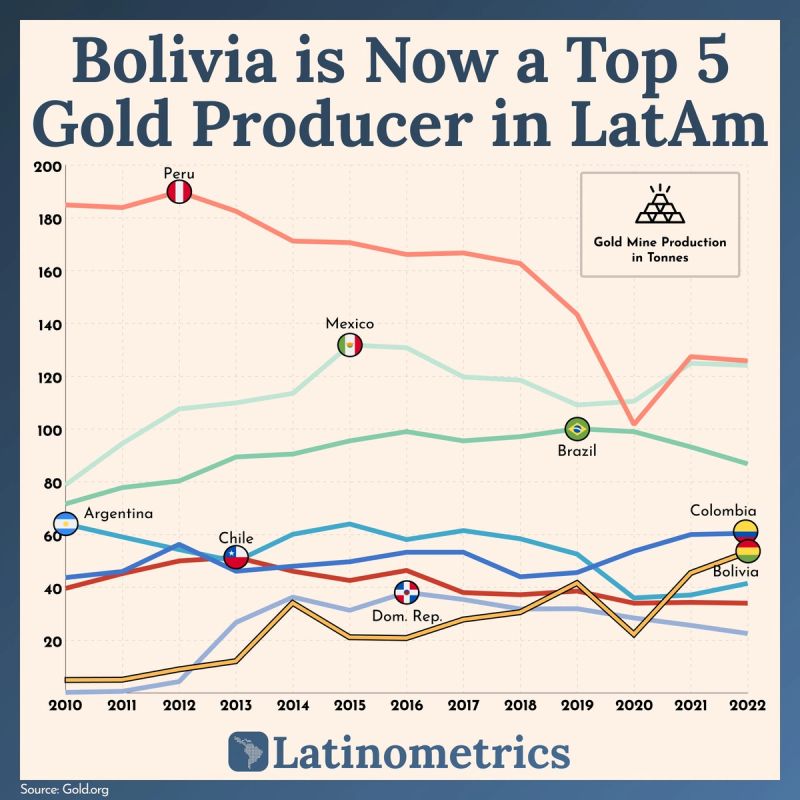
Bolivia is now LatAm's 5th-largest gold producer, poised to surpass Colombia by 2025.

Is Bolivia too reliant on gold? We explore its export economy as the country is poised to surpass Colombia in production.
The Spanish Empire may have hoped to reach Asia when they landed on the shores of the Americas in the late fifteenth century, but they stayed upon realizing that this “new” land they had discovered was packed to the brim with natural resources.
And none of these resources excited them quite as much as gold.
The hunt for cheap sources of precious metals like gold (and its less shiny cousin, silver) was a major driver in the Spanish colonization of the Americas. So-called treasure fleets carrying gold back to Spain departed from Cartagena, Panama, and Veracruz and were the preferred targets of British pirates hoping to make a fortune while infuriating the Crown of Castille.
Which brings us to today. Gold remains a key commodity coming out of the region, a more or less consistent export as of late in a region which has seen huge fluctuations in the prices of other things like soy and petroleum.
Today the colonial-era mining heavyweights continue to dominate, with Peru and Mexico each producing over 120 tonnes per year. For reference, this figure puts them in the top 10 producers worldwide.
However, it’s Bolivia by which we’re most impressed. In the last ten years, the Andean country has leapfrogged over its neighbors and competitors such as the Dominican Republic to become the 5th-largest producer of gold in Latin America. Based off current trajectory, it’s expected to surpass Colombia by 2025, particularly as the latter country intends to turn away from an extraction-based economy.
Given Bolivia’s heavy government intervention in the mining sector under former President Evo Morales, the state coffers have benefitted from growing production. Indeed, the country’s gross domestic product (GDP) has grown at between 2-6% annually over the last decade, and its vast deposits of not only gold but also zinc, tin, and lithium make it a major player in the metals trade.
Today gold is the country’s most profitable good, representing just shy of a quarter of all exports. If this seems high, though, it’s actually below the roughly 85% share seen by contraband gold in the late 1980s. Bolivia is nearly unique among its Mercosur partners for being so mining-reliant, with over 135K workers employed in the sector.
And this is just the latest chapter in Bolivia’s mining love affair. Consider the case of the city of Potosí, near the Cerro Rico. For centuries, this was the richest city in Spanish America owing to its massive silver deposits, which powered the transatlantic economy and reached all the way to China.
Five centuries after the Crown of Castille arrived in the New World, Bolivia remains a clear mining heavyweight. Five centuries from now, we can only hope all that mineral wealth has landed in the hands of the people who dug it out of the earth.


