
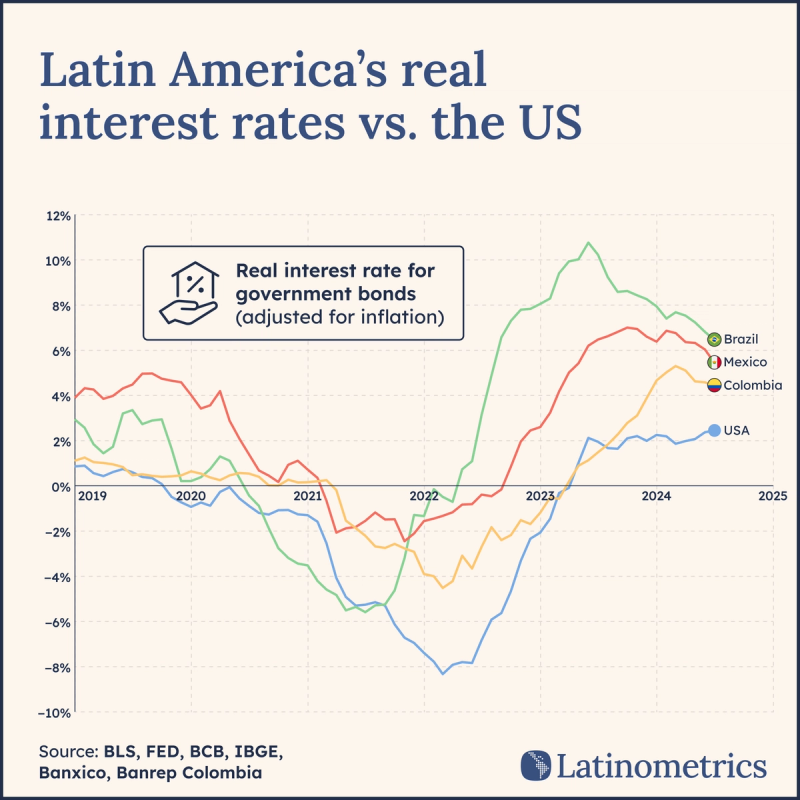
Latin America’s real interest rates vs. the US
Mexico's bonds returned 20% in 5 years, outperforming US Treasuries by 30 points.

Latin America's history with inflation isn't a pretty one.
Driven by boom-and-bust cycles, poor fiscal discipline, and at times, simply bonkers monetary policy, the region has been characterized by consistent struggles with keeping prices under control for decades.
Much of the 1980s and 1990s were marked by staggering debt crises in Latin America's biggest economies, as currency values plummeted amidst triple-digit and even quadruple-digit hyperinflation levels. For example, in 1993, the Mexican government famously decided to cut three 0s from the peso — one "new peso" was thus worth one thousand old pesos.
Since that era, increasingly independent central banks have – for the most part – tried to keep the economic woes to a minimum through strict monetary policy. In fact, recent years have even seen these central banks staying conservative while their European and US peers were slashing rates to stimulate demand during the pandemic. Clearly, history hasn't faded from anyone's mind.
Setting interest rates is by no means an exact science. Different countries have had different results in the post-pandemic era, with Brazil's central bank pursuing an especially aggressive monetary strategy to curb inflation.
Negative real interest rates, meanwhile, reflect months and even years where inflation outpaced nominal interest rates. This brought down yields and weakened the value of government bonds across both US and Latin American government bonds.
Since 2022, though, real interest rates are on the rise. So, let’s put everything together and pretend you invested $1K five years ago in different bonds. Where would you be at today?
Well, this may not surprise some readers who recall our recent look at Mexican investment portfolios, but Mexican government bonds – or CETES – have returned the best results, with a 20% return. Owing to strong macroeconomic fundamentals and monetary discipline since even before the pandemic, Mexican government bonds remain highly attractive to investors all over.
Consistently high real interest rates, minimal inflation, and a superpeso that has outperformed all other major currencies have all helped Mexican bonds leave the competition – yes, even the competition up north – in the dust. The overall yield would look to be about 20% today, compared to a loss of roughly 10% for US treasury bonds and double that in Brazil and Colombia.


