
From zero to $157B: The rapid rise of China-Brazil trade
Fifty years of bilateral ties...what has been the result?

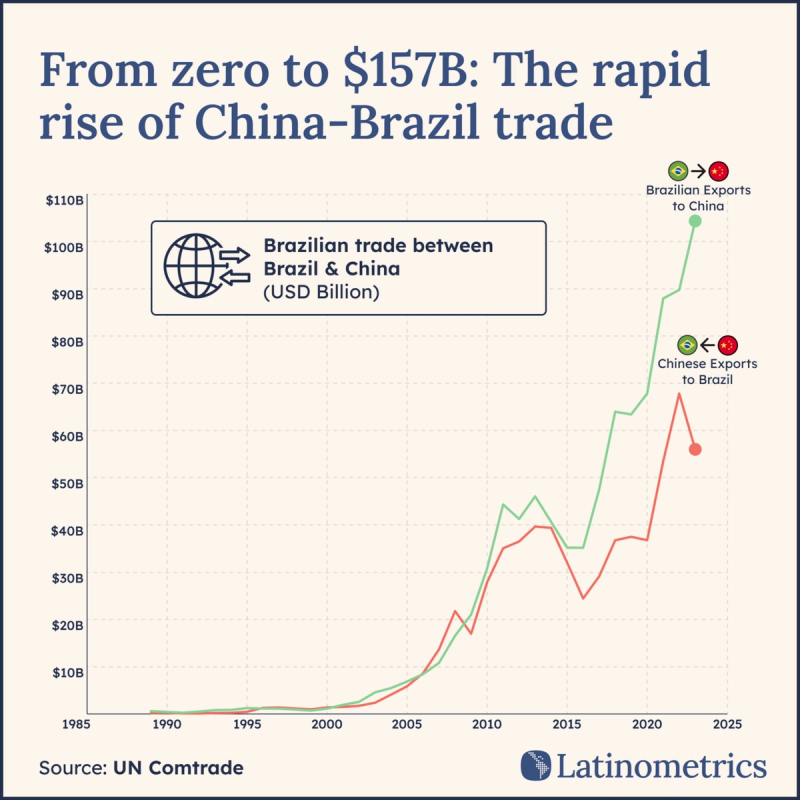
Last month marked an interesting milestone that’s far more important than it may seem at first glance.
Brazil and China, two of the world’s largest countries, officially commemorated 50 years of diplomatic relations. And a half-century after Brazil’s then-dictatorship officially recognized the People’s Republic of China, relations between the two countries have never been so rosy.
And yet, as recently as 2000 there was minimal trade to speak of.
All of that changed in the early 2000s with the arrival of the commodities boom. Put incredibly simply, China’s growing population and industrializing economy needed raw goods—lots of raw goods. Enter Brazil, an agricultural powerhouse on the other side of the world with enough beef, soybeans, iron, and oil to meet Chinese demand.
In just a decade, two-way trade skyrocketed by roughly $60B. China became Brazil’s largest trade partner in 2009, and in 2020 was the destination for a third of all Brazilian exports. And there’s been no slowdown since: the most recent figures place bilateral trade at $160B and growing. Last year Brazil’s exports broke a new record for the fourth straight year and wound up at double their amount from 2013.
Well, this is where things are perhaps a bit less rosy for nossos amigos brasileiros.
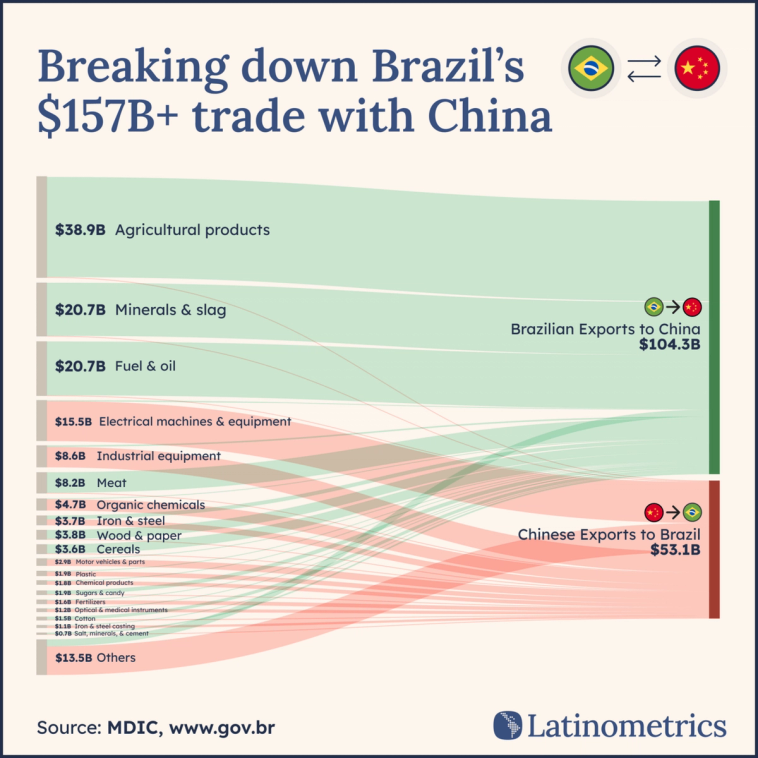
Brazil remains highly commodity-dependent in its exports to China. Nearly a quarter-century after trade began to balloon, it’s still exporting the same old goods – soybeans, oil, chicken, and iron and other minerals – while importing higher value-added products like electrical machinery and industrial equipment.
The country has seen exports – and economic growth – powered by agribusiness in recent years, but is thus at the mercy of commodity and fertilizer prices.
Put alternately? You live by the soy, you die by the soy.
And imports from China are not without their own harm in this regard, having been cited as a major contributor to Brazilian deindustrialization in recent years (like elsewhere). Which makes sense—if you import all of your electric cars from elsewhere, how are you supposed to get the competitive advantage to build your own domestic industry?
Which isn’t to say there’s no upside: recent Chinese investments have been targeted towards less extractive sectors. Maybe, just maybe, foreign direct investment from trade partners like China can help lead Brazil on a path resembling less its colonial past and more its great-power future.


