
Brazil Produces About as Much Sugar Cane as All of Asia
Brazil's sugarcane exports match all of Asia, producing 40% of the global total for $8.95B.

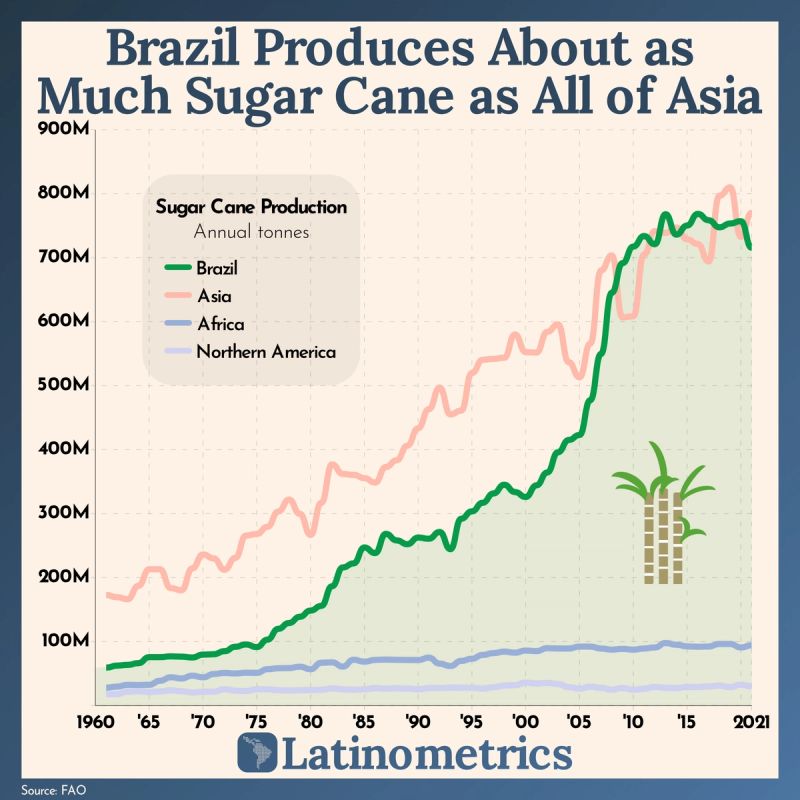
Sugarcane was first introduced to Brazil in 1532. Nearly 500 years later, the country exports over 700M tonnes yearly—roughly the same amount as the continent of Asia, and 7x the amount exported by Africa.
This is a staggering number, not least because Brazil’s population of 216M is far below both continents’ total populations and land area. The country is the world’s largest exporter of sugarcane, producing 40% of the global total in 2020, which contributed $8.95B to its economy.
Cana de açúcar, as it’s locally called, is not native to Brazil and was instead brought to the country by Portuguese settlers. The commodity has a number of distinct uses. It can be drunk raw or turned into a special juice, caldo de cana, which is quite popular across the country. Sugarcane is a key ingredient in molasses and other sweetening syrups, as well as distilled into Brazil’s national liquor, cachaça, which is the key ingredient of the country’s national cocktail, the caipirinha.
There are also major environmental implications for Brazil’s booming sugarcane business. As we’ve previously explored, the crop can be turned into biofuel, specifically ethanol. This biofuel is then blended with gasoline to reduce up to 96% of fossil fuel emissions from cars.
Brazilian sugarcane will only become more significant in the energy-starved world we inhabit today. The country’s ethanol exports to the European Union tripled between 2021 and 2022, and sugarcane cultivation is far less destructive or controversial than other major Brazilian industries such as meat and poultry.
With all this in mind, we hope to see Brazil’s green transition continue as the country supplies much of the globe with this essential crop. Whether it be exported to China or Europe, Brazil leads the world in taking advantage of its arable land and natural resource endowment in the essential sugarcane industry.


