
China powers Brazils electric car boom
China's EVs dominate Brazil, with sales soaring 2x 2023 totals and one company opening a factory.

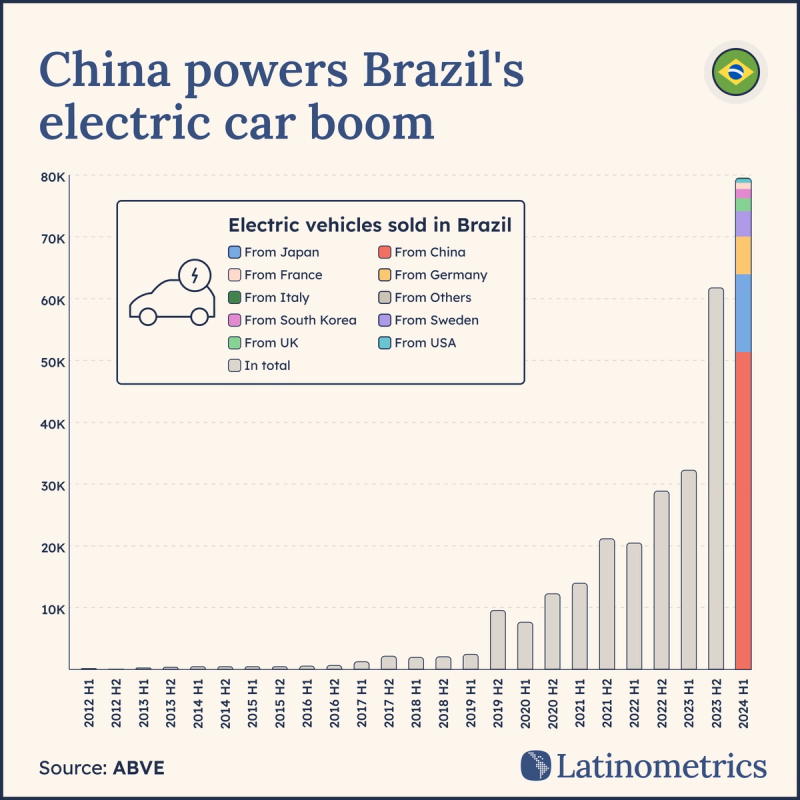
Brazilians are buying more EVs than ever. One country in particular is profiting.
In case you’ve been living under a rock for the last few years, the single-combustion engine is facing its most dire threat since the walkable city. The name of this scourge is electric vehicles (EVs), and they’ve become all the rage as of late.
Today the world is seeing one country outperform all of the competition when it comes to making and selling these EVs. Unsurprisingly, that country is China, which has been the world’s single largest market for electric cars and other “new energy” vehicles for nearly a decade now.
China began its program promoting these vehicles in 2009, and has rolled out intense public subsidies to stimulate demand and develop the industry. The result? Today they’re exporting more EVs than ever, and in the process spooking other major producers who worry they’re being left behind on this ultra-high-value new technology.
With Europe and the United States imposing heavy tariffs to dissuade imports of Chinese EVs, ostensibly for “national security” (protectionist) reasons, China’s carmakers are looking elsewhere to offload their high supply. And Brazil is looking mighty attractive.
Brazil actually surpassed Belgium in May to become the number-one destination for Chinese EVs, something you’d know already if you cared to read the Domingo Brief each Sunday.
Remarkably, in the first half of this year, Brazil has seen electric car sales soar, surpassing twice the total of 2023 and quadrupling that of 2022.
Roughly 60% of all electric vehicles sold this year in Latin America’s largest market came from China. And this will be the first year that Brazil tops 100K electric vehicles sold.
But who’s leading the charge? Is there a Chinese Elon Musk?
Well if there is, he’s certainly much less…visible than the American one. Two Chinese companies, BYD and Great Wall Motors, actually top the charts when it comes to EV sales in Brazil.
With no American or European company coming even close, it’s clear that this is a case where the Brazil-China trade relationship is just that much stronger. After all, BYD is even opening a manufacturing plant in Brazil, having bought a defunct Ford factory in the northeastern state of Bahia. If that isn’t symbolic, we don’t know what is.
Notably, it’s not just Brazil’s massive domestic market which is so attractive for BYD and its Chinese competitors. Electric vehicles also require minerals such as lithium, of which Brazil has relatively little but its neighbors have much more.
All of this taken together, it’s clear that Chinese EVs are not going anywhere in Brazil’s automobile future.


