
Buenos Aires construction costs nearly doubled since 2015
Why building in Buenos Aires got so much more expensive after 2023

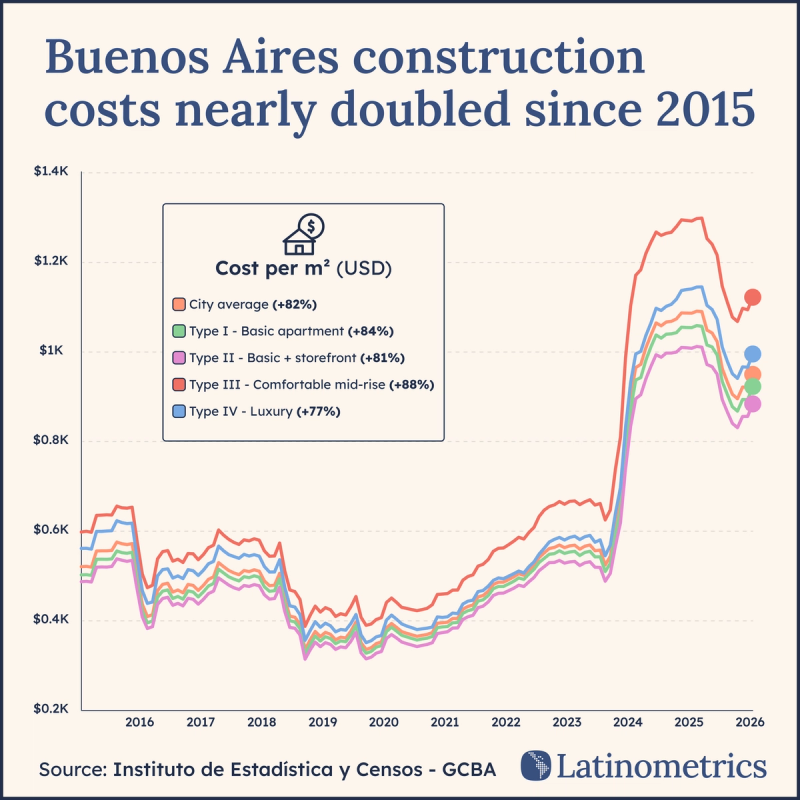
Argentina's real estate rebound is colliding with a much less flattering reality: building in Buenos Aires has become dramatically more expensive.
This chart incorporates data from IDECBA, the statistical agency of Argentina's bustling capital city, to track the construction costs for four standardized residential construction models between 2015 and 2026.
Type I encompasses a simple multifamily apartment building, while Type IV spans high-end towers with covered parking, a gym, and two elevators. Counterintuitively, the most expensive line on the chart is Type III — the "comfortable" 9-floor mid-rise — because its costs spread over fewer floors than the luxury tower. The spread between the lines reflects differences in building complexity, not neighborhoods or market prices.
Across all types, though, construction costs per square meter have soared since 2015, with the sharpest jump coming after 2023 with the deregulation of Argentina's real estate sector.
Buenos Aires construction costs nearly doubled since 2015
Milei's Market Moves
If that timing raises your eyebrows, it should, as that coincides exactly with Argentina's macro reset under the presidency of one Javier Milei.
As a reminder, we're talking a major peso devaluation, rapid price adjustment, deregulation, and above all a political bet that short-term pain could restore global investor confidence in Latin America's third-largest economy.
So Argentina's rally comes with a price tag: every peso it now costs to build makes whatever's already standing more valuable. A rally in real estate prices across the country can reflect in part a repricing of scarcity in the market. After all, as construction costs rise, existing property is more valuable since it's tougher to replace it.
Should've Bought the Home in 1994
So Argentina's post-COVID reality is likely familiar to many of our US-based readers.
For landlords or developers sitting on completed inventory, these are good times: the replacement cost for your assets have gone up. But for anyone looking to buy or build their first house, these are more painful times, as higher construction costs means higher sale prices for new supply.
As investor appetite improves, demand can recover faster than supply, something which supports housing prices but also likely deepens the divide between those who own property and those trying to enter the market.
Real estate, like most sectors under reform, pays in upfront pain. Deregulation can attract capital, improve market liquidity, and even unlock new rentals. But inflation remains at 30% forecasts for the year, while construction costs will also be impacted by imported inputs, financing costs, and exchange-rate volatility.
A freer market may allocate housing more efficiently, but it does not magically make cement, labor, land, or credit cheap.


