
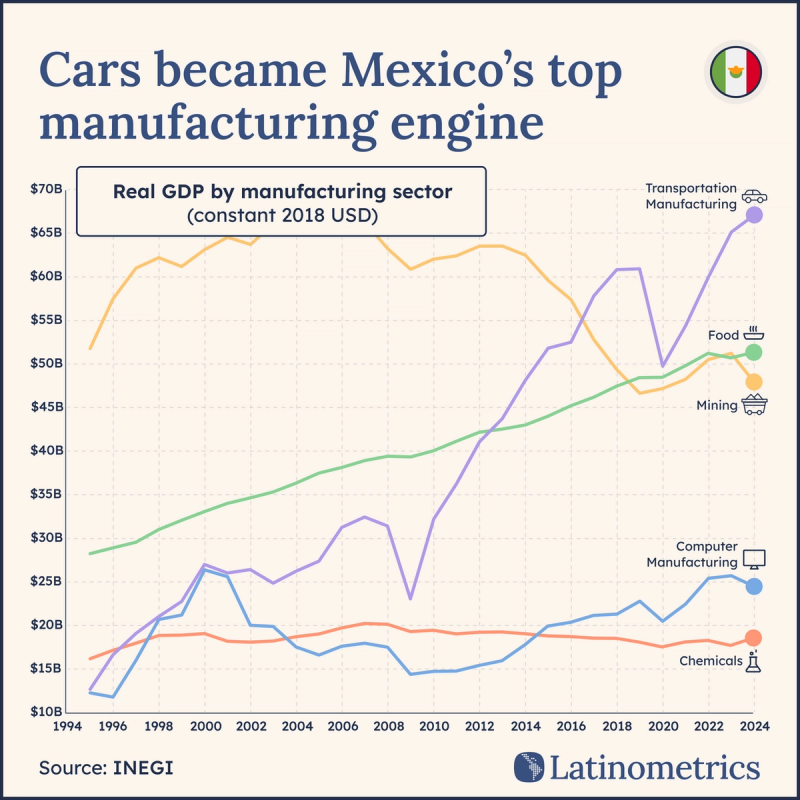
Cars became Mexico's top manufacturing engine
Exploring Mexico's key role in North America's car supply chain.

Claudia Sheinbaum has been officially deemed the Trump whisperer.
In office since October, la Presidenta has managed a cool, respectful relationship with her neighbor to the north, US President Donald Trump, in a way which certainly puts leaders in Brussels, Ottawa, or Beijing to shame. And it’s not by accident—exports to the US are hugely important to Mexico’s economy, so each month where she manages to get his threatened 25% tariffs postponed is critical.
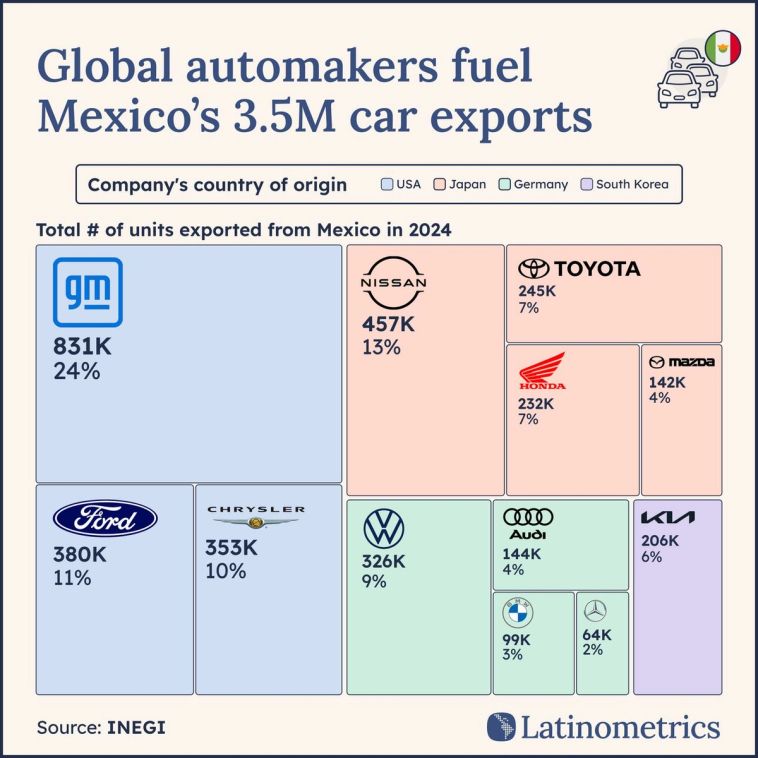
The 3.5M Mexican cars exported last year make the country the seventh-largest auto exporter worldwide, with 80% of these cars heading north to the US. Per Allan Holst Chaires, an economist at Mexico’s central bank, factors such as Mexico’s trade benefits, competitive labor costs, supply chain resilience, and strong international investment all contribute to the country’s powerful export position.
With the imposition of Trump’s proposed tariffs, North American supply chains could be shattered as multinational car manufacturers seek to reduce their exposure. Holst anticipates production slowdowns, job losses, and higher vehicle prices in the US – the last of these to the tune of roughly $6K per car – as a result of the newfound tariffs.
The “pivotal role” of the United States—Mexico—Canada Agreement (USMCA), which replaced NAFTA in 2018 during Trump’s first term, in strengthening Mexico’s automotive sector can be greatly impacted by tariffs, making the negotiations around their imposition highly important to leaders in both the public and private sectors.
In short, Mexico’s high dependence on the US makes the present moment both delicate and challenging. However, long-term the country’s manufacturing strengths, such as its infrastructure and industrial ecosystem, make it potentially competitive for alternative markets.
“Diversification is challenging in the short term,” Holst acknowledges. With current logistical constraints, car exports to Europe, South America, or the Asia-Pacific region would be hard-pressed to replace the current integrated US-Mexico supply chain.
“However, if tariffs persist, Mexico will need to actively seek long-term trade diversification to reduce dependence on US demand.”


