
USA is now Cemex's top market
The story of a 24-year-old Monterrey native built a cement empire.


At 24 years old, what were you (or will be) up to?
Well, if you were Lorenzo Zambrano, you were returning to your hometown of Monterrey, Mexico to join the family business, Cemex, after completing your MBA at Stanford. Over the next few decades, particularly as CEO, you’d turn the 1906-founded company – which both your father and grandfather ran prior to their early deaths – into one of the premier cement producers in the world.
Zambrano’s early life and entry into Cemex may read like a cross between Game of Thrones and Succession. But with widespread acquisitions across Europe and the Americas, you could say he cemented (sorry) his family’s legacy, both in the Cemex firm and in Monterrey history.
Under Zambrano, Cemex began its internationalization process in 1992 when it acquired Spain’s two largest cement firms.
Two years later, it took over Venezuela’s largest cement producer, as well as production plants in both Panama and the United States. By the mid-2000s, additional acquisitions across the world – including in Costa Rica, the Dominican Republic, Egypt, England, Indonesia, and the Philippines – had made Cemex a global leader in the industry.
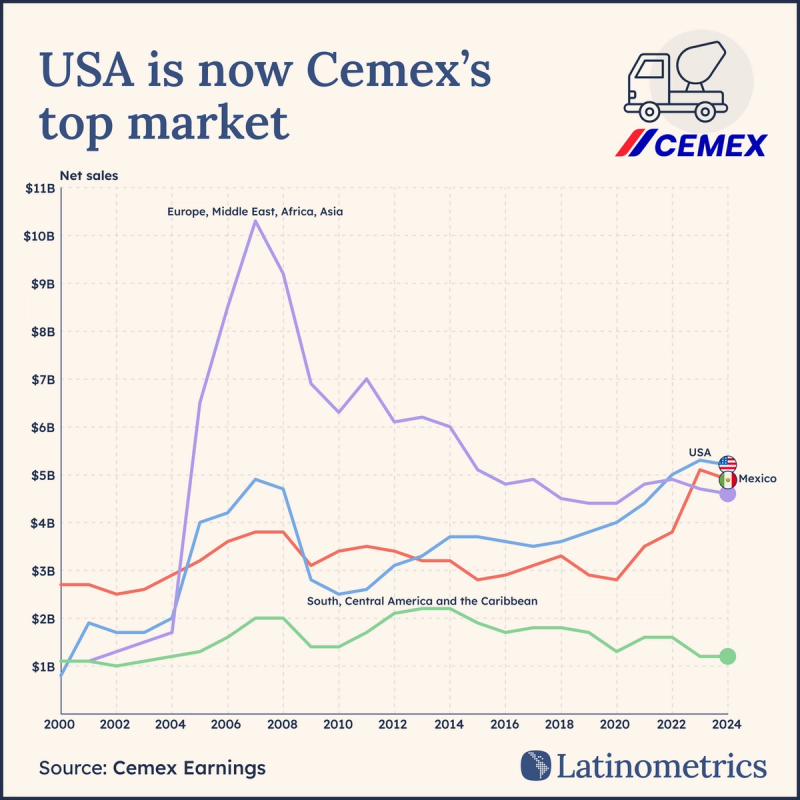
Where once Cemex derived roughly half of its annual sales from the Old World, though, this has changed in recent years. Sales in Africa, Asia, and Europe have dropped from a high of over $10B in 2007 to less than $5B last year. Meanwhile, domestic business in Mexico has soared, outpaced only by the rise of the United States as the largest Cemex market.
As for the rest of Latin America and the Caribbean, a series of setbacks – such as the Venezuelan nationalization of the cement industry in 2008 – has led to a stagnation and even decline in regional sales over the last twenty years.
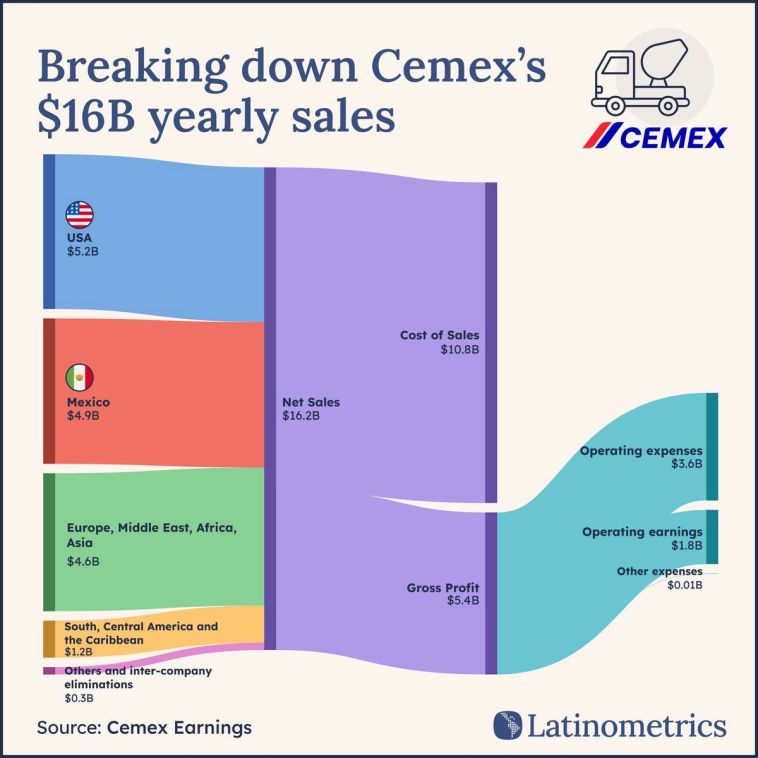
The shift back to North American sales is nonetheless fascinating, particularly given the relatively small size of Mexico as a market versus Afro-Eurasia. As for the US, we’re interested in seeing whether import tariffs on cement hurt – or bolster – Cemex production stateside.
Over 120 years following its founding, Cemex is no doubt a national champion for Mexico, and a source of regional pride for Monterrey. Can the company’s leadership successfully modernize operations and stay ahead of disruptions in global supply chains?


